
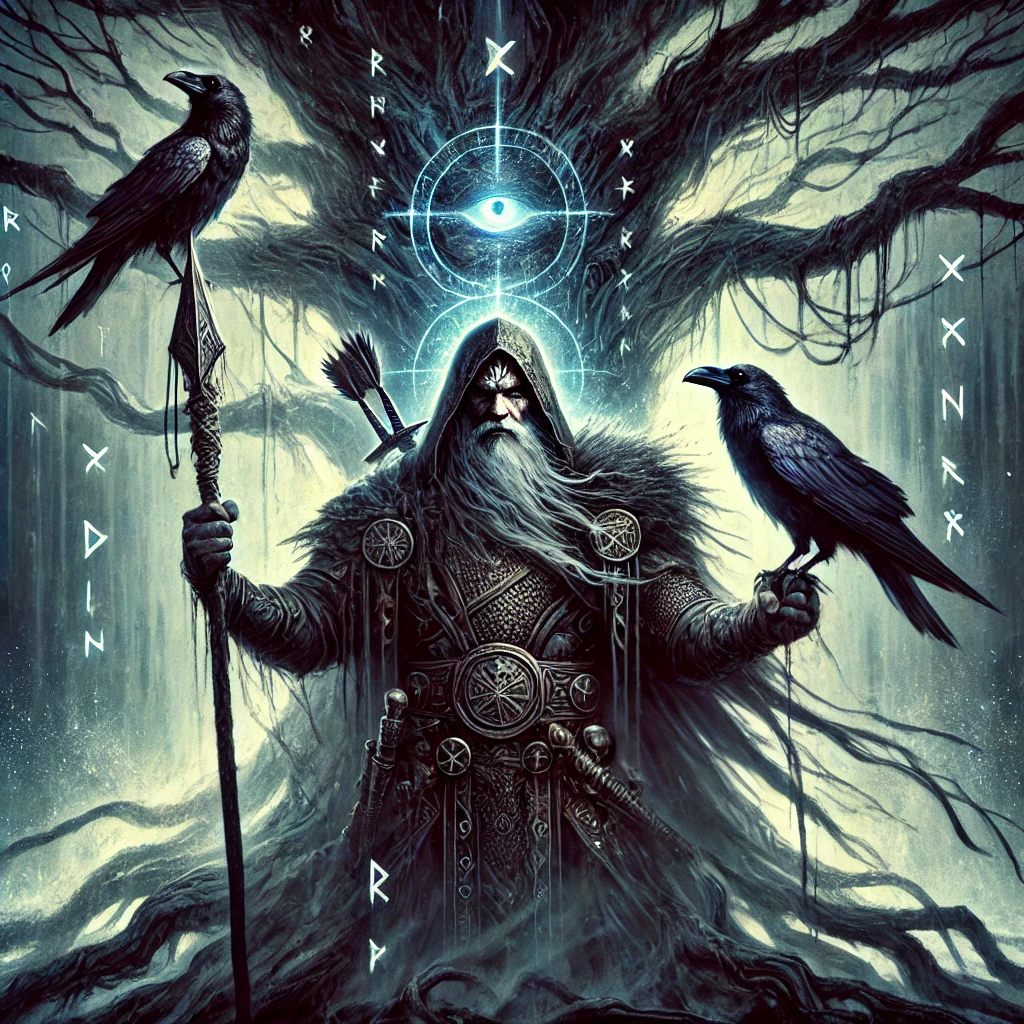
“I know I hung on that windswept tree,
Nine long nights, wounded with a spear…”
— Hávamál
Odin is not just a god. He is a story—a living myth that unfolds across time, realms, and the human soul. Called Allfather, Wanderer, One-Eye, Raven God, and Lord of the Slain, his tale is not a straight line. It’s a spiral of creation, wisdom, sacrifice, and inevitable doom. And yet, even death cannot stop him.
This is the timeline of Odin’s mythic life—a sacred biography woven from poetry, blood, and stars.
The Primordial Origins
Before the worlds had names, before time had rhythm, Odin was born to Borr, a divine being, and Bestla, a giantess from the ancient race of jötnar. From this union came Odin and his two brothers, Vili and Vé—mind, will, and holiness made flesh. The three brothers stepped into a shapeless world, facing the churning chaos of fire and ice.
From this raw void came Ymir, the first being and ancestor of the giants. Ymir was not just a creature—he was the embodiment of formless potential. But potential unchecked can be dangerous. And so, the three brothers took up arms. In the first act of divine violence, they slew Ymir and carved the cosmos from his body: his flesh became the earth, his blood the seas, his bones the mountains, his skull the sky. They set his brains to float as clouds and placed sparks from Muspelheim as stars.
Creation was not gentle. It was a necessary sacrifice.
The Breath of Life
Odin’s role as a shaper of the cosmos did not end with the world. On a shore, he and his brothers found two tree trunks—driftwood, lifeless, but with potential. From these they crafted the first humans: Ask and Embla.
Odin breathed spirit—óðr—into them. It was not just life he gave, but awareness, inspiration, and soul. Vili granted them will, and Vé shaped their form and voice. This act set Odin apart: he was not merely a ruler or warrior—he was the giver of consciousness. The first and oldest poet.
The Rise of the Allfather
In time, Odin became king of the Aesir, the tribe of gods who would inhabit Asgard, the celestial realm. He married Frigg, the goddess of foresight and weaving of fates. Yet Odin’s romantic life was far from simple. He also consorted with Jörð, the Earth herself, giving birth to Thor, the thunder god. With Rindr, he fathered Vali, a child born for vengeance.
As ruler, Odin was not static. He did not settle into a throne and grow fat with power. His reign was marked by endless restlessness. He was a seeker, a wanderer, a god who could never be satisfied with half-answers.
The Endless Hunger for Knowledge
Odin’s pursuit of wisdom bordered on madness—and perhaps it crossed that line many times.
He sought the deep waters of Mímir’s Well, hidden beneath the roots of the World Tree, Yggdrasil. But wisdom has a price. To drink, Odin gave one of his eyes, casting it into the well’s depths. In return, he gained vision that pierced beyond sight—understanding of cosmic patterns, destiny, and death.
Still, it wasn’t enough.
To learn the runes—the primal symbols of fate and magic—Odin underwent a terrifying ordeal. He hung himself from Yggdrasil, pierced by his own spear, offering himself to himself. For nine nights he dangled between life and death, with no food, no drink, only the whisper of the wind and the creak of branches. At last, the runes revealed themselves. They were more than letters—they were living powers, songs of the soul, spells of shaping.
And still, he wanted more.
Odin sought out seiðr, the powerful magic of weaving fate, often practiced by women and viewed with suspicion by warrior society. To learn it, he humbled himself before Freyja and broke social norms. He became both shaman and sorcerer, blurring the lines of gender, power, and identity.
The Watcher and the Wanderer
Though he ruled from Asgard, Odin was rarely at home. He walked the worlds in disguise—Grimnir, Gangleri, Harbard—testing mortals, teaching the worthy, and gathering information. Two ravens, Huginn (Thought) and Muninn (Memory), flew across the nine realms and whispered their findings into his ear. Wolves flanked him, and his eight-legged steed, Sleipnir—born of Loki’s strange encounter with a stallion—carried him between realms.
Odin’s presence was never restful. He brought knowledge, yes, but also disruption. Wisdom often comes at the cost of comfort.
The Lord of the Slain
With an eye toward the end of days, Odin began to gather warriors to his hall. Those who died bravely in battle were brought by Valkyries to Valhalla, the Hall of the Slain. There they would feast and fight, preparing for the final war. To fill his army, Odin even stoked conflict in the mortal world. This earned him a reputation as a god of war—but not in the sense of glory or conquest. Odin’s war is one of preparation. He arms himself against fate.
He knows what’s coming.
The Shadows of Doom
Odin’s unease deepens when his beloved son, Baldur, begins to dream of death. The shining god, the most loved among the Aesir, is fated to die. Odin travels to the underworld, disguised and cloaked, to awaken a dead seeress. What he hears confirms his fears: Baldur will fall, and his death will unravel the gods’ power. Loki, the trickster and blood-brother of Odin, sets the events in motion, and Baldur is slain by his own brother’s hand.
From this moment on, the gods move like actors toward a known tragedy. Odin becomes obsessed. He seeks knowledge from the dead, summons the spirits of ancient witches, and consults seers in desperation. But nothing can change the fate he has seen.
Ragnarök and Death
The skies crack. The world freezes, then burns. The signs of Ragnarök are undeniable.
Fenrir, the monstrous wolf and child of Loki, breaks free of his bonds. The giants surge from Jötunheim. The dead march. The world groans.
Odin dons his golden armor, takes up his spear Gungnir, and rides at the head of his warrior dead. But he does not fight to win. He fights because it is his role. He meets Fenrir in battle and is devoured whole.
Not even the Allfather escapes the jaws of fate.
Legacy and Renewal
Odin’s death is not the end. His son, Víðarr, the silent god, kills Fenrir in vengeance. Other gods survive—Magni and Modi, Thor’s sons; Baldur and Höðr return from Hel. A new world rises from the sea, green and pure. The cycle begins anew.
And Odin?
He lingers.
In the whisper of wind through trees. In the flash of inspiration before a poem is born. In the restless wanderer with a hunger for truth. Odin is not a static deity. He is a pattern, an archetype, a presence. He is both warning and guide.
Odin as a Living God
To follow Odin is not to seek comfort. It is to walk the edge of the blade.
He challenges, he tests, he deceives, and he inspires. His lessons are not safe—but they are real. Sacrifice. Wisdom. Fate. Courage in the face of death. These are the gifts he offers, and the price is never cheap.
Yet, for those who walk with him, there is power in the storm. There is clarity in the madness. There is poetry in the pain.
Odin’s life is not a line. It is a spiral—beginning and ending in the same breath, always moving, always changing, always becoming.
Leave a Reply to What Are The Many Branches of Modern Heathen? – The Elemental MindCancel reply