
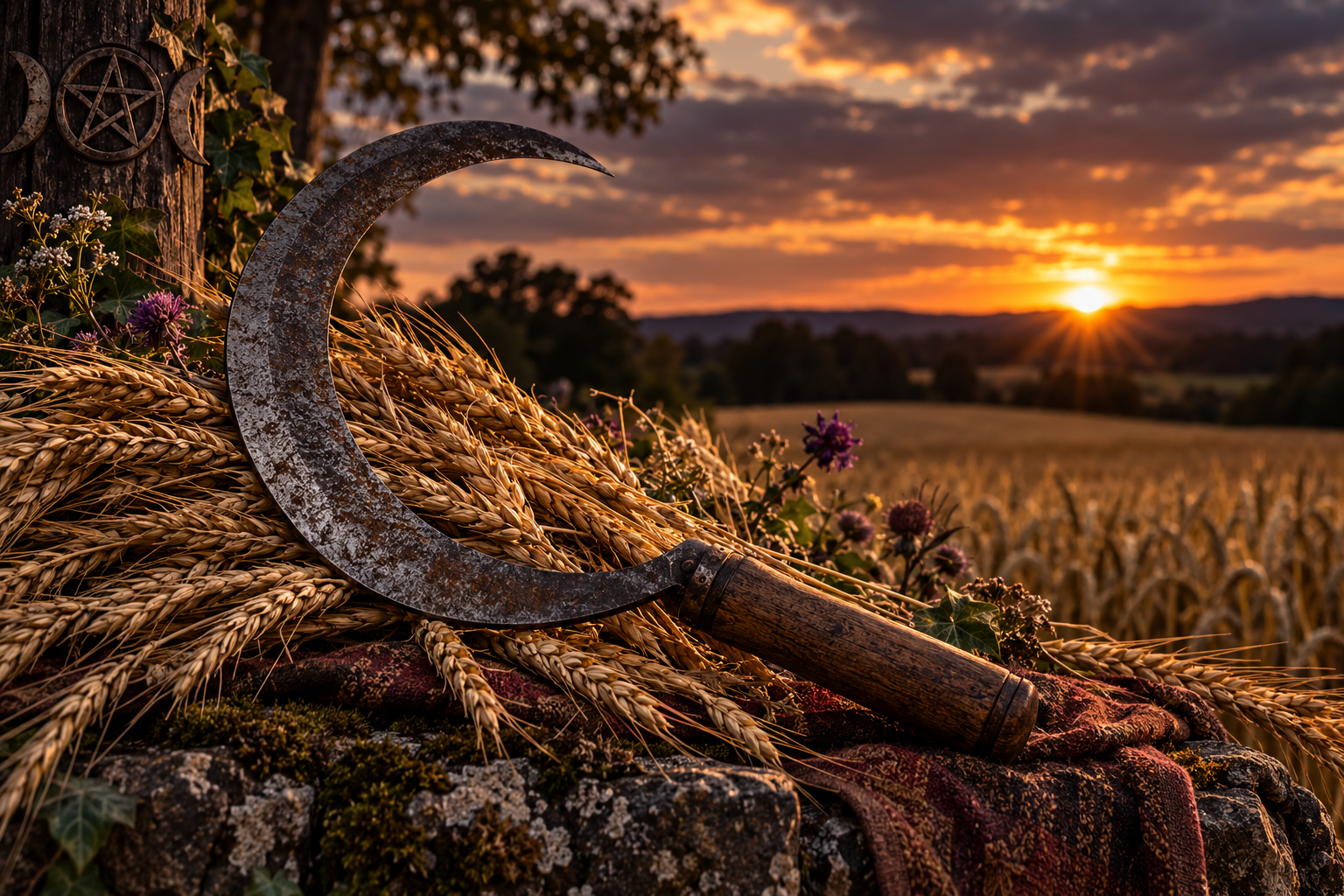

HARVEST · COMPLETION · RELEASE · RENEWAL
Nature ends. Nature renews. The cycle continues.
There is something deeply symbolic about the moment a harvest begins.
For months, the fields have been growing. Seeds that were once hidden beneath the soil have pushed upward, matured beneath the sun, and finally reached the point when they are ready to be gathered. Then comes the blade.
Among the oldest tools associated with this moment is the sickle, a curved harvesting blade traditionally used to cut grain and other crops by hand. It is a simple agricultural tool, yet its connection with the harvest gave it meanings that reached far beyond the field.
In mythology and symbolism, the sickle can represent harvest and abundance, but it also carries more complicated ideas: endings, separation, mortality, time, and renewal. The blade cuts down what has grown, but that cutting is not meaningless destruction. It allows the harvest to be gathered, food to be preserved, and seeds to be saved for another growing season.
For those exploring pagan spirituality today, the sacred sickle offers a powerful image for the harvest season. It asks us not only what we have grown, but what we are ready to gather, and what has reached its natural ending.
THE SACRED SICKLE AT A GLANCE
Season
Harvest
Element
Earth
Themes
Completion · Release · Renewal
Symbols
Grain · Sickle · Seed · Setting Sun
The Sickle and the Ancient Harvest

Before the mechanization of agriculture, harvesting grain required enormous amounts of physical labor. Sickles allowed people to cut mature stalks close enough to gather them into bundles for threshing and processing.
Because agriculture was essential to survival, harvest tools naturally became connected with something much larger than their practical purpose.
A successful harvest meant food through the coming months. A failed harvest could mean hunger. The agricultural year therefore created a rhythm that human communities could not ignore: preparation, planting, growth, ripening, harvest, and eventually the return of the fields to dormancy.
The sickle belonged to one of the most important moments within that cycle.
Its curved blade separated the mature crop from the earth that had sustained it. Yet the purpose of that separation was preservation. Grain was harvested so that it could nourish the community, while some seed could eventually return to the soil.
It is a blade associated with cutting, but also with gathering.
It represents an ending, but the ending makes continuation possible.
Seen this way, the sickle becomes an appropriate symbol for the harvest itself. Nature does not preserve everything exactly as it is. Growth eventually reaches maturity, and maturity is followed by change.
Divine Sickles: Cronus, Saturn, and the Power of the Blade
The sickle also appears dramatically in classical mythology.
In Greek mythology, Cronus, one of the Titans, was given a sickle by his mother, Gaia. According to the story preserved in Hesiod’s Theogony, Gaia had suffered because Uranus, the sky god, prevented their children from emerging freely into the world. Cronus used the sickle to overthrow and castrate his father, separating Uranus from Gaia and changing the divine order.
It is a violent myth, but symbolically the sickle again appears at a moment of separation and transition. One age ends and another begins.
Cronus was later identified by the Romans with Saturn, an agricultural deity strongly connected with sowing, cultivation, and abundance. Saturn was traditionally represented carrying a sickle or similar agricultural implement.
This association eventually contributed to another familiar image: the old figure carrying a harvesting blade as a representation of Time.
Sickle or scythe? Modern images of Death or Father Time often show a scythe, the long-handled agricultural blade familiar from depictions of the Grim Reaper. A sickle is smaller and generally used with one hand. The two are related through harvesting symbolism, but they are not the same implement.
The connection between harvest blades, time, and death nevertheless makes symbolic sense.
Time ripens everything, and eventually everything reaches its season of completion.
The harvest blade becomes a reminder that nothing remains permanently at the height of its growth.

The Sacred Act of Cutting Away

Modern people often associate growth with improvement. We are encouraged to build, accumulate, expand, and become more.
The symbolism of the sickle suggests another possibility: sometimes growth has already accomplished what it needed to accomplish.
At harvest, the farmer does not look at mature grain and say, “Let it keep growing forever.”
There comes a point when growth must become harvest.
This is where the sickle becomes especially meaningful as a spiritual symbol. Its blade can represent discernment, the ability to recognize what has reached completion and to separate what should be gathered from what should be released.
Not every ending is a failure.
A project can end because it has fulfilled its purpose. A belief can be released because experience has taught us something new. A habit that once protected or supported us may eventually become unnecessary.
The difficult part is recognizing when that moment has arrived.
The sickle does not symbolize cutting simply for the sake of destruction. Within the imagery of harvest, cutting has purpose. What is valuable is gathered. What can nourish us is preserved. Seeds are carried forward.
That distinction makes the sickle a richer symbol than one of simple death.
What is worth keeping from what has ended?
The Sickle and the Pagan Harvest Season
Harvest imagery holds an important place in many contemporary pagan traditions, particularly during the movement from late summer into autumn.
Different traditions observe this season in different ways. Lughnasadh, traditionally associated with the beginning of August, is often understood by modern pagans as the beginning of the harvest season. Later, the autumn equinox, frequently called Mabon in modern pagan practice, marks another seasonal turning point as daylight and darkness come into balance and the northern landscape moves increasingly toward winter.
It is important to remember that modern pagan traditions are diverse. There is no single interpretation of the harvest festivals, and practices can vary considerably between paths, communities, and individual practitioners.
Still, harvest symbolism offers something widely understandable.
Spring asks what we will plant.
Summer tends what is growing.
Harvest asks what came from it.
That question does not always have a comfortable answer. Some things we hoped to grow may never have taken root. Others may have developed in unexpected directions. And occasionally something we barely noticed becomes one of the most meaningful parts of our personal harvest.
The sickle reminds us to gather honestly rather than judging the entire season by what we originally expected it to become.

A Harvest Reflection for Everyday Spiritual Practice
You do not need an actual sickle, or an elaborate ritual, to work with its symbolism. Instead, the image can become a focus for reflection during the harvest season.
Consider the months that have passed since the beginning of the year. What have you grown?
Perhaps you learned something new, strengthened a relationship, completed difficult work, developed a spiritual practice, changed an old habit, or simply endured a challenging season.
Then consider what has reached completion. Is there something you continue carrying because you have not acknowledged that it is finished?
Finally, ask what should be preserved. This may be the most important part of harvest symbolism. We do not simply cut the field and walk away. We gather something from it.
An experience that ended may still contain wisdom. A mistake can produce understanding. A difficult season can reveal resilience, boundaries, or priorities that were previously unclear.
HARVEST REFLECTION
What am I harvesting?
What am I ready to cut away?
What seed do I want to carry into the next season?
There is no need to force dramatic answers. Spiritual reflection can be quiet. Sometimes simply recognizing that something has ended is enough.
Conclusion: What We Carry Beyond the Harvest
The sacred sickle contains a contradiction that is also found throughout the natural world.
Its blade brings an ending, yet it participates in continuation.
It cuts the grain, but the grain becomes nourishment. It clears the field, but seeds remain for another season. It reminds us that abundance cannot always remain standing exactly where it grew. Eventually, something must be gathered.
This may be one reason harvest symbolism continues to speak so strongly to spiritual life.
We spend much of our time thinking about beginnings. We ask what we should start, what we should create, and what we hope will grow.
What has become ripe?
As the season turns and the fields empty, we are reminded that completion has its own sacredness. There is wisdom in recognizing when something has reached its fullness, courage in releasing what has finished, and gratitude in gathering what remains.
ONLY THE GRAIN.
The harvest does not ask us to carry the entire field forward.
And perhaps that is the lesson of the sacred sickle: to know what to gather, what to release, and what is worth carrying into the season still to come.
Leave a Reply