
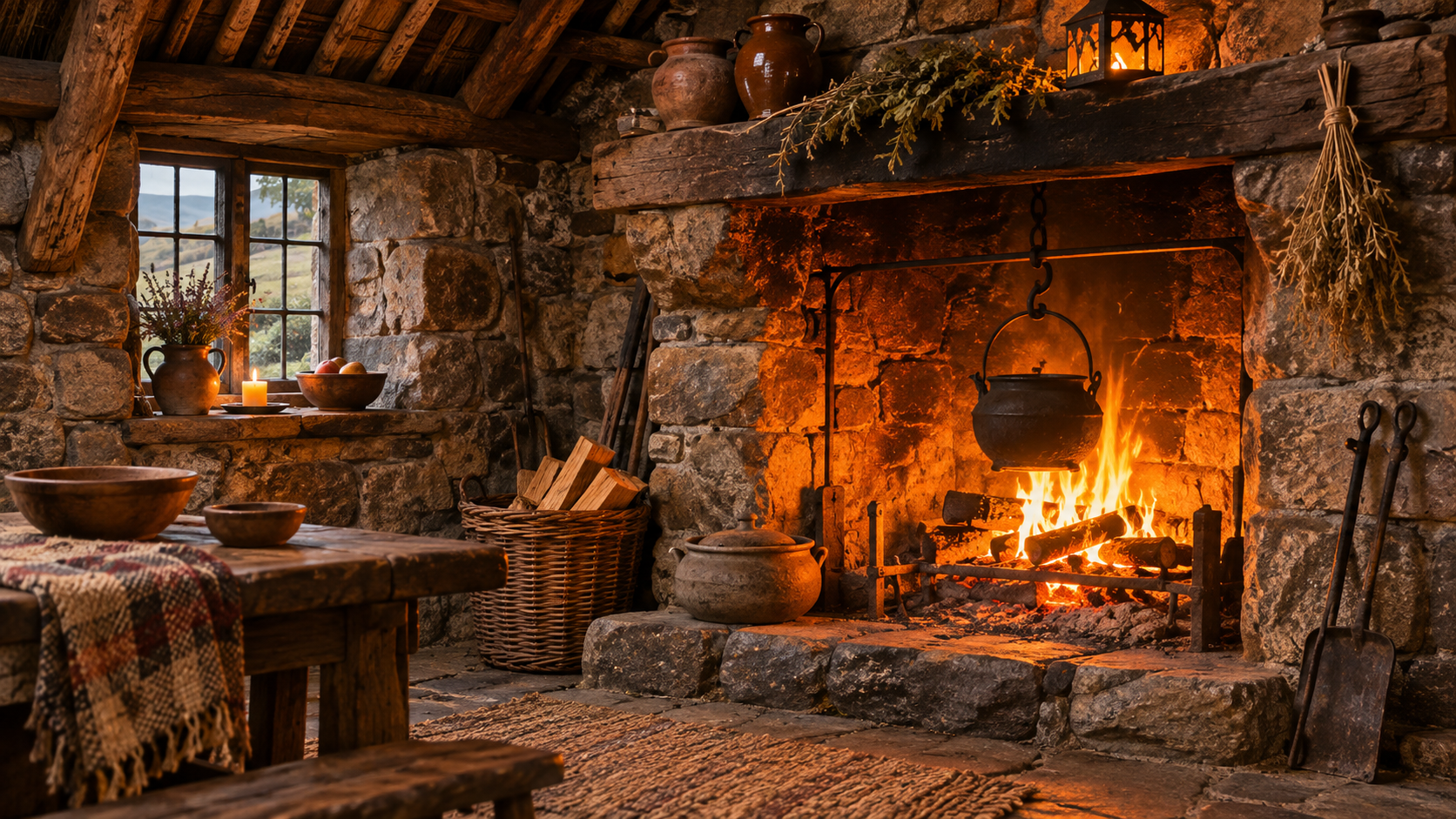
Before fire became something we switched on with a button, it was something we gathered around, tended, and carried into the heart of our homes.
Imagine a cold evening centuries ago. Outside, darkness settles over the landscape. Inside, a small fire crackles in the hearth. Someone tends a cooking pot while others gather nearby, sharing stories, working, or enjoying the warmth. That fire provides heat, cooks food, and offers light. Over time, the hearth also became associated with the spiritual heart of the home.
Across ancient Greek and Roman religion, and in later Irish folklore, we find traditions connecting fire with domestic life, sacred responsibility, hospitality, and protection. How did an ordinary household fire become something sacred?
The Hearth: Where Everyday Life Became Sacred
Before modern heating and electricity, the hearth occupied an essential place in daily life. It was where meals were prepared, warmth was shared, and household activities unfolded. A well-tended fire could symbolize stability and continuity. Welcoming someone to its warmth became an expression of hospitality.
In certain ancient religious traditions, the hearth was also a place for offerings, prayers, and ceremonies marking important changes in family life. A fire could cook dinner and receive an offering. A hearth could warm a family and serve as a place of worship.
Hestia: The Quiet Heart of Ancient Greece

In ancient Greek religion, Hestia was the goddess of the hearth and its sacred fire. Unlike deities whose stories involved dramatic conflicts and adventures, Hestia was associated with the stability of household and communal life.
Greek households could make small offerings at the hearth during meals. The hearth also played a role in ceremonies welcoming new members into a family. Her significance extended beyond individual homes: some Greek cities maintained public hearths in civic buildings known as prytaneia. Fire could be carried from a parent city to a newly established colony as a symbol of continuity.
The hearth was therefore more than a domestic feature. It could represent the shared identity of an entire community. Hestia reminds us that the sacred can be found in the ordinary acts that sustain a household.
Vesta: The Sacred Flame of Rome
The Romans honored Vesta as the goddess of the hearth and its fire. Like Hestia, Vesta was connected with domestic life, but her worship also held an especially important place in Roman public religion.
At the Temple of Vesta in Rome, a sacred flame was maintained by priestesses known as the Vestal Virgins. The flame represented the continuity and well-being of the Roman state. Its care was a religious duty, and allowing it to go out was considered a serious failure.
The Vestals occupied a distinctive position in Roman society, with religious responsibilities and privileges unusual for women of their time. While household hearths belonged to the private sphere, Vesta’s public flame reflected a larger idea: the security of the community was symbolically connected to the care of its sacred fire.
This does not mean Romans believed every household flame possessed supernatural protective powers. Rather, fire was embedded in religious practices expressing continuity, duty, and communal well-being.
Brigid: Fire, Folklore & the Irish Home

In Irish tradition, Brigid is a fascinating figure whose story crosses the boundaries of mythology, religious history, and folklore. The pre-Christian goddess Brigid appears in medieval Irish sources associated with poetry, healing, and smithcraft. Fire symbolism is especially prominent in later traditions surrounding Saint Brigid of Kildare.
The distinction matters. Although Brigid is frequently described today as an ancient Celtic hearth goddess, surviving early evidence does not establish a fully developed pre-Christian household fire cult dedicated to her. The famous perpetual fire at Kildare is documented in medieval Christian tradition, but its supposed continuation from a pre-Christian flame remains uncertain.
Nevertheless, fire and household protection became important themes in Irish customs associated with Saint Brigid. Brigid’s crosses, traditionally woven from rushes or straw, were placed in homes and farm buildings as protective objects. Her feast day on February 1 also became associated with seasonal renewal and the approach of spring.
For modern Pagans, Brigid may hold additional spiritual meaning through contemporary devotional practices. Those interpretations are valuable parts of living spirituality, even when they cannot be presented as documented ancient customs.
Why Was Fire Associated With Protection?
A controlled fire provided warmth during dangerous cold, made food preparation possible, and illuminated spaces after sunset. It also demanded respect. An unattended or poorly managed fire could destroy the very home it helped sustain.
That dual nature gives its symbolism depth. Fire can nurture or consume. It can offer comfort or cause destruction. Its usefulness depends upon attention, boundaries, and responsible care.
In spiritual interpretation, those qualities can become lessons about protecting a household. Protection is not always about keeping every difficulty outside the door. Sometimes it means caring for what is inside: maintaining relationships, creating a welcoming environment, and recognizing when boundaries are necessary.
When the Hearth Is More Than a Flame
Most of us no longer depend upon an open fire for daily survival. Our homes may have electric heating, modern kitchens, and lights that illuminate every room. Yet the idea of a hearth remains familiar.
Think of the kitchen where everyone gathers during a celebration. The table where conversations stretch late into the evening. The quiet corner where you drink tea before the rest of the household wakes. These places can become the emotional center of a home.
In contemporary spiritual practice, someone might create a symbolic hearth with a candle, a small altar, or a meaningful object. There is no need to recreate an ancient ceremony to appreciate what the hearth represented. The sacred hearth can remind us that a home is something we continually create through care, attention, and belonging.
And home does not have to mean a traditional family or even a permanent building. It may be a place shared with friends, a quiet room of one’s own, or a space where a person finally feels safe enough to rest.
A Simple Modern Hearth Blessing
This is an original contemporary practice inspired by hearth symbolism, not a reconstruction of an ancient historical ritual.
Choose a peaceful space and a candle or battery-operated candle. Clear away a little clutter if you wish. Welcome the light, and take a moment to appreciate the warmth and shelter your home provides.
May warmth dwell within these walls.
May kindness find a welcome here.
May peace rest upon this home,
And may those within be held in care.
Think of one thing about your home that brings you comfort. Extinguish the candle safely, carrying that intention into your day. The purpose is not to promise supernatural protection, but to create a meaningful moment of gratitude, reflection, and care.
Keeping the Hearth Alive
For the ancient Greeks, the hearth was connected with Hestia, family ceremonies, and civic identity. For the Romans, Vesta’s sacred flame represented an important religious responsibility. In Irish folklore, customs associated with Brigid brought themes of protection, renewal, and blessing into the home.
These traditions are not interchangeable, but each offers a perspective on the relationship between fire and belonging. A home becomes meaningful through the lives unfolding within it: the meals shared, stories remembered, kindness offered, and care given when someone needs it most.
The flame matters, but so does everything we gather around it.
Sources & Further Reading
Oxford Classical Dictionary: Hestia — Greek hearth worship and civic traditions.
University of Exeter: The Vestal Virgins — Roman religious practices.
Dictionary of Irish Biography: Brigit — Irish mythology and folklore.
Dorothy Ann Bray: Saint Brigit and the Fire from Heaven — historical discussion of fire imagery.
Leave a Reply