
Finding hope, resilience, and sacred renewal in the green that remains.
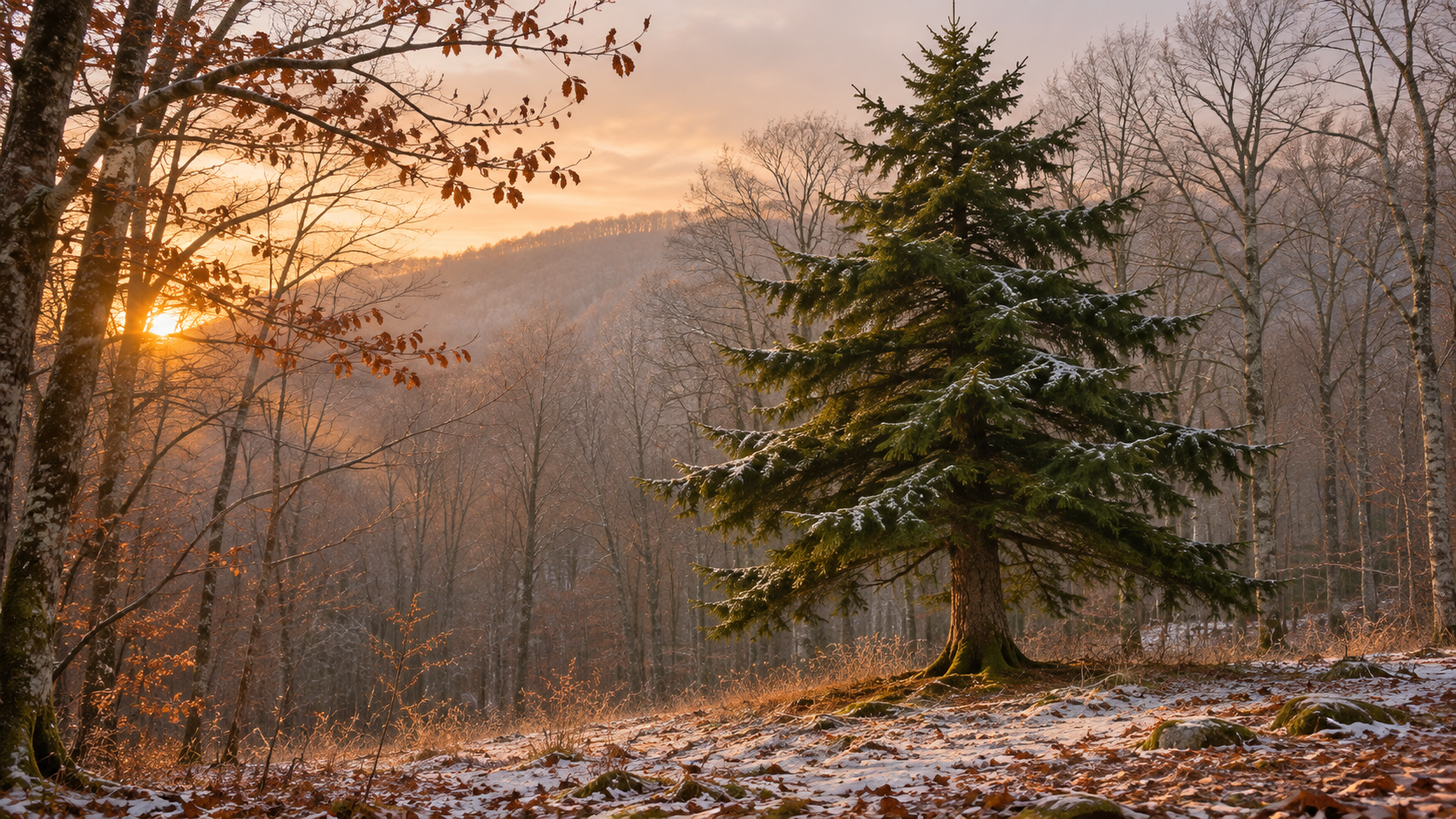
By late November, you can see farther into the woods than you could a month ago. The last oak leaves rattle on their branches. A bird’s nest shows through a bare fork overhead. And halfway down a slope you’ve passed a hundred times, you notice a little stand of pines.
Those pines were there in July, too. It took the rest of the woods losing their leaves for you to notice what had stayed green.
That’s where the spiritual meaning of evergreens begins for me. Winter changes what we can see. In our own lives, too, there are things we come to recognize only in a spare season. A friendship we can lean on. A practice we return to. A little hope we thought we’d lost somewhere along the way.
The Sacred Green of Winter

People have carried winter greenery across their thresholds for centuries. At the Kalends of January, the Roman New Year, wreaths and garlands were among the gifts people exchanged. Centuries later, an account from London in 1444 described homes and parish churches dressed with holly, ivy, bay, and whatever else the season still offered in green. A Short History of Christmas Greenery
Sometimes the meaning belonged to one small sprig. In Worcestershire and Herefordshire, English folklorists recorded a belief that a piece of holly brought home from a church’s Christmas decorations would bring the household good luck. There’s something tender in that detail. Someone carried a bit of green from a place they held sacred into the room where ordinary life went on. A Dictionary of English Folklore, entry for holly
In a Pagan home today, a branch on the altar can hold a meaning of its own. As the Wheel of the Year turns toward Yule, its green can remind us of what we want to carry through the longest night.
The Spiritual Meaning of Different Evergreens

Spiritual correspondences vary across traditions and personal practices. If one of these plants grows near you, begin with what you notice about it. The meaning you discover on a familiar walk may stay with you longer than any list.
Pine: Endurance and Renewal
Look closely at a pine sprig. Each needle is slender enough to bend between your fingers. Together, those needles give a whole hillside its winter color.
Pine can be a companion in seasons that ask for endurance. Let it call to mind one small thing that has helped you keep going. Perhaps it was a morning walk, a regular phone call, or the simple habit of opening the curtains to let the day in.
Fir: Hope and Continuity
Follow a fir branch with your eye, from the woody stem out to its green tips. It gives hope a shape you can trace with a finger.
A fir sprig can mark something you’re looking forward to, however modest. A visit from someone you miss. A bulb you planted in autumn. The first evening you’ll be able to walk home in daylight.
Holly: Protection and Strength
Holly has a long place in English protective folklore. People planted it near homes in the belief that it could guard the household from harm.
On a personal altar, its prickly leaves can prompt a question about boundaries. What do you want to keep safe enough to flourish? The answer might be an evening with your family, an hour for your practice, or the right to close your door and rest.
Ivy: Connection and Persistence
In winter, it’s easier to follow a strand of ivy with your eye. A length of green that seems to hang in midair leads back to bark or stone, where the stem has found a hold.
Ivy invites reflection on the people and places that have given you such a hold. If someone comes to mind, reaching out to them can be its own small seasonal practice. A simple “I’m glad you’re in my life” will do.
Cedar: Grounding and Sacred Space
For a personal grounding practice, a cedar sprig offers something tangible to attend to. Notice its weight in your palm, the branching pattern, and whatever scent it carries. Give yourself time to notice a second detail after the first.
On the altar, cedar can mark the place where you set down the day’s demands and give your attention to something sacred.
Evergreens and the Wheel of the Year
For many Pagans who observe the Wheel of the Year, Yule falls at the winter solstice. Here in the Northern Hemisphere, the December solstice brings the longest night. Afterward, daylight begins to lengthen, though it may be weeks before you notice the difference from your kitchen window. NOAA on the changing seasons
There’s room in a Yule practice for that interval. We can welcome the returning light while we still need an extra blanket and a lamp to read by. We can sit with the dark long enough to notice what it offers us, too.
An evergreen branch on the altar gives us somewhere to rest our eyes as we hold both parts of the season sacred.
The Evergreen as a Mirror of the Self
When someone asks what you’ve been doing lately, it’s easy to reach for the things you can count. A project finished. A room painted. A list finally crossed off. Some winters, the most important thing you’ve done is harder to put into words.
Maybe you kept answering a friend’s calls through a season of grief. Maybe you found your way back to a spiritual practice by sitting at the edge of your bed each morning and saying one honest sentence. Maybe you learned to ask for company on a difficult day.
If this has been that kind of year, take a moment to name what it took care to keep alive. You’re allowed to count that, too.
A Simple Evergreen Ritual for Endurance and Hope

You can do this ritual as winter approaches, on the longest night, or on an ordinary evening when you could use a little steadiness.
You will need
- A small, responsibly gathered evergreen sprig
- A white or green candle
- A small dish
- A quiet place to sit
Place the sprig on the dish, well away from the candle. Light the candle and take a few quiet breaths. Look closely enough at the branch to notice something you missed at first glance.
Bring to mind one thing that sustained you this year. Be specific. If it was a person, say their name. If it was a place, picture yourself there. If it was something you did for yourself, give yourself credit for it.
When you’re ready, speak these words aloud or quietly within yourself.
Through the darkness, life remains.
Through the silence, strength sustains.
Rooted deep, through frost and night,
I carry within me the returning light.
Choose one small way to care for what you’ve named in the weeks ahead. When you’re finished, extinguish the candle. You may leave the sprig on your altar as a reminder of that intention.
Questions for Seasonal Reflection
Choose whichever question draws your attention. Give it a page in your journal or Book of Shadows.
- What did I only notice about my life when things grew quiet?
- Who or what helped me through a difficult stretch this year?
- What boundary would give me more room to rest this winter?
- Which small hope would I like to tend between now and spring?
- When I look at the green that remains where I live, what does it mean to me?
Life Beneath the Stillness

The next time you pass an evergreen, pause beside it if you can. Look for one detail you’ll recognize when you come this way again. A crooked branch. A spray of needles at eye level. An ivy leaf shaped a little differently from its neighbors.
Perhaps that’s where a seasonal practice takes root. You notice a living thing. You return to it. Somewhere along the way, an ordinary bend in the path becomes a place where you remember to check in with yourself.
And on a hard winter day, when hope feels like too large a thing to ask for, you’ll know where to find that single green branch against the sky.
May your roots remain strong, your spirit nourished, and your inner light endure throughout the turning of the Wheel.
Blessed Be.
Leave a Reply