
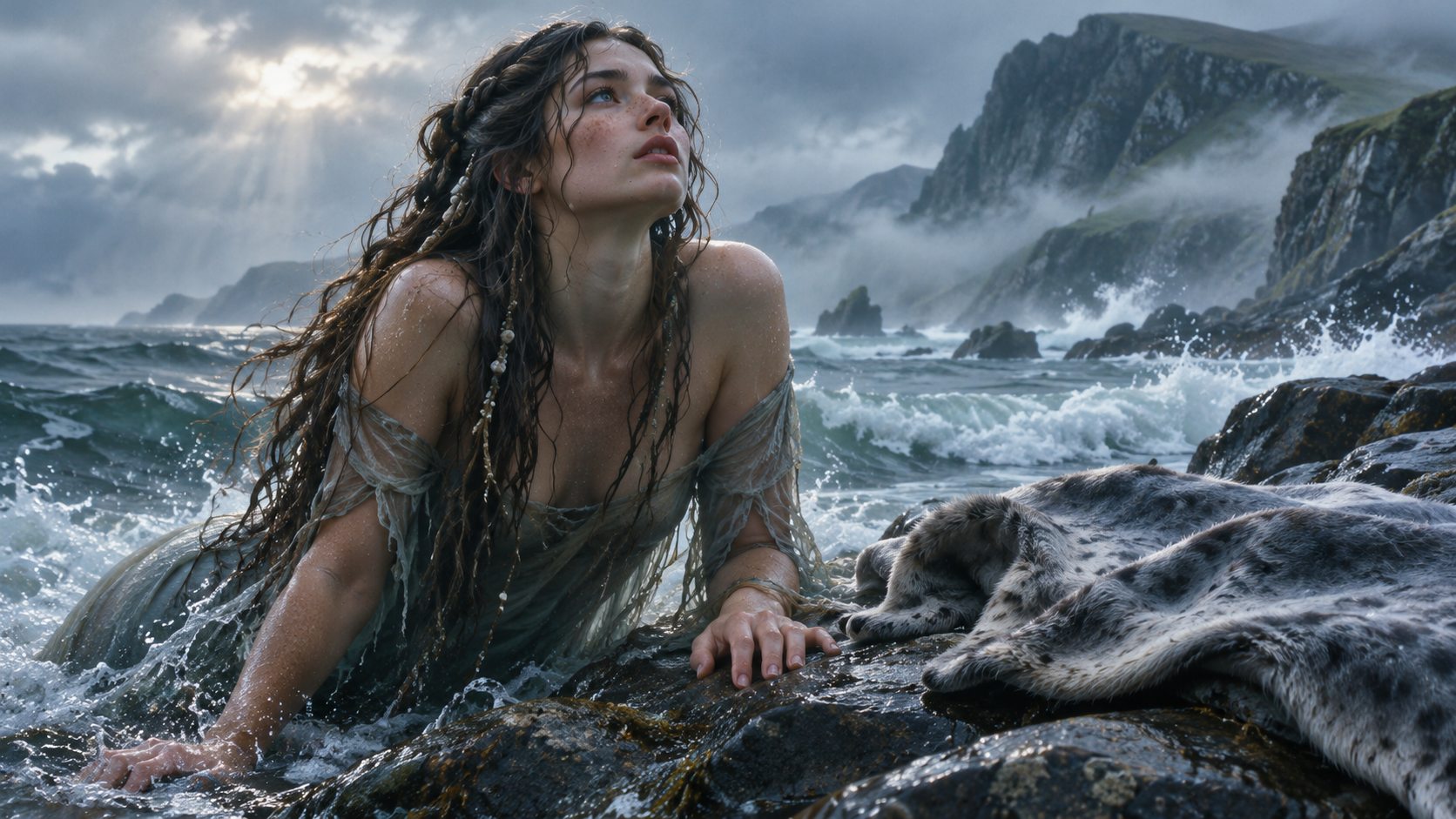
Along the windswept shores of Scotland’s Northern Isles, generations of islanders have told stories of mysterious beings who belong to two worlds. They are the selkies, the seal folk. In the sea they are seals; on land they can remove their skins and walk as humans. Their tales explore transformation, longing, love, loss, and the freedom to return home.
What Is a Selkie?
A selkie is a supernatural seal being especially associated with the folklore of Orkney and Shetland. The name is related to Scots words for seals, including selch. Unlike a mermaid, a selkie changes between two distinct forms. Its sealskin is essential: without the skin, it cannot return to seal form. This detail drives many of the best-known stories.
For island communities surrounded by cold seas, seals were familiar yet mysterious neighbors. Their expressive eyes, haunting calls, and sudden disappearances beneath the waves inspired tales in which the boundary between animal and human was less certain than it seemed.
The Stolen Sealskin: A Story of Love and Captivity
One widely told story begins when a man finds seals who have removed their skins and taken human form on a secluded shore. He steals the skin of one woman and hides it. Unable to return to the ocean, she remains on land. In many versions they marry and have children, but she continues to long for the sea.
Years later, the hidden skin is discovered, sometimes by one of her children. She puts it on and returns to the waves. Some versions describe a sorrowful farewell; others tell of a seal watching her family from offshore. Her departure need not mean she has forgotten her children. The sea is part of who she is.
Love, Loss, and Freedom
Traditional versions describe a supernatural being deprived of the means to return home. Modern readers may also see themes of captivity, coercion, consent, and personal autonomy. Those are contemporary readings, not a single historically documented meaning shared by every storyteller. Still, the tale poses a difficult question: can love truly exist where freedom has been taken away?
Male Selkies and The Great Silkie of Sule Skerry
Selkies are not exclusively female. The traditional ballad The Great Silkie of Sule Skerry, catalogued as Child Ballad 113, tells of a supernatural seal-man, a human woman, and their son. Sule Skerry is a remote rocky islet west of Orkney.
The silkie reveals that he is the child’s father and explains that he is a man on land and a seal in the sea. He foretells that the woman will marry a gunner who will kill both him and their son. This tragic prophecy makes the ballad much more than a simple romance. It explores the dangerous intersection of human and marine worlds.
Selkies in Orkney and Shetland
The Northern Isles preserve a particularly rich body of selkie storytelling. Fishing, seafaring, seal encounters, and unpredictable weather shaped island life, while folklore offered imaginative ways of speaking about the surrounding waters. Some stories concern stolen skins and marriages; others involve supernatural ancestry or unexpected visitors from the sea.
Orkney and Shetland have distinct histories and storytelling traditions, even where motifs overlap. Their Scottish and Norse cultural inheritances provide context, but a specific story should not be assigned to a particular origin without evidence.

Selkies and Irish Coastal Folklore
Ireland also has coastal traditions about supernatural seals, seal people, and connections between humans and marine beings. Some share motifs of transformation, unusual marriages, and longing for the sea. But Irish traditions should not be treated as identical to the Northern Isles’ stories. Selkie is particularly associated with Scots usage, and Irish narratives may use different terms and details. Preserving those regional differences makes the folklore richer, not less connected.
The Spiritual Symbolism of the Selkie
Selkie stories were not necessarily instructions for spiritual practice, and there is no single historical Pagan tradition that universally worshipped selkies as deities or treated them as spiritual guides. The interpretations that follow are modern reflections inspired by folklore.
The Sealskin: Identity and Freedom
The sealskin allows the selkie to return to its own nature. Symbolically, it may represent identity, autonomy, and parts of ourselves we set aside to satisfy others. Its recovery can suggest the freedom to choose our own direction. What parts of yourself have you hidden in order to belong?
The Ocean: Emotion and the Inner World
In many contemporary spiritual frameworks, water symbolizes emotion, intuition, and the unconscious. Through that lens, the selkie’s ocean home can represent memory, belonging, and emotional needs that cannot be ignored.
Transformation: Between Two Worlds
Selkies cross the boundary between seal and human, ocean and shore. They can speak to anyone navigating change or holding more than one identity. Sometimes transformation means becoming something new; sometimes it means remembering who we have always been.
The Shoreline: A Threshold
The tides continually redraw the boundary between land and water. In modern spiritual reflection, this makes the coast a potent image of transition and possibility. The selkie inhabits that changing threshold.
Selkies, Mermaids, and Other Water Beings
Selkies are seal beings who remove their skins to assume human form. Mermaids are aquatic beings often pictured with human upper bodies and fishlike tails, though older descriptions vary. Kelpies are supernatural water horses in Scottish folklore, frequently linked to danger and deception. Merrows belong to Irish sea folklore and vary across recorded stories. These traditions share water imagery, but they are not interchangeable.
Connecting With Selkie Symbolism in Modern Pagan Practice
The following is a contemporary reflective exercise, not a reconstructed historical ceremony. Sit somewhere quiet, perhaps near a safe coastal viewpoint or beside a bowl of water. Take a few slow breaths and imagine a selkie holding the skin that lets it return home.
Ask yourself: Where do I feel most authentically myself? Have I set aside important parts of my identity to meet someone else’s expectations? What does freedom mean to me? How can I honor my relationships while remaining true to myself? What would reclaiming my symbolic sealskin look like?
Journal your thoughts if you wish. When visiting the coast, observe seals from a safe distance, do not disturb wildlife, and never leave objects or offerings in the water.
Why Selkie Stories Still Matter
Selkie legends endure because they speak to homesickness, longing, complicated relationships, separation, and belonging. They ask whether love means keeping someone close or allowing them to choose their own path. Some stories end in sorrow rather than comfort, and their emotional complexity is part of their power.
Final Reflections: The Call of the Deep
Along the rocky shores of Orkney and Shetland, selkies remain among the most evocative figures of northern maritime folklore. Neither permanently human nor confined to the sea, they carry stories of transformation and return. The ocean does not promise an easy life, but for the selkie it represents the freedom to return to its own nature. What does it mean to return to yourself?

Sources and Further Reading
Dictionary of the Scots Language, entries for selch and related forms; Francis James Child, The English and Scottish Popular Ballads, Ballad 113, “The Great Silkie of Sule Skerry”; Walter Traill Dennison, The Orcadian Sketch-Book (1880); Jessie M. E. Saxby, Shetland Traditional Lore (1932); University of Edinburgh, School of Scottish Studies Archives. Historical sources document folklore; spiritual interpretations here are modern.
Leave a Reply