
Every autumn, as the light begins to soften and the nights stretch longer, Pagans across many traditions mark the Autumn Equinox under a familiar name:
Mabon.
We associate it with harvest tables and apples, grain and gratitude, balance and the slow turning toward the darker half of the year.
But before Mabon became the name of a Sabbat, Mabon was a figure in an old Welsh story.
And his story is considerably stranger than the baskets of apples and autumn leaves that usually surround his name today.

The Child Who Disappeared
Mabon ap Modron appears in medieval Welsh tradition, most famously in Culhwch ac Olwen.
His name identifies him through his mother: Mabon ap Modron, Mabon son of Modron.
And almost as soon as his story begins, he disappears.
Mabon is taken from his mother when he is only three nights old.
No one knows where he has gone.
No one knows what has become of him.
By the time Mabon is needed in Culhwch ac Olwen, he has been missing for so long that finding him requires something extraordinary.
Arthur’s companions must ask those whose memories reach farther back than their own.
Ask Those Who Remember
The search becomes a journey backward through time.
Arthur’s men first seek the wisdom of an ancient animal.
That creature cannot remember Mabon.
But perhaps someone older can.
And so they continue.
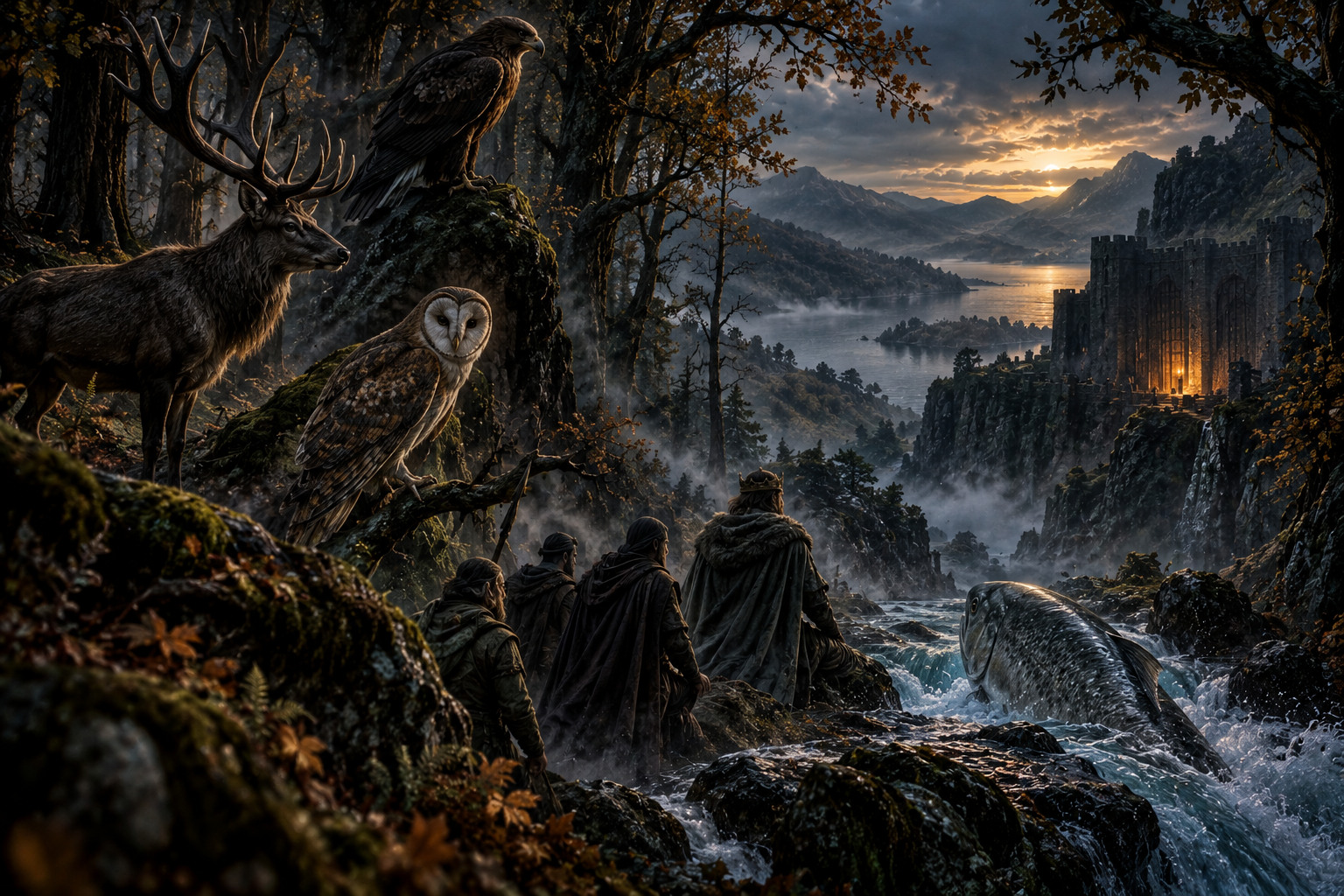
From one ancient creature to another they travel: the Stag of Rhedynfre, the Owl of Cwm Cawlwyd, and the Eagle of Gwernabwy.
Each has lived through extraordinary spans of time.
Each carries memories of a world that has changed around them.
And still, Mabon lies beyond their remembering.
Finally, the Eagle leads them to the Salmon of Llyn Llyw.
The salmon knows.
With every tide he has traveled upriver toward the walls of Caer Lloyw, Gloucester, and there he has heard terrible lamentation coming from within a stone prison.
Arthur’s men travel upon the salmon until they reach the prison.
There, they finally hear the voice of the one they have been seeking.
Mabon.
The child taken after three nights has survived.
He has been imprisoned.
Arthur’s company eventually frees him, and Mabon joins them in the great hunt for the enchanted boar Twrch Trwyth.
The lost one returns to the world.

But Was Mabon an Ancient Autumn Equinox Festival?
No.
And this is where the history becomes just as interesting as the mythology.
There is no surviving evidence that ancient Welsh or Celtic peoples celebrated the Autumn Equinox with a festival called Mabon.
Mabon ap Modron belongs to medieval Welsh literary tradition.
The equinox itself is an astronomical event far older than any surviving story about it, and harvest customs surrounding this portion of the year have deep roots in many cultures.
But calling the modern Pagan Autumn Equinox Mabon came much later.
The name was introduced into the developing modern Pagan calendar by Aidan Kelly in the 1970s. Kelly was looking for names for seasonal celebrations and chose Mabon ap Modron for the autumn equinox.
The name spread.
Eventually, Mabon became so familiar within modern Paganism that it began to sound ancient itself.
But it isn’t.
And I don’t think that makes it less meaningful.
I think knowing the difference makes the tradition more interesting.
The equinox is ancient.
The Welsh story is old.
Calling the Sabbat Mabon is modern.
Those truths do not have to compete with one another.
The Myth Beneath the Harvest
What fascinates me is that, despite the modern connection between Mabon and the Autumn Equinox, the old story feels strangely at home here.
At the equinox, we stand at a threshold.
The outward rush of summer is ending.
The harvest is being gathered.
The nights are growing longer.
The world begins turning inward.
And somewhere inside that darkness sits the story of someone who has been lost.
Finding Mabon does not require strength at first.
It requires memory.
One ancient creature leads to another.
Older.
Deeper.
Farther into what has been forgotten.
Until finally someone remembers.
That gives us a very different image of Mabon than the one we usually place on our altars.
Perhaps this season isn’t only about asking:
What have I harvested?
Perhaps it is also a time to ask:
What did I lose while I was growing?
What part of myself disappeared somewhere along the road?
What have I forgotten because life kept moving?
And if I wanted it back, how far into my own memory would I have to travel to find it?

A Living Tradition
Modern Paganism is full of layers.
Ancient stories.
Old folk customs.
Reconstructed practices.
Modern interpretations.
And entirely new traditions that eventually become familiar enough to feel as though they have always been here.
There is power in knowing which is which.
We do not need to pretend Pagans have called the Autumn Equinox Mabon for thousands of years for the name to hold meaning today.
A tradition does not have to be ancient to be sacred.
But its history deserves to be told honestly.
So this Mabon, set out the apples.
Share the harvest.
Give thanks for what has grown.
Stand for a moment in that strange balance between light and darkness.
But remember the story behind the name.
Remember Modron, whose child was taken.
Remember the ancient animals carrying memories across impossible stretches of time.
Remember the salmon who finally knew where to look.
And remember Mabon, waiting beyond the walls until someone came searching.
Because perhaps there is another kind of harvest hidden inside this season.
Not gathering something new.
But recovering something we thought was lost.
Blessed Mabon, and blessed Autumn Equinox.
May we be grateful for what we have gathered, honest about what we have lost, and brave enough to go looking for what is worth bringing home.
Leave a Reply