
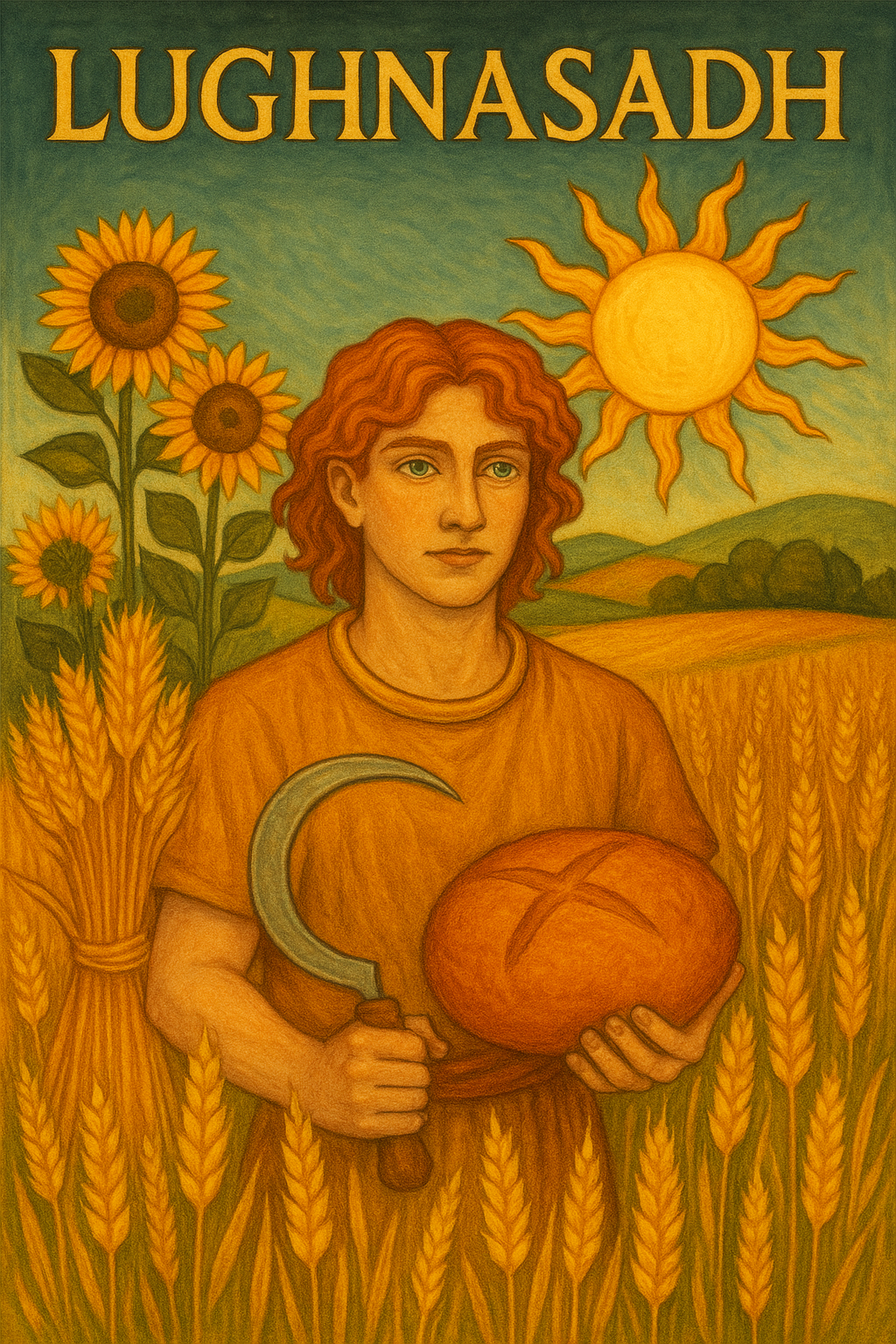
The Wheel turns again. The bright heat of summer begins to mature into something heavier. The days are still long, but shadows now stretch a little further in the evening. Something shifts—not in the sky, but in the land. And deep down, we know: it is time to reap what was sown.
Welcome to Lughnasadh (pronounced LOO-nah-sah), the first harvest festival in the Celtic pagan calendar. More than just a marker of agricultural cycles, Lughnasadh is a deeply spiritual moment—a time to honor the gods, the land, and the sacrifices that make life possible.
🌾 What Is Lughnasadh?
Lughnasadh is one of the four major Gaelic fire festivals, along with Imbolc, Beltane, and Samhain. Celebrated around August 1st, this holy day marks the first fruits of the harvest, especially grain. The word “Lughnasadh” itself comes from Lugh (the god) and násad, meaning assembly or gathering. It was a community-based festival, rooted in gratitude and ritual.
This is not a festival of finality or death (that comes later, with Samhain). Instead, Lughnasadh is a celebration of skill, strength, sacrifice, and sustenance. It is a sacred pause at the peak of abundance—a moment to both honor the growth cycle and acknowledge that the wheel will soon begin its descent toward winter.
🔥 The God Lugh: Light, Skill, and the Assembly of the People
At the center of Lughnasadh is Lugh Lámhfhada, the long-armed god of light and many talents. Lugh is no one-trick deity—he’s a master of all arts: blacksmithing, poetry, magic, warfare, music, and leadership. He’s often seen as a solar figure, but not merely a sun god—Lugh represents illumination in all forms, especially through knowledge and mastery.
According to Irish myth, Lugh established the festival of Lughnasadh in honor of his foster-mother, the earth goddess Tailtiu. She died clearing the land of Ireland to make it arable for farming. Her sacrifice of labor and life ensured survival for generations to come. Lugh decreed that every year, games, feasts, and rites would be held in her name.
This is key: Lughnasadh is a festival of remembrance and gratitude for what was given so that others may live.
🌄 The Áenach Tailten: Sacred Assemblies and Games
One of the most fascinating aspects of pre-Christian Lughnasadh was the Áenach Tailten (Tailtiu’s Assembly), a massive gathering held at Teltown in County Meath, Ireland.
This wasn’t just a party—it was a sacred event. Activities included:
Athletic competitions (similar to the ancient Olympics) Feasting and music Legal agreements and fosterage contracts Handfastings and trial marriages Market trading Ceremonial games in honor of the dead
These games weren’t frivolous; they were acts of devotion. Competing in Lughnasadh games was a way of showing strength, skill, and gratitude to the gods, particularly Lugh.
The spiritual community aspect is critical here. Lughnasadh wasn’t about solitary worship. It was about the tribe coming together, not only to celebrate but to acknowledge interdependence—among people, between humanity and the land, and between mortals and the divine.
🐚 Tailtiu and the Sacred Sacrifice
Lughnasadh isn’t all light and laughter. Underneath the celebration is the shadow of sacrifice. The story of Tailtiu reminds us that life comes from death—that every grain harvested once had to be buried, every loaf of bread comes from a living stalk cut down.
The old folk traditions knew this. In some areas, ritual sacrifices (animal or symbolic) were performed during Lughnasadh to honor the land spirits or ensure abundance. In many versions, effigies made of straw or grain were burned or buried as part of the ritual—acknowledging the spirit of the crop and offering thanks for its surrender.
This is not cruelty—it is reciprocity. The gods and spirits gave, and the people gave back.
🌾 First Fruits, Sacred Grain, and the Spirit of the Land
The cutting of the first sheaf of grain was a highly symbolic act. It marked not just the start of the harvest, but a contract with the land: the promise that the fruits of the earth would sustain the tribe through winter, and that the people would continue to honor and steward the land in return.
Many early Lughnasadh rites involved:
Baking the first bread from harvested grain and offering it to the gods or spirits Carrying the first sheaf through the village in a ceremonial procession Offering fruit or grain at sacred wells or hills Feasting on what the land had newly provided: berries, early vegetables, grains, beer or mead
This is where modern Pagan Lughnasadh celebrations often find their roots: in the simple, powerful act of breaking bread in gratitude.
🔮 Modern Ways to Celebrate Lughnasadh
Even if you don’t live in an agrarian society (or have a wheat field out back), Lughnasadh can still be deeply meaningful. Here are ways to bring the spirit of the festival into your modern Pagan practice:
🥖 1. Bake Your Bread
There is no more iconic Lughnasadh ritual than baking a loaf of bread. Use local grain or organic flour if you can. Before eating, bless it and offer the first piece to your ancestors, gods, or spirits of the land.
🔥 2. Light a Sacred Fire
Lughnasadh is a fire festival, so kindle a bonfire, fire pit, or even a candle. As the flame burns, offer your thanks for the abundance in your life, and meditate on what you’re willing to sacrifice to make room for new growth.
🎯 3. Honor Your Skills
Lugh is the god of many talents. Spend the day practicing your craft—whether that’s painting, writing, blacksmithing, gardening, or divination. Dedicate your efforts to Lugh or to the spirit of the season.
🌿 4. Leave an Offering to Tailtiu
Especially if you work with Irish deities or land spirits, thank Tailtiu for her sacrifice. Leave a few grains, a flower, or a small piece of bread outdoors as a gift to her—or simply speak her name and share her story.
🌻 5. Gratitude Ritual
Create a gratitude altar with symbols of the harvest: wheat, corn, sunflowers, apples. Write down five things you are grateful for and five things you’ve accomplished so far this year. This is your spiritual harvest.
🧹 6. Harvest and Release
Just as farmers begin gathering crops, this is a good time to ask yourself: What have I cultivated this year? What is ready to be reaped? What should I let go of before the dark half begins?
Write down what you wish to release—burn it safely in your Lughnasadh fire.
🌀 Seasonal Magic: The Turning of the Wheel
Lughnasadh sits at the crossroads of light and dark. The sun still shines brightly, but the solstice is behind us. Each day shortens, the wheel turns, and nature begins its slow spiral inward.
It is a reminder that nothing lasts forever, and that’s not a tragedy—it’s a gift. The harvest comes, yes, but only because someone planted the seed and tended the soil. It is now our turn to reap the fruits of our effort—to celebrate what has grown, even as we prepare for what must fall away.
✨ Final Thoughts
Lughnasadh is more than just the first harvest. It is the sacred intersection of labor and reward, sacrifice and sustenance, death and abundance. It teaches us that the most beautiful things—bread, life, art, joy—are often born from effort, offering, and love.
This festival is an invitation to honor your ancestors, your craft, your gods, and your land. So this Lughnasadh, lift a cup to Tailtiu. Thank the grain for its gift. And step into the waning year with gratitude—and power.
Blessed Lughnasadh to you, however you celebrate. May your harvest be abundant, and your spirit strong.
Would you like a matching graphic, social caption, or ritual PDF handout to go with this post?
Leave a Reply