
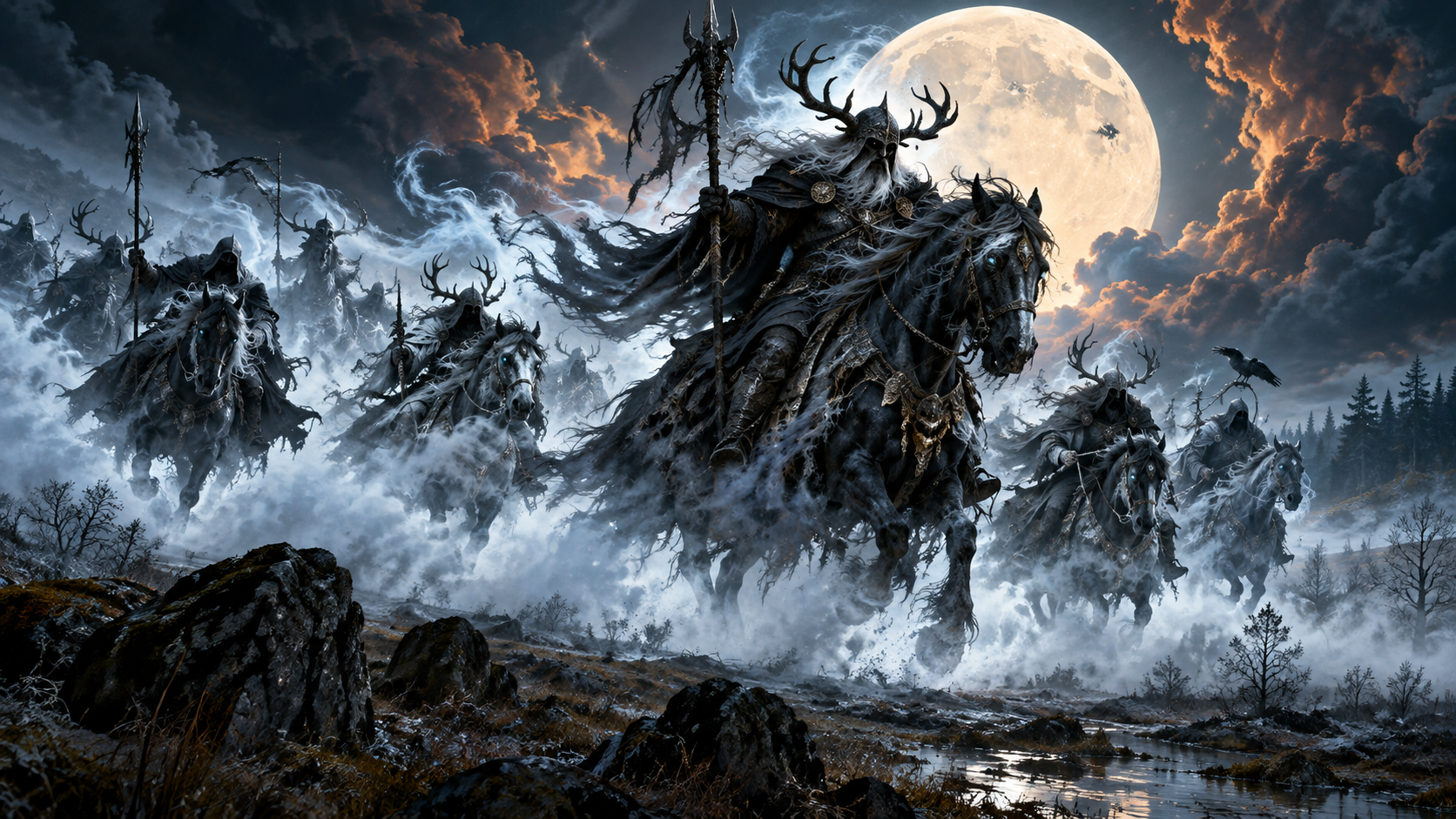
Hooves in the darkness. Hounds beyond the trees. And a procession that belongs neither entirely to the living nor comfortably to the dead.
Imagine a winter road after sunset. The fields are silent, the trees black against the sky, and somewhere beyond the last farmhouse a hunting horn sounds. In stories told across parts of Europe, this is the moment a traveler realizes the night has company.
We often call that company the Wild Hunt. Yet this is not one ancient legend with a single leader and fixed rules. It is a family of traditions about spectral hunters, restless companies, ominous processions, and the uneasy border between this world and another.
What Is the Wild Hunt?
In its most recognizable form, the Wild Hunt is a supernatural procession heard or seen moving through the night. Its company might include mounted hunters, black hounds, ghostly soldiers, the dead, or beings whose nature remains unexplained. Some accounts emphasize a chase; others describe a passing army or a frightening assembly.
The details change with geography and with the people recording the story. A medieval monk might understand a procession as a warning about sin or disorder. A later storyteller might give it a named huntsman, while a modern Pagan might see an image of the turning year and the presence of ancestors.
That variety is not a flaw. Folklore is carried by communities, reshaped by new circumstances, and remembered through the concerns of each generation.
Black Riders at Peterborough: The Year 1127
One of the most striking early English accounts appears in the Peterborough continuation of the Anglo-Saxon Chronicle. Its entry for 1127 describes reports of frightening hunters after the arrival of an unpopular abbot, Henry of Poitou. The figures were said to be dark and enormous, accompanied by fearsome black hounds.
According to the chronicle, the hunters rode black horses and other dark animals, while horns sounded through the woods between Peterborough and Stamford. The disturbances reportedly continued through Lent until Easter. These are claims preserved by a medieval writer, not independently established supernatural events.

The setting matters. The chronicler’s account is bound to the monastery’s resentment of its new abbot. The hunt makes a troubling appointment feel like a disturbance in the moral and natural order. A scholarly discussion of the Peterborough text explores this political dimension.
The passage also reminds us that not every hunt belongs to midwinter. This English account is explicitly connected to Lent and Easter. The popular picture of a procession that always arrives at the winter solstice is narrower than the surviving evidence.
Herlechin’s Company: The Dead on the Road
Another important account comes from the Anglo-Norman historian Orderic Vitalis, writing in the twelfth century. He recounts a priest’s reported encounter in Normandy, set on a night in January 1091, with a terrifying company known as Herlechin’s troop or familia Herlechini.
This was not simply a party of hunters racing after a stag. Orderic’s narrative features a procession of the dead, with suffering figures whose condition reflects the Christian moral imagination of the period. Its horror lies as much in the recognition of souls and their punishments as in the strangeness of the nighttime spectacle.
Modern discussions often place this account beside the Wild Hunt, and the comparison is useful. Yet we should not pretend that Orderic used the same fully developed category later folklorists would popularize. A ghostly procession of the dead and a supernatural hunting party can overlap without becoming identical.
Wodan, Odin, and the Germanic Traditions
For many readers, the Wild Hunt immediately brings Odin to mind. That association has a history, particularly in Germanic-speaking folklore and later scholarship. The name Wodan, related to Old Norse Óðinn, appears in discussions of wild or furious companies moving through the night.
But Odin is not the universal leader of every Wild Hunt. Different regional tales name different figures, and some name no leader at all. Medieval Norse texts about Odin do not supply one tidy version of the modern Wild Hunt story.
The influential nineteenth-century scholar Jacob Grimm gathered a wide range of Germanic material in Deutsche Mythologie, first published in 1835. He argued that later supernatural hunts preserved traces of older beliefs associated with Wodan and other figures. His comparative work shaped generations of readers, although scholars today approach claims of uninterrupted ancient survival more cautiously.
Grimm also discussed female figures and local variations. The folklore was never so obedient to one picture of a single male god leading an army.
A Crossroads of Omens and Uncertainty
What did hearing the Hunt mean? There was no universal answer. In some traditions, the apparition warned of death, conflict, bad weather, or another disruption. In others, the emphasis fell on the danger of meeting the procession or standing in its path.

These beliefs reveal how people made sense of uncertainty. A sudden hornlike noise, violent wind, an unexplained cry in the dark, or the fear of traveling alone could become part of a story that gave shape to danger. That does not mean every tradition began as an explanation for the weather; the stories lived in landscapes where darkness and exposure were real experiences.
For a traveler, the boundary between safe and unsafe space might be no more than the last lantern on a road. For a community, the boundary could be between order and upheaval, the living and the dead, the ordinary calendar and a night believed to be different.
Herne the Hunter: A Windsor Ghost
In England, Herne the Hunter is frequently linked with the Wild Hunt, but his earliest surviving literary appearance deserves to be read on its own terms. In Shakespeare’s The Merry Wives of Windsor, a story is told of a horned former forest keeper haunting an oak in Windsor Forest at midnight during winter.
Herne shakes chains, harms trees, and disturbs cattle. He is an eerie local ghost, not explicitly the commander of a continent-wide cavalry. The Royal Shakespeare Company’s account traces how later interpretations connected him to wider Wild Hunt traditions.
Modern retellings sometimes present Herne as an ancient Celtic god or automatically identify him with Cernunnos. Such connections have been proposed, but they are not proven by Shakespeare’s text. A compelling resemblance is not the same thing as historical evidence.
Winter Nights and the Edge of the Year
It is easy to understand why the Hunt feels at home in winter. Bare trees reveal the shape of the woods, darkness arrives early, and wind can turn a familiar landscape into something strange. In northern European seasonal storytelling, the long nights offer a natural stage for unseen riders and voices carried through the air.
Still, the calendar varies. Peterborough’s account belongs to Lent; other traditions have their own seasonal settings. We can appreciate the Hunt’s winter atmosphere without insisting that every version was always a solstice legend.

Winter also sharpens a human theme: remembrance. In the quiet months, stories of returning spirits and restless companies ask who remains present after death, how the living honor those who came before, and what happens when the familiar world seems to open onto something beyond it.
Instead of a silent ghost at a window, the Hunt offers a whole company passing through the night, impossible to stop and difficult to forget.
What the Folklorists Changed
The Wild Hunt familiar from modern books is partly a creation of comparison. Collectors and scholars noticed related motifs across regions, brought them together, and gave them a shared name. Grimm’s nineteenth-century synthesis was especially influential, but it was an interpretation of varied sources rather than a transcript of one prehistoric belief.
This does not make the traditions false or unimportant. It means history and interpretation must remain in conversation. A twelfth-century monk, a Shakespearean character, a nineteenth-century folklorist, and a contemporary spiritual practitioner are not all telling the same story for the same reasons.
Scholarship on medieval beliefs about spectral companies also reveals how Christian writers understood these tales through punishment, morality, and spiritual danger. Thomas de Mayo’s study of William of Auvergne, for example, explores how a thirteenth-century theologian interpreted the Wild Hunt and related popular beliefs within his religious framework.
The Wild Hunt in Modern Pagan Reflection
For some modern Pagans, the Wild Hunt carries meaning beyond its historical documentation. It may evoke ancestral memory, the passage of seasons, the presence of the dead, or the frightening energy of transformation. Others connect it to Odin, local spirits, or the experience of standing at a symbolic threshold.
Those can be meaningful spiritual interpretations without being presented as established facts about every medieval community. It is possible to honor the stories and acknowledge where the sources end and personal practice begins.
A thoughtful approach starts by asking which version we are engaging with. Is it a Germanic hunting procession, a Norman company of the dead, an English woodland ghost, or a contemporary ritual image? Each deserves to retain its own voice.
When the Woods Fall Silent
The Wild Hunt survives because it refuses to stay still. It races from monastery chronicles into local ghost stories, from folklore collections into paintings, songs, and modern spiritual imagination. Along the way, its riders change faces, its hounds change shape, and even the season can change.
What remains is a sense of the world becoming briefly larger than we thought it was. The road is familiar until the horn sounds. The trees are ordinary until something seems to pass between them.
Whether we read the Hunt as history, folklore, or spiritual symbolism, we need not flatten its many stories into one. We can let the different voices remain, and leave a little room for wonder at the edge of the woods.
Further Reading
- The Peterborough continuation of the Anglo-Saxon Chronicle (1127). English translation and scholarly commentary.
- Jacob Grimm, Teutonic Mythology, volume 3. Digitized volume.
- Royal Shakespeare Company, “Herne the Hunter.” Literary context.
- Thomas de Mayo, “William of Auvergne and Popular Demonology” (2007). Scholarly paper.
- Ronald Hutton, Queens of the Wild: Pagan Goddesses in Christian Europe (2022). Publisher information.
Leave a Reply