
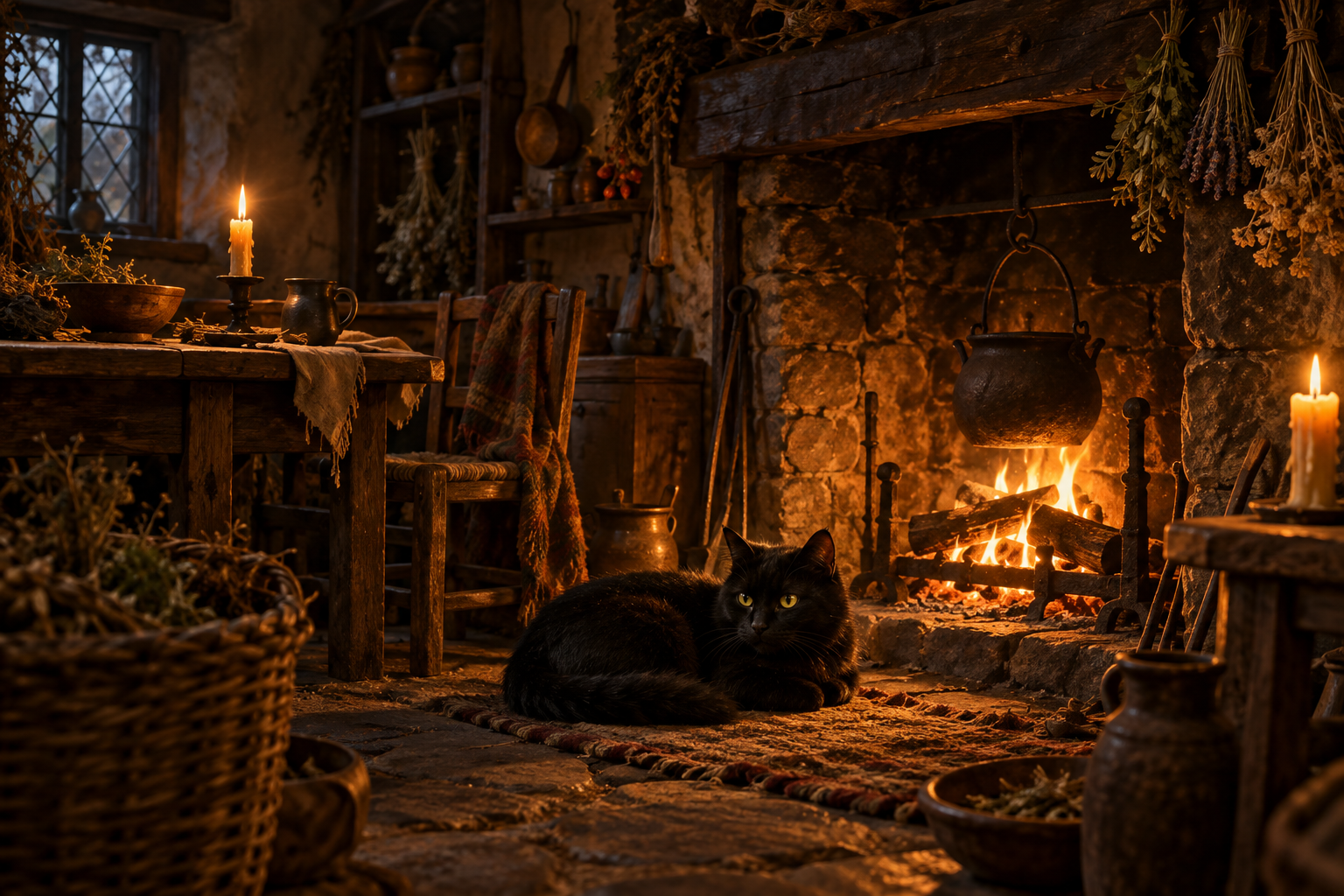
A cat beside the hearth.
A toad beneath the floorboards.
And a name whispered in a courtroom.
When we picture a witch’s familiar today, we often imagine a beloved black cat, a watchful raven, or an animal companion who shares its keeper’s magical life.
It is an appealing image, familiar from novels, illustrations, and modern Pagan practice.
But the older stories are stranger.
And far less comfortable.
In the witch-trial records of early modern England, familiars were described as spirits that could appear in animal form, make bargains, demand nourishment, and carry out a witch’s supposed wishes.
Those accounts emerged from a world of suspicion, interrogation, and religious fear.
To understand them, we need to ask more than what the stories said.
Who was telling the story—and what happened to the person being accused?

The Familiar Before the Black Cat
The word familiar comes from the idea of something close or intimate, and in magical and religious writing it could refer to a spirit associated with a particular person.
The creature of English witch-trial lore was often imagined as a spirit helper.
It might appear as a cat, dog, toad, mouse, hare, or something that did not resemble any ordinary animal at all.
The important distinction is that an alleged familiar was understood as more than an animal.
In the accusations, it could speak, bargain, or act on supernatural instructions.
A neighbor’s cat wandering through a kitchen was not, by itself, evidence of witchcraft, although fear could make ordinary details appear sinister.
Nor was there one universal European definition.
Familiar-spirit stories are especially prominent in some English witchcraft records.
Other regions emphasized different beliefs about witchcraft, harmful magic, the Devil, and spirit relationships.
We lose the history when we treat every witch trial as though it followed the same script.
A Cat Called Sathan: Essex, 1566
One of the best-known early English accounts comes from the 1566 Chelmsford witch trials in Essex.
A contemporary pamphlet, The Examination and Confession of Certaine Wytches at Chensforde, describes accusations involving Elizabeth Francis and a white-spotted cat called Sathan.
According to the printed account, the cat was said to have been passed between women and associated with requests for wealth or harm.
It is an arresting story, with the unnerving specificity of a named animal.
But its details survive through a sensational account of a prosecution.
They cannot be treated as an independent record of supernatural events.
That difference matters.
A confession printed in the sixteenth century may tell us what authorities wanted to hear, what an accused person believed might satisfy interrogators, or how publishers presented a case to readers.
It does not tell us that a spirit-cat actually carried out the acts attributed to it.
The Witch-Hunts and Their Animal Spirits
By the 1640s, England was experiencing another intense period of witchcraft prosecution.
Matthew Hopkins, who styled himself the Witchfinder General, became notorious for his role in investigations in East Anglia.
His 1647 pamphlet, The Discovery of Witches, defended his methods and repeated stories of supposed familiar spirits.
In these narratives, familiars sometimes had bizarre names and forms.
Their very oddness made them memorable.
It also made them useful to a culture already primed to believe that secret, invisible wrongdoing could be revealed through interrogation.
Hopkins was not a detached historian.
He was an active participant defending a campaign of persecution.
His writing is valuable as evidence of the beliefs and practices surrounding those prosecutions, but it is not reliable proof that the accused possessed supernatural servants.
Some witch-finders also searched accused people for unusual bodily marks, which they interpreted as places where familiars fed.
Such examinations were invasive and rested on assumptions rather than sound evidence.
Ordinary skin features could be turned into accusations, and pressure could shape testimony.
Why Cats, Toads, Hares, and Dogs?

The animals that appear in familiar stories were not chosen from a world separate from everyday life.
Cats lived in homes and barns.
Dogs followed their people.
Toads sheltered in damp corners.
Hares darted across fields.
These were creatures that could be encountered close to the places where ordinary lives unfolded.
That closeness helped make the stories persuasive.
A familiar might be imagined at the edge of the hearth, just beyond the threshold, or slipping through the garden after dark.
Folklore transformed the familiar landscape into a place where an unseen bargain might be taking place.
The black cat eventually became the dominant image in popular culture, but historical accounts mention many forms and colors.
Reducing every familiar to a black cat flattens the variety of the sources, and it can make us forget that the real subject of these records was often a person in danger.
The Difference Between a Spirit and a Pet
A modern animal companion can feel deeply attuned to us.
We notice the way a cat appears when we are sad, how a dog anticipates our routines, or how a bird seems to watch from the same branch each morning.
Those experiences can carry personal or spiritual meaning.
But that is not the same relationship described in a seventeenth-century accusation.
The familiar of a trial pamphlet was often framed as a demonic or dangerous spirit.
Modern Pagan uses of the term may instead describe companionship, intuition, symbolism, or a consciously cultivated spiritual connection.
Neither meaning should be forced onto the other.
We can respect contemporary practice without pretending that persecuted women were simply misunderstood versions of today’s witches with magical pets.
What the Records Can and Cannot Tell Us
Witch-trial documents preserve accusations, confessions, legal proceedings, and printed interpretations.
They are indispensable historical sources, but they are not transparent windows into private belief.
Questions asked by authorities, expectations about the Devil, local conflicts, and the conditions under which testimony was obtained all affected what was recorded.
Historians study these sources to understand communities and the ideas that made accusations possible.
A familiar story may reveal anxiety about illness, livestock, poverty, social relationships, or misfortune.
It may also show how a vulnerable person became the focus of fear.
The accusation is historical evidence.
The supernatural event it describes is not an established fact.
Familiars in Modern Pagan Practice
Today, the word familiar has taken on new life in witchcraft communities, fiction, and spiritual conversation.
For some practitioners it describes an animal with whom they share an unusually close bond.
For others, a familiar is a spirit rather than a living pet.
Still others avoid the term altogether.
There is no single practice that speaks for every modern witch or Pagan.
And an animal does not need a supernatural title to be treasured.
The relationship itself may be meaningful enough.
If familiar lore calls to you, begin with curiosity.
Read the historical accounts alongside modern scholarship.
Ask which details belong to folklore, which belong to legal persecution, and which meanings have been reclaimed or reinvented by later generations.
The Shadow Behind the Familiar
The witch’s cat has become an icon of mystery.
It curls beside candles in artwork, peers from book covers, and sits proudly at the center of autumn decorations.
There is room to enjoy that image.
But there is another story behind it: the people whose lives were judged through fear, rumor, and claims about unseen creatures.
Their experiences deserve more than a charming silhouette.
Perhaps the most powerful thing a familiar can teach us today is not how to recognize magic in an animal, but how easily a community can mistake suspicion for knowledge.
Free Printable: Familiar Spirits Coloring Page
Enjoy a free adult coloring page inspired by the animal companions of folklore. Featuring a raven, owl, cat, fox, hare, and mouse surrounded by mystical details, this printable is yours to color and enjoy.
Reflection prompt: What qualities do you admire in the animals who share your world?
Download the FREE Familiar Spirits Coloring Page (Printable PDF)
Sources and Further Reading
- The Examination and Confession of Certaine Wytches at Chensforde (1566). Contemporary pamphlet describing the Chelmsford accusations; read as a prosecution narrative rather than proof of supernatural events.
- Matthew Hopkins, The Discovery of Witches (1647). A witch-finder’s defense of his methods, requiring critical reading.
- James Sharpe, Instruments of Darkness: Witchcraft in England 1550–1750. Historical scholarship on English witchcraft beliefs and prosecutions.
- Emma Wilby, Cunning Folk and Familiar Spirits. A scholarly study of spirit beliefs in early modern British traditions.
Leave a Reply