
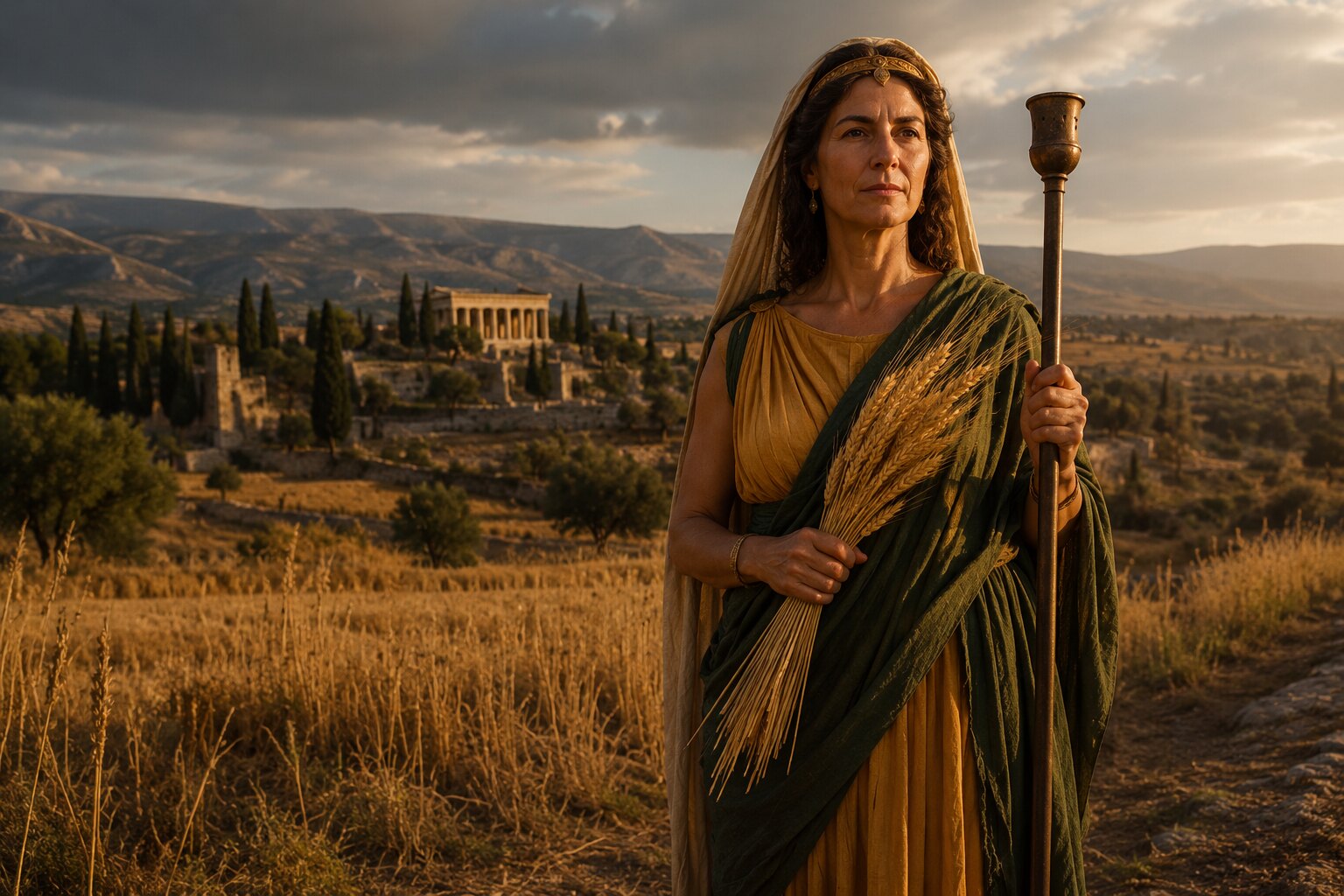
Mention Demeter, and most people immediately think of Persephone.
They remember a mother searching for her stolen daughter. They remember grief falling over the earth, the crops failing, and Persephone’s return bringing life back to the world.
It is a powerful story—but it has also made it easy to remember Demeter as though she were a supporting character in someone else’s myth.
She was not.
Demeter was one of the great goddesses of the ancient Greek world: a divine power of grain, cultivation, nourishment, sacred custom, and the ordered life of the community. She did not merely make flowers bloom. Her gifts allowed people to settle, plant, harvest, store food, and survive the lean season. Her worship stood at the center of the Eleusinian Mysteries, one of the most influential religious traditions of the ancient Mediterranean.
Persephone’s story reveals part of Demeter, but it does not contain all of her. Beyond the grieving mother stands a sovereign goddess with the power to sustain civilization—or bring it to its knees.
01 — Demeter Was Never Merely “Mother Earth”
Demeter is often described as an earth goddess, but that phrase can blur an important distinction.
Gaia is the earth itself: ancient, vast, and generative. Demeter’s realm is more specific. She is deeply connected to the cultivated earth—the field that has been prepared, planted, tended, and harvested. She is the grain drawn from the soil and transformed into bread.
Her landscape is not untouched wilderness. It is the meeting place between the living land and human labor.
A seed does not become a harvest through desire alone. The soil must be prepared. The planting must happen at the proper time. The young crop must be protected. The grain must be cut, threshed, stored, ground, and baked. Some of the harvest feeds the community now; some must be saved so the fields can be planted again.
That entire chain belongs to Demeter’s world.
Her gifts are therefore not limited to fertility in the broad sense. She represents the knowledge and discipline that turn fertility into sustenance. She is not simply abundance appearing from nowhere. She is abundance cultivated.
That distinction gives Demeter a different kind of power. She governs not only what grows, but what allows growth to become survival.
For a deeper look at the sacred meaning of the crops most closely associated with her, read Wheat & Barley: The Sacred Grain.
02 — The Goddess Who Feeds the Community
To understand Demeter’s importance, we have to remember what grain meant in the ancient world.
A poor harvest was not a disappointing season at the farmers market. It was hunger. It threatened families, cities, political stability, religious offerings, and the continuation of ordinary life.
Grain was daily survival.
This is why Demeter is better understood as a goddess of sustenance than as a simple symbol of plenty. Plenty is the overflowing basket. Sustenance is the loaf divided among the household. It is enough grain stored against winter. It is seed protected for the next planting, even when eating it now would be easier.
Demeter’s abundance has foresight within it.
One portion of the harvest belongs to the present. Another belongs to a future that has not arrived yet.
The Homeric Hymn to Demeter also shows the other side of this power. When Demeter withdraws her gifts, the fields fail and famine threatens humanity. The gods themselves face the loss of the offerings mortals provide. Her grief becomes a force that even Zeus cannot ignore.
Demeter does not politely request that the divine order be corrected. She makes life without her cooperation impossible.
That is not a minor agricultural function. It is sovereignty.
The familiar myth is often retold as an explanation for the seasons, but it is also a declaration of Demeter’s authority. The goddess who feeds the world has the right to refuse. Nourishment is her gift, not something the other gods may simply take for granted.
03 — Demeter Thesmophoros: Sacred Custom and the Order That Sustains Life

Among Demeter’s important titles was Thesmophoros, often translated as “Bringer of Law,” “Bearer of Sacred Custom,” or “Lawgiver.” The Greek word thesmos can refer to something established or laid down: an ordinance, custom, or sacred rule.
At first glance, law and grain may seem to belong to entirely different divine realms. In practice, they are closely connected.
Agriculture creates obligations.
Fields establish relationships between people and particular places. Planting and harvest require shared timing and labor. Stored grain must be protected and distributed. Questions of land, marriage, inheritance, family, and community survival become inseparable from the food supply.
The field has an order, and the community built around it needs one too.
Ancient authors connected Demeter’s gift of grain with the establishment of civilized life. Whether every later explanation of the title Thesmophoros captures its earliest meaning is uncertain, but the title itself preserves a side of Demeter that modern retellings often neglect. She was not associated only with natural fertility. She was also honored through sacred customs that protected continuity.
The Thesmophoria, a widespread festival held by women in honor of Demeter and Persephone, brought agricultural fertility, human fertility, ritual obligation, and community life together. The surviving evidence does not reveal every local practice or meaning, and the festival changed across time and place. What remains clear is that Demeter’s power reached far beyond an individual field.
She belonged to the structures through which a people continued.
This is one of Demeter’s sharpest spiritual lessons: growth needs form.
A garden needs boundaries. Grain needs the right season. A practice needs rhythm. A community needs responsibilities that do not vanish the moment they become inconvenient.
Demeter does not promise that anything will flourish merely because we want it to. She teaches cultivation—and cultivation asks for patience, repetition, limits, and care.
04 — The Motherhood of Demeter Is Power, Not Limitation
Looking beyond Persephone does not mean pushing Persephone aside. It means refusing to reduce Demeter to sorrow.
Her motherhood is not a weakness in the story. It is the place from which she acts.
Demeter searches. She grieves. She rages. She withdraws. She forces the gods to recognize that the harm done to her daughter cannot be separated from the order of the world.
She is not soothed into accepting the loss. A new arrangement must be made.
Even then, the myth does not offer a perfect restoration. Persephone returns, but she also belongs to the Underworld for part of the year. Demeter receives her daughter and must release her again. Reunion and separation become part of the same cycle.
There is no tidy ending here. There is relationship, power, compromise, and the knowledge that love does not always prevent change.
Demeter’s identity as mother should never erase her other roles. But neither should we treat motherhood as the lesser, softer part of her divinity.
In her myth, a mother’s refusal changes the will of Olympus.
Readers interested in how the Underworld side of Persephone’s story is often oversimplified may also enjoy Understanding Hades: The Misunderstood Underworld CEO.
05 — Demeter at Eleusis

Demeter’s religious importance becomes even clearer at Eleusis.
The Eleusinian Mysteries centered on Demeter and Persephone and endured for centuries. Initiation was open more broadly than participation in many civic institutions of the Greek world, eventually including women, enslaved people, and non-Athenians who met the requirements.
The deepest rites were secret. That secrecy deserves respect.
Ancient sources give us parts of the surrounding festival: purification, fasting, procession, sacred objects, ritual speech, and entry into the Telesterion, the great initiation hall at Eleusis. They do not give us permission to pretend we possess a complete script or a single certain interpretation of what initiates experienced.
What we can say is that the Mysteries connected Demeter and Persephone with profound questions of life, death, divine encounter, and hope beyond death. Demeter was not simply the goddess invoked when the crops needed rain. She stood at the heart of a tradition that helped people confront mortality.
Her agricultural realm already contained the language for such mysteries.
The seed disappears into darkness before it rises. Grain is cut down so that people may live. Part of the harvest is consumed; part is preserved. The field moves through emptiness and abundance, deathlike stillness and green return.
We should be careful not to declare that this image was the secret of Eleusis. We do not know that. But it helps us understand why grain could carry meanings far beyond food without ever ceasing to be food.
Demeter’s mystery is not found by escaping the material world. It begins inside the processes that keep the material world alive.
For more historical background, visit Exploring the Evolution of Hellenic Religion.
06 — Meeting Demeter Beyond the Myth
Modern Pagans and polytheists do not need to reconstruct the Eleusinian Mysteries—or invent replacements for what has been lost—to approach Demeter thoughtfully.
We can begin with what is still in front of us.
Bread. Grain. Labor. Patience. The land. The systems and people that carry food from a field to our tables.
A simple devotional reflection can begin with a piece of bread or a small bowl of grain. Place it before you and consider everything held within it:
- Seed saved from an earlier harvest
- Soil prepared for planting
- Rain and sunlight
- Human labor and agricultural knowledge
- Cutting, threshing, milling, transportation, and baking
- A living body nourished by the finished food
Ordinary bread contains a web of dependence. Demeter teaches us to see it.
You might sit with one of these questions:
- What is sustaining me right now?
- What am I cultivating through repeated care?
- Where am I expecting a harvest from something I have not truly tended?
- What must I preserve today so there will be something to plant tomorrow?
- What boundaries or sacred commitments protect the life I am trying to grow?
These are not questions of instant manifestation. Demeter’s wisdom is slower and more demanding than that.
She asks whether we are willing to prepare the ground.

07 — The Sacredness of What Keeps Life Going
Persephone’s story will always be essential to understanding Demeter. But Demeter is more than the mother left behind when her daughter descends.
She is the golden grain and the empty field.
She is nourishment and the terrible possibility of hunger.
She is the knowledge that turns seed into bread, the sacred custom that protects continuity, and the patience required to tend a life across seasons.
Civilization rests upon foundations so ordinary that we often stop seeing them: seeds, soil, rain, labor, food, and the decision to save enough to begin again.
Demeter makes those foundations sacred.
To encounter her beyond Persephone is not to leave the famous myth behind. It is to finally recognize the goddess standing at its center—a power great enough to feed the world, strong enough to withhold her gifts, and wise enough to teach humanity how life may continue.
08 — Sources and Further Reading
- Homeric Hymn to Demeter
- Callimachus, Hymn to Demeter
- Diodorus Siculus, Library of History, Book 5
- Pausanias, Description of Greece
- Mystery Cults in the Greek and Roman World — The Metropolitan Museum of Art
- The Great Eleusinian Relief — The Metropolitan Museum of Art
Leave a Reply