
The darkest days of winter have always been filled with strange tales and mythical creatures. When frost silences the world and darkness swallows the afternoon, our ancestors gathered by firelight to tell stories that taught lessons, explained the brutal season, and bound communities together through shared wonder and fear.
These aren’t just old stories—they’re ancestral wisdom carried forward, reminders that our relationship with winter’s darkness runs deeper than holiday lights and hot chocolate.
Here are four winter creatures from Northern European folklore that still speak to us today.
1. Krampus: The Horned Demon of the Alps
Origin: Austria, Germany, and Alpine regions
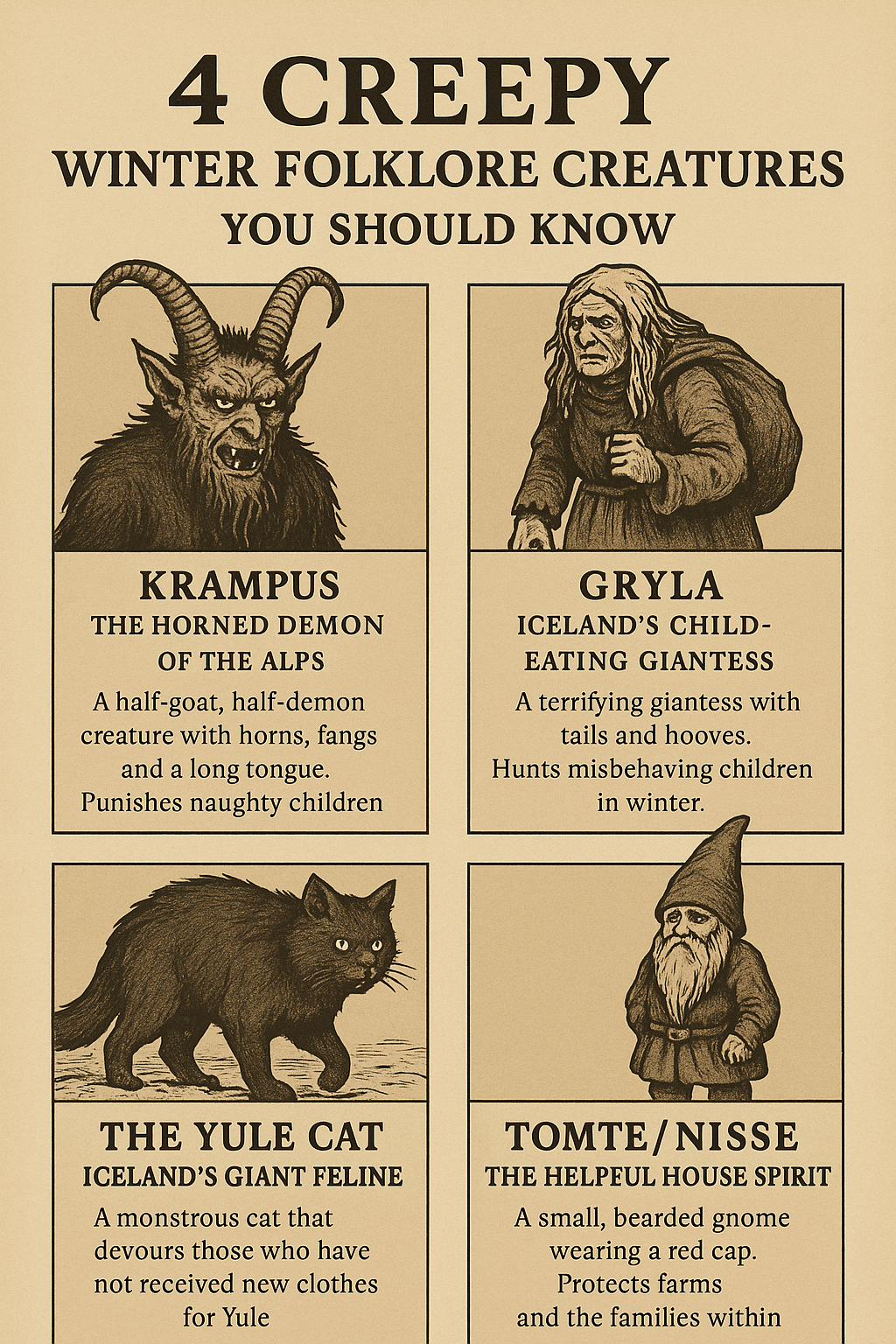
Krampus is a half-goat, half-demon creature with twisted horns, matted fur, fangs, and a lolling tongue. While gift-givers reward good children, Krampus punishes the naughty ones—dragging them away in chains or birch bundles on his back.
When he appears: December 5th (Krampusnacht)
On this night, the streets fill with the thunder of cowbells and the acrid smell of torch smoke as people dressed in elaborate Krampus costumes parade through towns in events called Krampuslauf (Krampus Runs). The air vibrates with drums, screams, and laughter as the horned figures chase spectators through cobblestone streets.
These festivals have exploded in popularity, with celebrations now happening across Europe and North America as people reclaim the darker, wilder side of winter traditions.
What he represents: The shadow side of winter—cold, harsh, and unforgiving. Krampus is the reckoning, the accountability that comes when the world goes dark. He reminds us that winter demands respect, and that we carry both light and shadow within ourselves.
2. Gryla: Iceland’s Child-Eating Giantess
Origin: Iceland (13th century)
Gryla is a towering troll woman who lives in a mountain cave and descends during the deepest winter to hunt misbehaving children. She’s the mother of the 13 Yule Lads—mischievous characters who visit homes on the nights before the holidays, each leaving either gifts or rotting potatoes depending on behavior.
The legend: Gryla has multiple tails, cloven hooves, fifteen tails by some accounts, and an insatiable hunger. The crunch of her footsteps in frozen snow announces her arrival. She kidnaps naughty children in her enormous sack and cooks them in her bubbling cauldron back in her frigid cave.
What she represents: The raw, untamed power of winter nature—the blizzard that doesn’t care about your plans, the cold that kills without malice. Gryla embodies the necessity of community bonds when survival isn’t guaranteed. In the old days, straying too far from the hearth—physically or socially—could mean death. She’s winter’s reminder that we need each other.
3. The Yule Cat: Iceland’s Giant Feline
Origin: Iceland
The Yule Cat (Jólakötturinn) is a monstrous feline the size of a house that prowls the frozen countryside with glowing eyes, hunting anyone who hasn’t received new clothes before the winter celebration.
The tradition: In Iceland’s farming past, workers who completed their seasonal tasks—especially the exhausting work of wool processing and weaving through the long dark—earned new clothing as payment. Those who were lazy got nothing—and risked being devoured by the prowling Yule Cat, whose whiskers scraped against cottage windows as it peered inside to see who wore new wool.
What it represents: Hard work, fair compensation, and the understanding that everyone must contribute when survival depends on cooperation. The Yule Cat isn’t about cruelty—it’s about justice. In a world where winter kills, laziness that burdens the community has consequences. It’s also a powerful reminder that workers deserve fair reward for their labor.
Fun fact: Icelandic singer Björk recorded a haunting song about the Yule Cat that captures its eerie presence perfectly.
4. Tomte/Nisse: The Helpful House Spirit
Origin: Sweden (Tomte), Norway and Denmark (Nisse)
Unlike the fearsome creatures above, the Tomte is a protective spirit—a gray-bearded gnome no taller than a child, wearing a distinctive red cap and wool clothing. He lives in the barn rafters or beneath the floorboards, and the soft shuffle of his footsteps can sometimes be heard on cold winter nights as he checks on the animals and property.
The tradition: Leave a bowl of warm porridge with butter melting into it on the doorstep. Treat your animals with kindness. Show respect and gratitude for your home and land.
An honored Tomte brings prosperity—animals stay healthy, tools are found when needed, and the family thrives. An offended one turns the milk sour, tangles the horses’ manes, and makes small but persistent misfortunes pile up like snow against a door.
What it represents: Gratitude, reciprocity, and respect for the unseen forces that sustain us. The Tomte is the spirit of place, the accumulated presence of care and attention given to a home over generations. He teaches us that winter survival requires relationship—with land, animals, home, and the mysterious help that comes when we live with respect and mindfulness.
Why These Stories Still Matter
Winter folklore wasn’t entertainment—it was survival knowledge wrapped in story.
These creatures taught essential truths:
- Behavior has consequences (Krampus, Gryla)
- Everyone must contribute to the collective (Yule Cat)
- Respect and gratitude sustain us (Tomte)
- Nature’s power demands acknowledgment (all of them)
Today, as these figures experience a cultural revival, they offer something our modern holidays often lack: complexity, shadow, and authentic connection to the season’s darker half.
In a world of commercialized cheer, these ancestral voices remind us that winter has always been a time of duality—darkness and light, fear and protection, death and renewal, isolation and fierce community bonds.
They teach us that the dark half of the year isn’t something to simply endure or cover with decorations—it’s a sacred threshold, a time when the veil thins and we remember that we’re part of something older and wilder than ourselves.
Claiming Your Winter Creature
These aren’t museum pieces. They’re living folklore, and they still have power.
Maybe this year, you leave porridge for a Tomte and practice gratitude for what shelters you. Maybe you acknowledge your inner Krampus—the shadow that demands honesty. Maybe you honor the Yule Cat’s reminder that your work matters and deserves recognition.
So here’s the question: Which winter creature claims you this season—and what is it here to teach you?
Drop your answer in the comments. I want to know which one is walking beside you through the dark.
Want to go deeper? Visit authentic Krampus festivals in Austria or Germany, explore Icelandic folklore museums, or simply gather your people around firelight and tell these stories again. That’s how folklore stays alive—not through preservation, but through practice.
Winter is the season of stories told in darkness. These creatures remind us that we’ve never walked through it alone.
Leave a Reply