
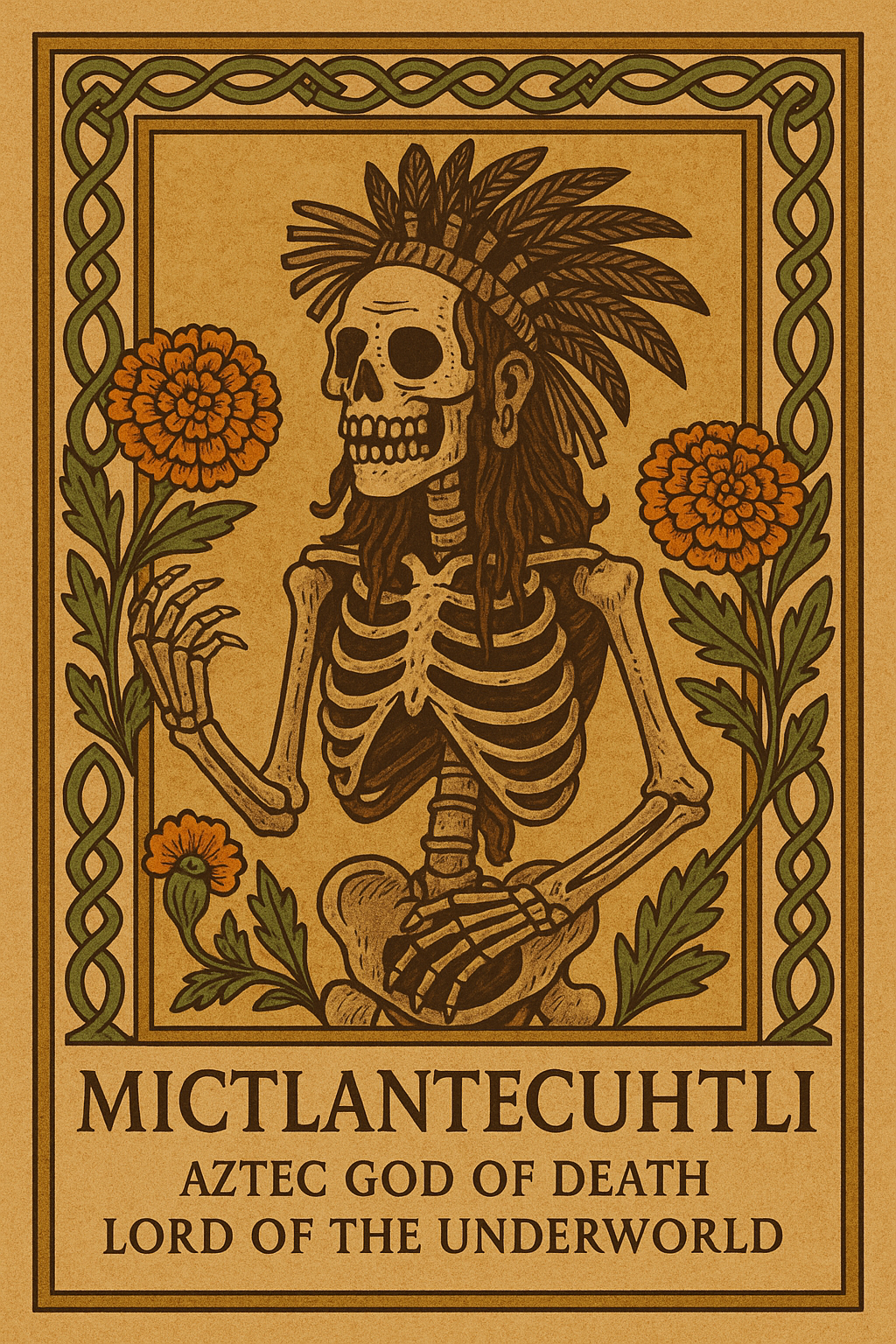
Few gods embody death with such calm authority as Mictlantecuhtli, the Aztec Lord of the Underworld. He wasn’t evil or terrifying—he was the keeper of cosmic order, ensuring every soul completed its sacred journey through the afterlife.
To the ancient Mexica people, death wasn’t an ending. It was transformation. And Mictlantecuhtli was its guardian.
Quick Guide:
- Mythology and meaning of the Death God
- Symbols, colors, and sacred associations
- How to honor him in modern practice
- Respectful cultural considerations
Who Is Mictlantecuhtli? Understanding the Aztec Death God
Pronunciation: Meek-tlan-teh-KUHT-lee
Mictlantecuhtli ruled Mictlan, the Aztec underworld, alongside his queen Mictecacihuatl.
But here’s what makes him different from other death gods: Mictlan wasn’t a place of punishment or eternal suffering. It was a transformative journey.
The Journey to Mictlan:
- Souls of those who died natural deaths traveled there
- The journey took four years through nine challenging levels
- At the end, souls returned purified to the cosmic flow
- Death wasn’t final—it was part of an eternal cycle
Mictlantecuhtli represented a profound truth: death gives meaning to life. Endings create space for new beginnings. He was the steady pulse beneath all existence.
The Myth: How Mictlantecuhtli Created Humanity
This story shows why even the Lord of Death is essential to life.
The Quest for Bones
After the previous world was destroyed, the gods needed to create new humans. But they needed the bones of earlier races to do it—and those bones lay deep in Mictlan.
Quetzalcoatl, the Feathered Serpent god, volunteered to retrieve them.
The Impossible Challenge
Mictlantecuhtli agreed to give up the bones, but set a test:
- Circle Mictlan four times
- While blowing a conch shell trumpet
- But the shell had no holes—impossible to play
Clever Quetzalcoatl called upon worms to bore holes through the shell and bees to make it sound.
The Chase and the Fall
Enraged by this trickery, Mictlantecuhtli pursued Quetzalcoatl as he fled with the bones.
During the chase, Quetzalcoatl stumbled. The bones scattered and broke.
He gathered what he could and escaped to the surface. The gods ground the bones into meal, mixed them with their own blood, and humanity was reborn—imperfect and varied because of the broken bones.
The lesson? Even the Lord of Death became essential to life’s renewal. The bones of the dead became the seed of the living.
What Does Mictlantecuhtli Look Like? Symbols and Meaning
Physical Appearance
Mictlantecuhtli’s appearance is unmistakable in Aztec art:
Key features:
- Skeletal body with exposed ribs and bones
- Skull face painted half-black, half-red
- A liver hanging from his throat (symbolizing life force)
- Owl feathers on his head (nocturnal wisdom)
- Clawed hands reaching to receive souls
- Wild, curly hair with paper ornaments
Why These Symbols Matter
Every detail has meaning:
The liver was considered the seat of life in Aztec belief. Seeing it exposed and vulnerable shows that even life’s essence ultimately belongs to death.
The bones don’t represent decay—they represent foundation. They’re the structure new life builds upon.
The owls and bats navigate between worlds, just like Mictlantecuhtli stands at the threshold between life and death.
Core teaching: Life and death aren’t opposites. They’re partners in eternal transformation.
Sacred Correspondences: Colors, Symbols, and Associations
Quick Reference
CategoryAssociationsElement Earth & Fire Direction North Colors Black, bone white, deep red, gold Season Late autumn (October-November) Numbers 9 (levels of Mictlan), 4 (years of journey)
Sacred Symbols and Tools
Animals: Owls, bats, spiders, scorpions
Plants: Marigolds (cempasúchil), copal resin
Objects:
- Skulls and bones
- Black obsidian
- Candles and torches
- Underground caves
His energy is:
- Grounding and steady
- Quietly transformative
- Patient and inevitable
- Focused on cycles and renewal
How to Work with Mictlantecuhtli: Modern Practices
The Right Approach
Do: Approach with respect and stillness—not fear
Don’t: Treat him as scary or evil
He doesn’t demand dramatic gestures. He asks for:
- Honest acknowledgment of endings
- Acceptance of life’s natural cycles
- Willingness to face difficult truths
What He Teaches
When you work with Mictlantecuhtli, you learn about:
- Acceptance of inevitable change
- Healthy closure and letting go
- Ancestral connection and honoring the dead
- Shadow work and facing what you avoid
- Transformation—turning endings into new growth
Offerings and Altar Ideas for Mictlantecuhtli
Traditional Offerings
Best offerings:
- Candles or torches (light in the darkness)
- Copal incense (sacred smoke carries prayers)
- Marigolds (guide spirits home)
- Pan de muerto or tamales (food for the journey)
- Water or pulque (drink for travelers)
- Tobacco (traditional death deity offering)
Modern Altar Setup
Create a space that honors death and transformation:
Essential elements:
- A skull or ethically-sourced bone (represents mortality)
- Black cloth creating an enclosed “cave” space
- Black and white candles together (balance)
- Photos of deceased loved ones
- Your own creative work about death themes
Optional additions:
- Small mirrors (reflection and shadow work)
- Keys (thresholds and passages)
- Seeds or soil (death feeding new life)
- Personal items from departed loved ones
Meditation Practice: Sitting with Death
This simple practice connects you with Mictlantecuhtli’s energy.
What to do:
- Sit in complete darkness and silence
- Breathe slowly and deeply
- Listen to what the stillness teaches
- Ask yourself:
- What needs to die in my life so something new can grow?
- What endings have I been avoiding?
- What wisdom do the dead still offer me?
Duration: Start with 10 minutes, work up to 30
Best time: Late at night or during the dark moon
Cultural Respect: Working with Mexica Deities
Important Context
You’re engaging with a living cultural tradition. The Mexica worldview continues in Mexican and Chicano communities today.
This isn’t “ancient wisdom up for grabs”—it’s someone’s spiritual heritage.
Guidelines for Respectful Practice
✓ Do this:
- Research deeply from academic and indigenous sources
- Acknowledge this is Mexica spirituality
- Support contemporary indigenous cultural preservation efforts
- Approach as a humble guest, not an owner
- Focus on universal themes (death, transformation, ancestors)
✗ Avoid this:
- Claiming closed practices or ceremonies
- Treating it as generic “mysticism”
- Appropriating without understanding context
- Using sacred practices for aesthetic purposes
- Speaking as an authority on someone else’s culture
For Beginners
Start slow:
- Begin with observation and learning, not invocation
- Read actual sources, not just blog posts
- Build relationships gradually
- Ensure you’re emotionally stable before death work
Remember: Death gods aren’t beginner-friendly. They demand emotional maturity and psychological groundedness.
Mictlantecuhtli and Día de los Muertos
His Role in the Holiday
While Día de los Muertos focuses on welcoming deceased family members home, Mictlantecuhtli and Mictecacihuatl are the rulers who permit souls to return.
They temporarily release the dead to visit the living during this sacred time.
How He’s Honored
Traditional observances:
- Creating ofrendas (altars) with marigold paths
- Leaving favorite foods for the deceased
- Burning copal incense
- Cleaning and decorating graves
- Offering prayers of gratitude to the Lord and Lady of Death
Direct offerings to Mictlantecuhtli:
- Extra candles on your ofrenda
- Copal burned specifically for him
- Verbal thanks for allowing ancestors to visit
- A small separate altar acknowledging his guardianship
FAQ: Common Questions About the Aztec Death God
Is Mictlantecuhtli evil or dangerous?
No. He’s not evil, though he is serious and commands respect.
In Aztec cosmology, death isn’t punishment—it’s a natural, necessary part of existence. Mictlantecuhtli ensures order and prevents chaos.
However: Death gods aren’t “safe” or comfortable. They challenge you to face difficult truths about mortality, loss, and endings. Work with them only when you’re emotionally stable.
Can anyone work with Mictlantecuhtli?
The complex answer:
Technically, yes—there’s no formal requirement or initiation needed for private devotional work.
But consider:
- Are you approaching with genuine respect or spiritual tourism?
- Have you studied Aztec cosmology beyond surface aesthetics?
- Are you prepared for serious, transformative death work?
- Can you honor this path without appropriating cultural practices?
If you’re not of Mexican/Mesoamerican heritage: Come as a respectful guest. Study deeply. Honor the source. Focus on universal themes rather than claiming cultural practices that aren’t yours.
What does it mean if I feel called to him?
A call to death deities often comes during:
- Major life transitions or endings
- Processing grief or loss
- Deep spiritual transformation
- Awakening to shadow work or death-related gifts
What to do:
- Take the call seriously—don’t dismiss it
- Don’t rush into formal practice
- Spend time in reflection and research
- Ensure you’re psychologically stable
- Start with simple observation and offerings
Remember: Death work is advanced spiritual practice. Prepare properly.
How is he different from other death gods?
Mictlantecuhtli emphasizes death as active transformation leading back to cosmic renewal.
Compare to:
- Hades (Greek) – Eternal residence in the underworld
- Anubis (Egyptian) – Guidance through judgment and weighing
- Hel (Norse) – Neutral reception of the deceased
Souls in Mictlan don’t stay forever. They complete a challenging journey, then dissolve back into the cosmic cycle. He’s a god of both death and renewal.
Final Reflection: Honoring the Lord of Death
When you honor Mictlantecuhtli, you honor:
- Every death you’ve survived
- Every ending that taught you to begin again
- Every loss that created space for something new
His realm may be shadowed, but his gift is profound: transformation is eternal and necessary.
The Sacred Truth
Death isn’t the opposite of life—it’s life’s most intimate partner.
- Without decay, no rich soil
- Without endings, no space for beginnings
- Without darkness, no appreciation of light
Mictlantecuhtli stands at the threshold, patient and inevitable. He reminds us that all things change, all things pass, and in that passing, all things become sacred.
The bones beneath your flesh were formed from those who came before. Someday, your bones will nourish those who come after.
This isn’t tragedy. This is the holy cycle.
“All that falls shall rise again, and all that dies shall feed new life.”
Leave a Reply