
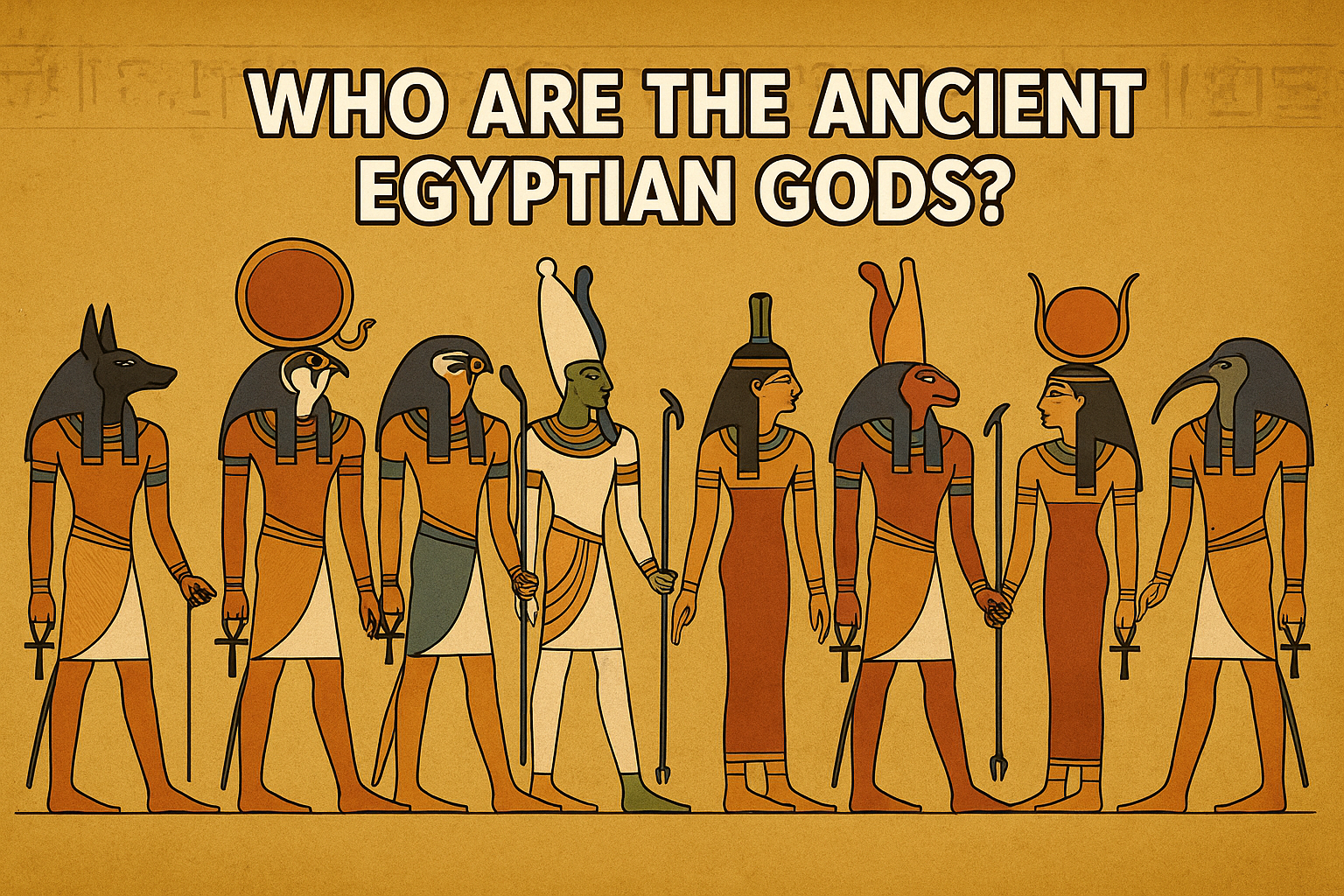
Egyptian Pantheon 
When we think of Ancient Egypt, we picture towering pyramids, golden tombs, and mysterious hieroglyphs. But behind all of that stood the Egyptian gods — a vast and ever-changing pantheon that shaped life, death, and everything in between.
Unlike the Greek or Norse pantheons, which have more fixed family trees, the Egyptian pantheon was more like a living ecosystem of gods. Over the course of 3,000 years, deities rose and fell in importance, merged into new forms, or were honored differently in different cities. Some were cosmic forces like the sun and sky, while others were household guardians keeping families safe.
Let’s dive into who these gods were, how they fit together, and why they remain so fascinating today.
The Nature of the Egyptian Pantheon
The Egyptian gods were not abstract ideas but living presences that touched every part of life. They represented:
Natural forces (the Nile, the sun, storms). Cosmic order (truth, justice, time). Human experiences (love, childbirth, protection).
Pharaohs were seen as divine themselves — living embodiments of Horus, the sky god, and after death, they became one with Osiris, ruler of the underworld.
But perhaps the most interesting thing about Egyptian religion is its fluidity. The gods were not rigidly defined. They could merge into composite beings (like Amun-Ra), take on new aspects, or be replaced by local favorites depending on the city and era.
Primordial and Creator Gods
At the heart of Egyptian mythology is the question: How did the world begin?
Nun – the endless waters of chaos. Out of Nun, all creation emerged.
Atum – the self-created god who rose from Nun and brought forth the first divine family.
Ra (Re) – the great sun god, central to Egyptian religion. Every day he was reborn at sunrise, and every night he traveled through the underworld to defeat chaos.
Ptah – creator god of Memphis, who imagined the world into being through thought and speech.
Amun – a hidden, mysterious creator from Thebes, who later merged with Ra to form Amun-Ra, “the King of the Gods.”
These gods embodied the Egyptians’ view of the universe as order emerging from chaos.
The Ennead of Heliopolis
One of the best-known groups of deities is the Ennead of Heliopolis, a family of nine gods who explained the structure of the cosmos.
Shu – god of air. Tefnut – goddess of moisture.
Geb – god of the earth. Nut – goddess of the sky.
Osiris – god of fertility, death, and rebirth.
Isis – goddess of magic, motherhood, and queenship.
Set (Seth) – god of storms, desert, and chaos.
Nephthys – protector goddess, associated with mourning and magic.
The struggles within this divine family — especially Set’s betrayal of Osiris and Horus’s revenge — became some of the most important myths in Egypt.
The Osiris Myth: Life, Death, and Resurrection
Perhaps the most famous Egyptian story is the cycle of Osiris, Isis, Set, and Horus.
Osiris was a just and wise king, beloved by his people. His jealous brother, Set, murdered him and cut his body into pieces. Isis, his devoted wife, used her magic to reassemble him and breathe life back into him long enough to conceive a son: Horus. Horus grew up to avenge his father, battling Set in a legendary struggle for kingship.
Osiris became the ruler of the underworld, symbolizing resurrection and eternal life. Horus became the divine symbol of kingship on earth. This story shaped Egyptian religion, funerary practices, and the idea that death was not the end.
Gods of Death and the Afterlife
Egyptian religion was obsessed with what happens after death. Naturally, several gods were central to guiding souls:
Anubis – the jackal-headed god of embalming and protector of graves. He guided the dead to judgment.
Thoth – ibis-headed god of wisdom and writing, who recorded the verdict of the afterlife.
Ma’at – goddess of truth, balance, and justice. In the famous Weighing of the Heart, a person’s soul was weighed against her feather of truth.
Osiris – ruler of the underworld, offering eternal life to those who lived in harmony with Ma’at.
This focus on judgment, order, and balance explains the Egyptians’ elaborate burial rituals and mummification practices.
Solar and Fiery Deities
The sun was life itself for the Egyptians, and so solar deities held immense power.
Ra – supreme sun god.
Khepri – the scarab beetle god, pushing the sun across the sky and symbolizing rebirth.
Sekhmet – lion-headed goddess, fierce protector and destructive force, known as the “Eye of Ra.”
Hathor – goddess of love, joy, music, and beauty, also connected to the sun and fertility.
Aten – the sun disk itself, briefly elevated as the only god during Pharaoh Akhenaten’s religious revolution.
The daily cycle of sunrise, sunset, and rebirth mirrored Egyptian beliefs about death and resurrection.
Household and Protective Gods
Not all gods were cosmic in scale — many were personal and domestic, guarding everyday life.
Bastet – cat goddess, originally fierce like a lion, later a gentle protector of homes and families.
Bes – dwarf god, protector of households, children, and women in childbirth.
Taweret – hippo goddess, guardian of pregnant women and infants.
These gods show that Egyptian religion wasn’t just for pharaohs and temples — it was lived in the home.
Regional and Hybrid Gods
Different cities had their own patron gods, and as dynasties rose and fell, the gods often merged or evolved:
Sobek – crocodile god of the Nile and fertility, worshiped in crocodile-filled temples.
Khonsu – moon god associated with healing.
Montu – war god of Thebes before Amun rose in power.
Serapis – a Greco-Egyptian fusion god created later to bridge Egyptian and Hellenistic cultures.
Syncretic gods – combinations like Ptah-Sokar-Osiris or Amun-Ra reflected Egypt’s tendency to blend deities instead of discarding them.
Themes in the Egyptian Pantheon
Three major themes run through Egyptian religion:
Duality – Order (Ma’at) vs. Chaos (Isfet). Gods like Set were necessary, even if feared, because chaos was part of the cycle.
Cycles – Life and death, the sun rising and setting, the Nile flooding and retreating. Gods embodied these rhythms.
Fluidity – Gods could merge, change roles, or take on different aspects, reflecting Egypt’s evolving society.
Why the Egyptian Gods Still Fascinate Us
The Egyptian gods were bigger than life yet deeply human. They fought, loved, betrayed, protected, and resurrected. They explained natural forces but also reflected human struggles — the desire for justice, protection, and eternal life.
Their stories shaped not just religion but also art, politics, and culture. Even today, images of Anubis, Horus, and Bastet remain iconic, representing mystery and power.
Conclusion
The Ancient Egyptian gods were not a static group of divine beings but a living, shifting pantheon that reflected the world around them. From the great sun god Ra to the household guardian Bes, they embodied every part of life — cosmic, political, and personal.
By understanding them, we get a window not just into Ancient Egypt but into humanity’s oldest questions:
Where did we come from? What gives life meaning? And what happens after death?
The gods of Egypt answered these questions with myth, magic, and a vision of eternity that still echoes today.
Leave a Reply