
Unlock the transformative potential of silence in your magical workings, rituals, and spiritual journey. Learn how to harness this overlooked element for deeper connection and more powerful spellwork.
When we explore the classical elements in witchcraft, Wicca, and other spiritual traditions, we typically focus on the foundational five: Earth, Air, Fire, Water, and Spirit. These elemental forces shape our rituals, guide our spellwork, and form the very foundation of magical practice. Yet there exists another force—one that’s always present but rarely acknowledged in magical literature: Silence.
What Is the Element of Silence?
Silence is far more than the simple absence of sound. In magical and spiritual contexts, silence represents:
- The sacred pause between drumbeats in ritual
- The held breath before lighting ceremonial candles
- The stillness that transforms ordinary words into sacred incantations
- The container that gives weight and power to our intentions
Unlike the traditional elements, silence isn’t bound by cardinal directions or specific ritual tools. Instead, it exists in the spaces between—the liminal moments where transformation becomes possible.
The Magical Properties of Silence
Silence as a Container of Power
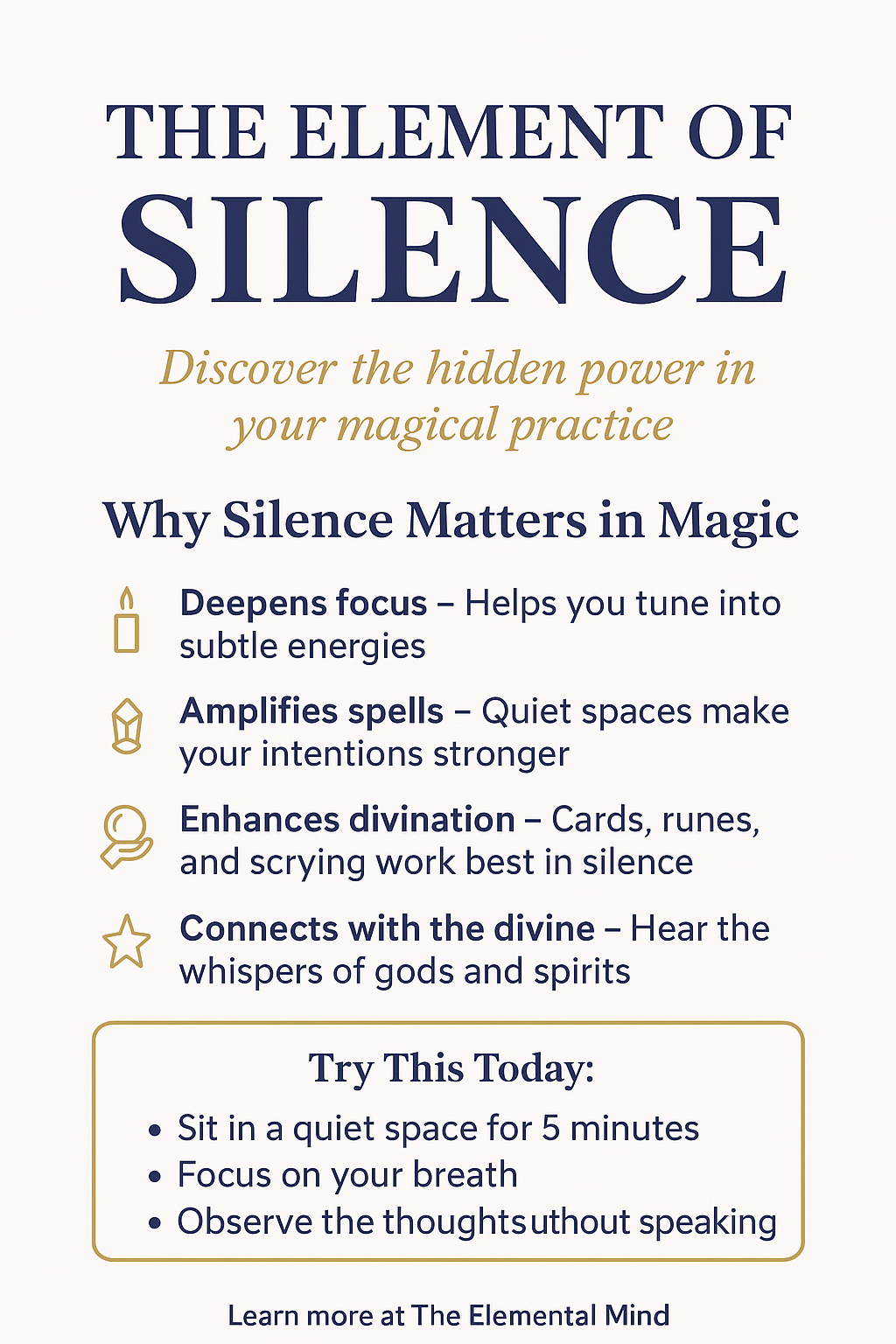
In magical practice, silence serves as an energetic vessel. When we speak words into silence, they carry exponentially more weight than words spoken into noise or chatter. Think of how a whispered spell in a quiet room feels more potent than shouted intentions in a crowded space.
Practical Application: Before casting any spell, create a moment of complete silence. Notice how this simple act changes the energy of your sacred space and amplifies your magical voice.
The Womb of Creation
Just as many creation myths describe the universe beginning from a primordial void, silence represents infinite potential waiting to be activated. It’s the blank canvas upon which we paint our magical intentions.
This concept appears across cultures:
- Norse tradition: The Ginnungagap, the primordial void from which all creation emerged
- Kabbalah: Ain Soph, the endless silence before manifestation
- Buddhism: Śūnyatā, the fertile emptiness that contains all possibilities
A Tool for Enhanced Focus
Removing auditory distractions allows the mind to achieve heightened states of consciousness. This makes silence invaluable for:
- Prophetic work and divination
- Deep meditation practices
- Channeling divine communication
- Energy raising and direction
Working with Silence in Different Magical Practices
Silence in Ritual and Ceremony
Opening Sacred Space:
Begin every ritual with 60 seconds of complete silence. This practice:
- Shifts consciousness from mundane to sacred
- Allows participants to center and ground
- Creates energetic cohesion in group workings
- Establishes clear boundaries between worlds
Closing and Integration:
End spellwork with intentional silence to:
- Allow magical energy to settle and integrate
- Prevent energy scatter or dissipation
- Create space for divine response or confirmation
- Seal the working with reverent stillness
Silence in Spellwork and Manifestation
Energy Charging Phase:
Use silence to gather and concentrate power before casting. This preparatory stillness acts like drawing back a bowstring—the tension creates potential for greater force upon release.
Post-Spell Integration:
After speaking your intentions, hold silence to:
- Let the energy find its natural rhythm
- Avoid “chasing” the spell with doubt or additional words
- Create space for the universe to respond
- Allow your subconscious to fully align with your intention
Banishing Applications:
Silence itself can serve as a banishing tool by:
- Cutting off negative mental chatter
- Creating protective energetic boundaries
- Refusing to feed unwanted energies with attention
- Establishing sovereignty over your sacred space
Silence in Divination and Intuitive Work
Divination requires two distinct skills: the ability to ask clear questions and the willingness to receive subtle answers. Silence serves both functions.
Tarot and Oracle Work:
- Shuffle in silence to attune to the cards’ energy
- Ask questions silently to avoid influencing the reading
- Sit quietly with each card before interpreting
- End readings with grateful silence
Scrying and Vision Work:
Silence creates the optimal conditions for:
- Accessing altered states of consciousness
- Receiving symbolic or visual information
- Distinguishing between mental noise and genuine insight
- Maintaining sustained focus during extended sessions
Rune Casting and Other Systems:
- Draw runes in contemplative silence
- Allow meanings to emerge naturally without forcing interpretation
- Use silence to “listen” for additional guidance beyond the written meanings
The Element of Silence Across Spiritual Traditions
Monastic Traditions
Religious communities worldwide have recognized silence as a spiritual teacher. Contemplative monks often observe periods of complete silence not as deprivation, but as a pathway to divine communion. This practice offers several benefits:
- Increased sensitivity to subtle spiritual communications
- Deeper introspection and self-knowledge
- Enhanced presence and mindfulness
- Greater appreciation for the power of spoken word
Indigenous Wisdom Traditions
Many indigenous cultures emphasize the sacred nature of silence:
- Vision quests often include extended periods of silence in nature
- Sweat lodge ceremonies incorporate silent reflection and prayer
- Shamanic journeying relies on internal silence to access other realms
- Nature-based rituals honor the quiet wisdom of the natural world
Modern Witchcraft and Neo-Paganism
Contemporary magical practitioners are rediscovering silence as an elemental force:
- Hedge witches use silence for boundary crossing and spirit work
- Green witches employ quiet observation to learn from plant allies
- Kitchen witches infuse cooking with silent intention and blessing
- Ceremonial magicians incorporate periods of silence into formal rituals
How to Incorporate Silence into Your Practice
Daily Practices
Morning Silence Meditation:
Start each day with 5-10 minutes of intentional silence. Simply sit quietly and notice:
- The quality of silence in your space
- How your body feels in stillness
- What thoughts or insights arise naturally
- The transition from sleep consciousness to waking awareness
Evening Reflection:
End your day by sitting in silence and reviewing:
- Moments when you felt most connected to the sacred
- Times when silence served you (or when its absence created difficulty)
- Gratitude for the day’s experiences
- Intentions for tomorrow
Weekly Practices
Silent Nature Immersion:
Spend time in natural settings without speaking, music, or other distractions:
- Sit by water and listen to its subtle sounds
- Walk in forests and tune into the “green silence”
- Observe sunrise or sunset in complete quiet
- Practice silent communion with trees, stones, or other natural allies
Technology Sabbath:
Designate specific times for complete digital silence:
- Turn off phones, computers, and other devices
- Engage in non-electronic activities (reading, crafting, cooking)
- Notice how technological silence affects your energy and mood
- Use this time for deeper spiritual practices
Monthly and Seasonal Practices
New Moon Silent Vigil:
Use the dark moon energy for deep silent reflection:
- Sit in darkness with minimal or no artificial light
- Practice silent divination or meditation
- Set intentions for the lunar cycle ahead
- Journal about insights that emerge from the silence
Seasonal Silence Retreats:
Mark the turning of seasons with extended silent periods:
- Spend solstice or equinox in contemplative silence
- Use seasonal transitions for deep introspection
- Align with natural rhythms through quiet observation
- Create seasonal altars in silence as moving meditation
Advanced Techniques: The Magick of Different Types of Silence
Active Silence vs. Passive Silence
Active Silence involves conscious engagement with stillness:
- Deliberately listening for subtle sounds or spiritual communications
- Using silence as a tool to direct energy or intention
- Maintaining alert awareness during quiet periods
- Actively creating space for divine presence or guidance
Passive Silence allows natural stillness to unfold:
- Simply being present without agenda or effort
- Allowing thoughts and sensations to arise and pass naturally
- Resting in the natural gaps between thoughts or sensations
- Surrendering to whatever emerges from the quiet
Group Silence Practices
Working with silence in group settings creates powerful collective energy:
Synchronized Breathing:
- Begin with several minutes of silent, synchronized breathing
- Allow the group’s energy to harmonize naturally
- Notice how individual energy merges into collective presence
- Use this foundation for group spellwork or ritual
Silent Circle Casting:
- Cast circles through synchronized movement rather than spoken words
- Use gesture, breath, and intention to create sacred space
- Allow participants to feel the energetic shifts directly
- Experience the power of non-verbal magical communication
Silence and the Other Elements: Creating Elemental Balance
Silence + Earth: Grounding in Stillness
Combine earth energy with silence for:
- Deep grounding and stability practices
- Silent work with crystals and stones
- Quiet gardening and plant communication
- Underground or cave meditation practices
Silence + Air: Mental Clarity and Communication
Merge air energy with silence to enhance:
- Telepathic or psychic communication
- Breath-based meditation practices
- Silent study of sacred texts or symbols
- Wind and weather observation practices
Silence + Fire: Focused Will and Transformation
Integrate fire energy with silence for:
- Candle meditation and flame gazing
- Silent energy raising and direction
- Transformational shadow work
- Solar energy absorption practices
Silence + Water: Emotional Depth and Intuition
Blend water energy with silence to deepen:
- Emotional healing and release work
- Intuitive development and psychic abilities
- Silent communion with water bodies
- Dream work and lunar practices
Silence + Spirit: Divine Connection and Unity
Combine spirit energy with silence to access:
- Direct divine communion experiences
- Unity consciousness and mystical states
- Past-life or soul memory access
- Connection with deceased loved ones or ancestors
Troubleshooting Common Challenges with Silence
“My Mind Won’t Get Quiet”
This is perhaps the most common concern when beginning silence practices. Remember:
- Silence doesn’t require an empty mind—it simply means creating quiet external conditions
- Thoughts are natural—observe them without judgment and return attention to the present moment
- Start small—even 30 seconds of intentional silence has value
- Use anchor points—focus on breath, heartbeat, or environmental sounds to maintain presence
“I Feel Uncomfortable in Silence”
Many people initially find silence unsettling, especially in our noise-filled modern world:
- Begin gradually—start with short periods and slowly extend duration
- Create comfortable settings—use familiar, safe spaces for initial practice
- Understand the discomfort—often this reflects our disconnection from natural rhythms
- Practice self-compassion—be patient as you develop this new capacity
“Nothing Happens When I’m Silent”
If you feel like silence practices aren’t “working”:
- Adjust expectations—silence work is often subtle rather than dramatic
- Look for small shifts—notice changes in mood, energy, or perspective
- Consider integration time—benefits often appear hours or days later
- Explore different approaches—try various types of silence practice to find what resonates
The Science Behind Silence: Research and Benefits
Neurological Effects
Recent neuroscience research reveals that silence creates measurable changes in brain function:
- Default Mode Network activation—silence engages brain regions associated with self-reflection and introspection
- Stress hormone reduction—quiet environments decrease cortisol and adrenaline production
- Enhanced neuroplasticity—periods of silence support brain healing and new neural pathway development
- Improved focus capacity—regular silence practice strengthens attention and concentration abilities
Psychological Benefits
Studies demonstrate that intentional silence practices offer significant mental health benefits:
- Reduced anxiety and depression symptoms
- Increased emotional regulation and stability
- Enhanced creativity and problem-solving abilities
- Greater self-awareness and introspection capacity
Physical Health Improvements
Silence practices also support physical wellbeing:
- Lower blood pressure and reduced cardiovascular stress
- Improved sleep quality and circadian rhythm regulation
- Enhanced immune system function through stress reduction
- Better digestion and metabolic function due to parasympathetic nervous system activation
Building Your Personal Silence Practice
Assessment: Understanding Your Current Relationship with Silence
Before developing new practices, honestly assess your current relationship with silence:
Reflection Questions:
- When do you naturally encounter silence in your daily life?
- How do you feel during quiet moments—comfortable, anxious, bored, peaceful?
- What stories or beliefs do you hold about silence?
- In what settings do you feel most at ease with stillness?
Creating Your Silence Practice Plan
Week 1-2: Foundation Building
- Practice 2-3 minutes of silence daily
- Notice your natural responses without judgment
- Experiment with different times of day
- Keep a simple journal of observations
Week 3-4: Expanding Duration
- Increase to 5-10 minutes daily
- Try different locations (indoor, outdoor, various rooms)
- Begin incorporating silence into existing spiritual practices
- Notice any changes in daily life or relationships
Month 2: Deepening Practice
- Extend sessions to 15-20 minutes
- Experiment with different types of silence (active vs. passive)
- Begin group silence practices if possible
- Start integrating silence with other magical workings
Month 3 and Beyond: Integration and Mastery
- Develop longer silent periods (30+ minutes)
- Create seasonal or lunar silence practices
- Teach others about silence work
- Consider silent retreat experiences
Silence as Sacred Technology
In our hyperconnected digital age, silence becomes not just a spiritual practice but a form of sacred technology—a tool for accessing states of consciousness and connection that our ancestors knew intimately.
Digital Detox and Sacred Silence
Modern silence practice often requires conscious disconnection from technology:
- Phone-free zones in your home, especially bedrooms and ritual spaces
- Notification silence during spiritual practices and meditation
- Tech sabbaths for extended periods of digital disconnection
- Nature immersion without devices for deeper silence experience
Silence as Resistance
Choosing silence in our noise-saturated culture becomes a radical act:
- Resistance to consumer culture that profits from constant stimulation
- Reclaiming agency over your attention and consciousness
- Modeling alternative ways of being for others
- Honoring ancestral wisdom in our modern context
Conclusion: Embracing the Element of Silence
Silence is not emptiness—it is the fertile void from which all creation springs. It is the pause that gives rhythm to music, the space that gives meaning to words, the stillness that allows movement to have purpose.
As you begin or deepen your work with silence as a magical element, remember that this practice connects you to an ancient lineage of seekers, mystics, and magical practitioners who understood that the most profound truths often emerge not in the speaking, but in the listening.
The next time you step into ritual or magical working, don’t just call upon Earth, Air, Fire, Water, and Spirit. Call upon Silence as well. Invite it in as an honored guest and teacher. Create space for it in your practice and in your life.
Listen to what emerges from the quiet. Trust what you hear in the stillness. Allow silence to be your teacher, your container, your sacred technology for transformation.
In a world filled with noise, silence becomes the most radical and powerful magic of all.
Quick Reference: Working with the Element of Silence
Daily Practices:
- Begin and end each day with intentional silence
- Create silent moments before meals, transitions, and important activities
- Practice silent walking or movement meditation
- Use silence to enhance other spiritual practices
Weekly Practices:
- Extended nature silence sessions
- Technology-free silent periods
- Group silence practices with family or spiritual community
- Silent cleaning, cooking, or creative activities
Monthly Practices:
- New moon silent vigils
- Extended silent retreats (even just for a few hours)
- Silent altar creation or sacred space tending
- Deep silent divination or spiritual guidance sessions
Seasonal Practices:
- Solstice and equinox silent observances
- Seasonal transition contemplation periods
- Silent gratitude and reflection practices
- Ancestor honoring through silent communion
Remember: Start where you are, use what resonates, and allow your practice to evolve naturally. Silence is patient—it will wait for you to discover its gifts in your own time and way.

Leave a Reply