
Why One God Rules Cattle, Magic, Death… and More
Sometimes when I’m studying ancient gods, I come across one that makes me pause and think: Wait, how are all these things connected? That happened when I started learning about Veles, the Slavic god of… well… a lot.
He’s the god of cattle.
The god of wealth.
Also, the underworld.
And magic.
And serpents.
And music?
…What?
It almost feels like Veles was the Slavic pantheon’s junk drawer—just toss in anything mysterious or earthy and call it his. But the truth is way more fascinating. Once I started digging into how Slavic people saw the world, it all started to make sense.
So, I’m sharing what I learned. Here’s why Veles is connected to so many things—and why he’s not “random” at all.
🌳 1. It Starts With the World Tree
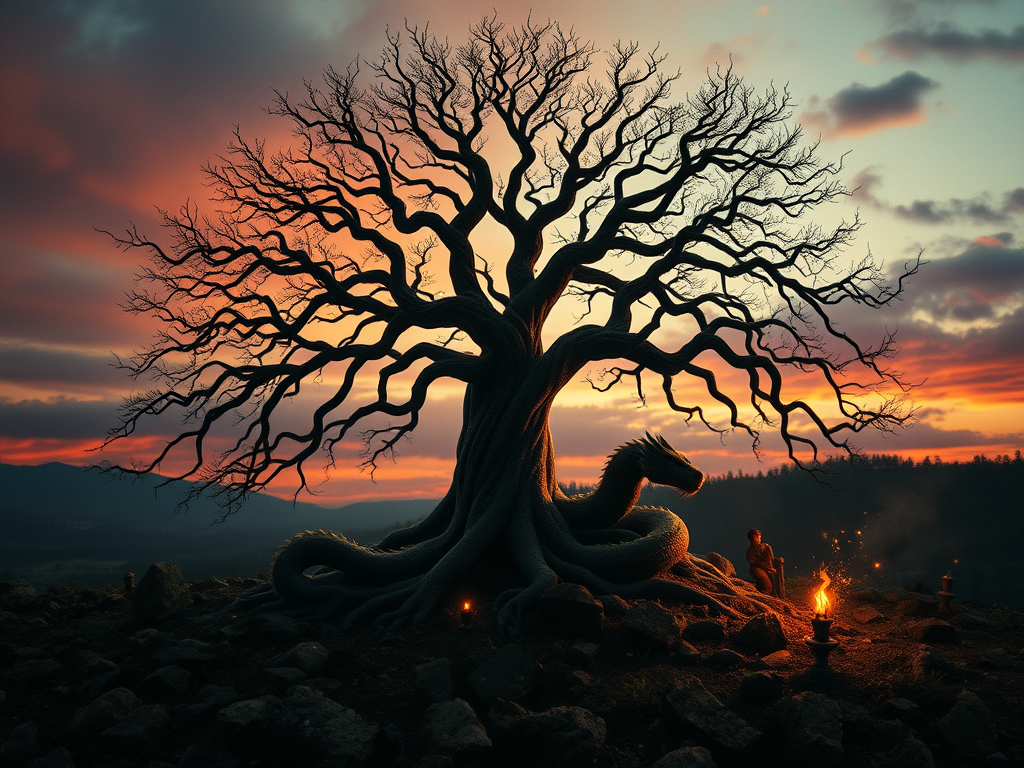
Ancient Slavic cosmology is structured around a World Tree—a giant tree whose roots, trunk, and branches connect three realms:
- Heaven (sky) – Home of Perun, the thunder god, symbol of law and order.
- Earth (middle) – Our world, full of people, animals, and change.
- Underworld (roots) – Shadowy, fertile, chaotic… and ruled by Veles.
This isn’t a good vs. evil setup—it’s balance. If Perun is the sky king, Veles is the one down in the dirt and water, keeping things real.
So what lives under the surface?
- Cattle, in barns and fields.
- Springs and swamps.
- Dead ancestors.
- The secrets of magic.
- Wealth, hidden in the land.
- Dreams, poetry, and intuition.
Veles becomes the god of all these—not randomly, but because they belong to his realm.
🐍 2. Veles Is a Shapeshifter
A lot of myths describe Veles as a serpent or dragon. That imagery isn’t just cool—it tells us something about how his energy flows.
Snakes:
- Move between realms (earth and water).
- Shed their skin (transformation).
- Hide in unseen places.
In myth, this makes Veles a master of transformation. He slithers through boundaries—between life and death, wealth and decay, silence and music. So of course his portfolio isn’t neat. He’s not a god of “this one thing.” He’s the god of everything in between.
⚡ 3. He’s the Cosmic Rival of Perun
In the Slavic storm myth, Perun (sky god) and Veles (underworld god) are locked in an eternal battle. Veles steals Perun’s cattle, or his wife, or some sacred object—then hides in the underworld. Perun chases him, thunderbolts flying.
This myth plays out in every thunderstorm, every shift in the season. But underneath the drama is something deeper:
- Perun stands for order, control, law.
- Veles represents chaos, trickery, nature.
And when society defines “order,” everything outside that becomes… Veles.
So he ends up with:
- Poets and bards (those who bend truth).
- Sorcerers and healers (who use invisible power).
- Farmers and herders (who depend on cycles, not rules).
It’s not random—it’s relational. Veles is the other side of the coin.
🎵 4. He’s the Patron of the Liminal
In ancient Slavic culture, certain people lived in-between: shamans, storytellers, herbalists. They weren’t rulers or warriors—they were the ones who knew how to speak with spirits, heal with unseen knowledge, and twist words into power.
Veles became their patron. He is:
- The voice in the dark.
- The magic in the swamp.
- The whisper from your ancestors in a dream.
So now we can add music, poetry, and trance to his list—and again, it fits.
🐄 5. Cattle = Wealth = Death = Life
One of Veles’s oldest roles is as a god of cattle. Sounds simple, right? But in a farming culture, cattle were everything: food, money, status, security.
Where Veles goes, cattle follow. Where cattle go, wealth grows. But cattle also die, rot, and feed the soil.
So Veles is:
- The god of wealth (what we store).
- The god of life (what we grow).
- The god of death (what returns to the earth).
And honestly, that’s just… perfect. Life isn’t linear. Neither is Veles.
🌀 So Why Is Veles “Everything”?
Because in Slavic mythology—and in most ancient worldviews—gods weren’t specialists like modern job titles. They were forces. Archetypes. Stories.
Veles doesn’t rule one thing. He moves through things.
He’s what flows beneath the surface.
He’s the reason the dead feed the living.
He’s the magic in the swamp, the richness in decay, the music that bends the rules.
He’s not chaos for the sake of chaos—he’s the necessity of change, of mystery, of magic that lives beyond logic.
🌑 What Veles Teaches
If you’re walking a spiritual path that honors transformation, mystery, or the unknown—Veles might already be with you.
He teaches:
- Let go of rigid control.
- Embrace cycles, decay, and rebirth.
- Value what’s hidden or in-between.
- Speak your truth with craft—not just clarity.
And maybe most importantly:
Not everything powerful needs to be understood.
Leave a Reply