
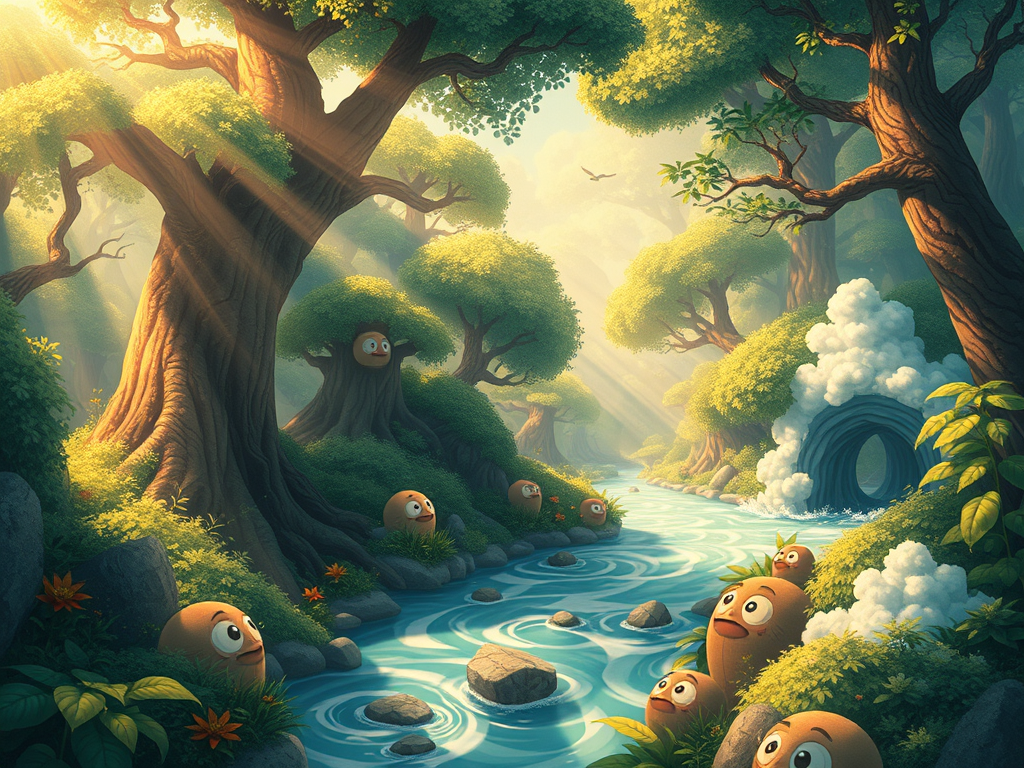

Have you ever stood still in the woods and felt like the trees were… watching you?
Or stared at the ocean and felt it wasn’t just water, but some vast living presence?
You were brushing up against something ancient.
Something our ancestors lived with every day: Animism.
Let’s really explore it.
🧠 What Animism Actually Is
Animism is the belief — or more accurately, the experience — that everything is alive.
Not just humans and animals, but rivers, rocks, winds, dreams, songs — all carrying spirit, personality, agency.
“The world is full of persons, only some of whom are human.”
— Graham Harvey, Animism: Respecting the Living World
In this view, reality isn’t a collection of dead stuff.
It’s a community of living beings, all woven together.
🪄 Imagine it like this:
You’re at a family reunion.
- Uncle River grumbles at the clouds.
- Cousin Tree hums quietly under his breath.
- Auntie Mountain looms large, steady and patient.
Everything is someone.
Nothing is just something.
🚫 No, Animism Isn’t “Primitive Religion”
For a long time, scholars like Edward Tylor called animism the “earliest, most primitive” religion — basically saying early humans were just naive.
But that’s wrong.
Modern anthropologists like Nurit Bird-David and Graham Harvey have shown that animism is a sophisticated philosophy — a different way of seeing reality.
It’s not about ignorance.
It’s about relationship.
💬 Real-world example:
When Inuit hunters kill a seal, they perform rituals to honor the seal’s spirit.
They believe the seal chose to offer itself — and if not properly thanked, the spirit may refuse to return in future hunts.
This isn’t superstition.
It’s ethics.
It’s reciprocity between beings.

🛠 How Animism Works
1. Personhood Is Everywhere
In animism, anything can be a person — a river, a rock, a gust of wind.
It’s not about intelligence.
It’s about agency — the ability to act, influence, and relate.
Anthropologist Irving Hallowell once asked an Ojibwe elder, “Are all the stones we see alive?”
The elder replied:
“Some are.”
🌟 Visual idea here:
[Graphic of a river, a tree, a fox, a mountain — all drawn with gentle faces, glowing faintly — showing personhood across nature.]
2. You Don’t Take Without Giving
In an animist world, there’s no such thing as “resources.”
There are only relationships.
- When you harvest plants, you offer thanks.
- When you hunt, you honor the spirit of the animal.
- When you drink from a spring, you greet it first.
Nature isn’t a store.
It’s a neighborhood.
You don’t steal from your neighbors.
You ask. You share. You thank.
3. Communication Isn’t Just Words
Animists read the world like a living text:
- The movement of birds.
- The way a river bends.
- Dreams full of strange animals.
Nature speaks — just not always in English.
🌟 Visual idea here:
[A dreamy, semi-abstract art piece showing waves whispering messages, a fox leaving trails of glowing pawprints, stars forming stories overhead.]
🌍 Animism Isn’t Just “Somewhere Else” — It’s Everywhere
| Culture | Example |
|---|---|
| Australia | Aboriginal Dreamtime: The land itself sings the world into being. |
| Japan | Shinto: Spirits (kami) dwell in rocks, rivers, trees. |
| Amazon | Yanomami treat forests as full of intentional, conscious life. |
| Arctic | Inuit honor seals, whales, and caribou as beings with souls. |
| Africa | Dagara people see ancestors living in stones, stars, and rivers. |
🧩 The Deeper Philosophy Behind Animism
Ontology: What Exists?
- Reality isn’t made of inert stuff.
- It’s made of beings in relationship.
Epistemology: How Do We Know?
- We don’t learn by standing apart.
- We learn by participating — by living and feeling with the world.
Ethics: How Should We Live?
- The core rule: Respect every relationship.
🎯 Big metaphor to lock this in:
Modern science often tries to know the world like a sniper — hidden, distant, neutral.
Animism knows the world like a dance partner — stepping onto the floor, trusting, feeling, moving together.
🔬 Wait… Isn’t This Just Magic Thinking?
Not really.
Ironically, the deeper science goes, the more animism starts making sense:
- Quantum physics shows particles exist only through relationships.
- Ecology shows that no creature survives alone — life is tangled webs.
- Systems theory models reality as fluid, interdependent processes.
In other words:
Reality is relational.
The world is alive.
Our ancestors weren’t ignorant.
They were paying attention.
🌟 So What Now?
Here’s your invitation:
Look around.
- Next time you pass a tree, say hello in your mind.
- When the wind brushes your skin, imagine it’s greeting you.
- Watch the clouds — not as objects — but as old beings telling slow, white-drifting stories.
Start small.
Start noticing.
Who knows what relationships might open up?
📚 Sources and Inspirations:
- Graham Harvey, Animism: Respecting the Living World (2005)
- Nurit Bird-David, “Animism Revisited” (1999)
- Irving Hallowell, “Ojibwa Ontology, Behavior, and Worldview” (1960)
- Viveiros de Castro, “Perspectivism and Multinaturalism in Indigenous Cosmologies” (1998)
💬 Final Check-In
You’ve got the big picture now.
But to really own this knowledge, try thinking through these:
- Relational Ontology: What’s the difference between seeing reality as made of “things” vs “relationships”?
(Give me a technical answer and a metaphor.) - Distributed Agency: How is “distributed agency” in animism different from “emergent behavior” in systems science like an ant colony?
- Participatory Epistemology: How would an animist critique the scientific “objective observer” model?
Leave a Reply