
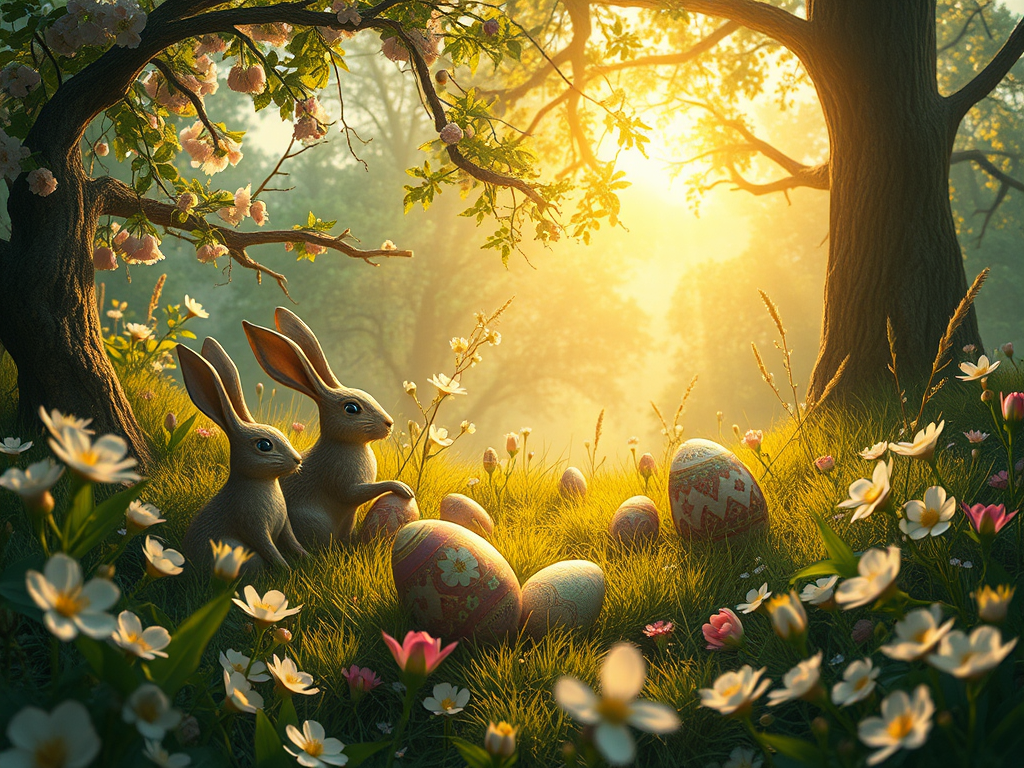
From Fields to Festivals
Today, Easter might make you think of jellybeans, chocolate bunnies, and plastic eggs tucked into neon grass. It’s marketed as a bright, happy celebration of spring — and for many, a religious holiday. But peel back the layers, and you’ll find something far older, stranger, and more powerful than candy and Sunday brunch.
The real roots of Easter lie in ancient Pagan traditions — in the raw need for survival, the sacredness of fertility, and the timeless miracle of the Earth waking from winter’s death.
This is not just a story of one religion absorbing another.
It’s a glimpse into a world where the heartbeat of nature shaped human life — and where spring was the promise that death was never the end.
Fertility, Life, and the Ancient Earth
Long before temples or churches, humans lived by the mercy of the seasons.
In the Neolithic era (roughly 10,000 BCE), as agriculture first took hold, communities across Europe, the Near East, and beyond built their lives around the rhythms of the soil. When the snow melted and green returned, it wasn’t just “good weather” — it was survival itself.
In these early societies, fertility wasn’t an abstract concept. It was literal:
- Fertile soil meant food.
- Fertile animals meant herds grew.
- Fertile women meant communities didn’t vanish.
The Evidence:
- Archaeological digs across Europe and Anatolia have unearthed thousands of fertility figurines — famously the Venus of Willendorf (c. 28,000–25,000 BCE) and similar statues found in Malta, Siberia, and Çatalhöyük (Turkey). These figures exaggerated hips, breasts, and bellies — emphasizing the vital importance of life, pregnancy, and abundance.
- At Çatalhöyük, wall paintings show wild scenes of animal fertility and seasonal cycles, suggesting early humans marked and celebrated these transitions ritually.
(Sources for research: Look into Çatalhöyük excavations, Venus figurines, and Neolithic fertility cults.)
Symbols Older Than Memory: Eggs and Hares
Across cultures, certain symbols naturally took center stage in spring rites:
- Eggs — perfect metaphors for life’s hidden potential.
- Hares and rabbits — prolific breeders, bursting with life energy.
The egg as a sacred object predates Christianity by millennia.
- Ancient Persians (at least 2,500 years ago) dyed eggs red for Nowruz, the New Year celebration tied to the spring equinox.
- Slavic pagans decorated eggs with intricate designs in springtime rituals honoring the Earth goddess.
Meanwhile, hares were sacred to many deities:
- In ancient Celtic Britain, hares were considered magical, linked to the Otherworld.
- Among Germanic tribes, hares were believed to carry messages between the mortal and divine realms — tied directly to springtime renewal.
(Sources for research: Nowruz traditions, Slavic pysanky eggs, Celtic hare symbolism.)
The Goddess of the Dawn: Eostre and Her Ancient Kin
One of the most cited — but poorly documented — figures in this history is Eostre (also spelled Ostara).
The Venerable Bede, an Anglo-Saxon monk writing in 8th-century England, mentions that April was called Eosturmonath, named after a goddess honored with spring festivals. However, Bede’s mention is brief, and skeptics sometimes question how widespread Eostre’s worship was.
But when we step back and look linguistically, a wider picture emerges:
- Across Indo-European cultures, a dawn goddess appears again and again: Hausos (reconstructed Proto-Indo-European goddess of dawn), Eos (Greek goddess of dawn), Aurora (Roman goddess of dawn).
- All these goddesses are associated with renewal, light, life, and the awakening of the world — core themes of spring.
The name Eostre or Ostara likely reflects these older beliefs:
- “Eos” meaning “dawn” in Greek.
- “Austron” in Proto-Germanic meaning “to shine” or “east” — where the sun rises.
(Sources for research: Indo-European Dawn Goddess theories, Bede’s De Temporum Ratione, Comparative Mythology studies.)
The Sacred Calendar: Spring Equinox Celebrations
Tracking the seasons wasn’t a casual hobby — it was life or death.
Ancient people built incredible monuments aligned with the sun and stars:
- Stonehenge in Britain aligns with the solstices and possibly equinoxes.
- Newgrange in Ireland, even older than Stonehenge (c. 3200 BCE), is aligned so that at the winter solstice, sunlight floods its central chamber — symbolizing rebirth.
The spring equinox — when day and night are balanced — became a natural focus for festivals:
- Planting could begin.
- Animals birthed young.
- Human communities prayed and celebrated to ensure abundance.
Fire festivals like Beltaine (later May Day) also have roots here — kindling bonfires to awaken the land, purify the fields, and bless the livestock.
(Sources for research: Stonehenge alignments, Newgrange, Celtic Fire Festivals.)
Ritual Practices: Sowing, Blessing, and Celebrating
Pagan spring rites across Europe share common themes:
- Blessing seeds before planting — a form of sympathetic magic.
- Decorating eggs — symbolizing Earth’s fertile womb.
- Dancing and singing — often around a central pole (Maypole dancing) representing life force and connection between Heaven and Earth.
- Lighting fires — to drive out the deathly chill of winter and call in the warmth of summer.
Every element of these celebrations — the egg, the rabbit, the fire, the dance — spoke directly to survival, joy, and awe.
(Sources for research: May Day traditions, Slavic Spring Rituals, Germanic Ostara festivals.)
How Christianity Layered Over the Old Ways
When Christianity spread across Europe, it didn’t so much erase Pagan traditions as reframe them:
- The timing of Easter — the first Sunday after the first full moon following the spring equinox — is still anchored to ancient lunar and solar cycles.
- Symbols like eggs and rabbits slipped quietly into Christian celebrations, even though they had no theological tie to resurrection.
- Spring festivals were given Christian interpretations, but their bones — fertility, renewal, the return of life — remained distinctly Pagan.
Today, when you dye eggs or watch a rabbit hop across a cartoon meadow, you’re participating in a 10,000-year-old human tradition, whether you know it or not.
Final Thoughts: Honoring the Deep Story
Modern Easter — commercial, religious, secular — is a mosaic built on far older stones.
It’s the story of desperate prayers in the dead of winter.
It’s the story of fires on hilltops and fields tilled by calloused hands.
It’s the story of a million hopes, stitched across millennia, that life would return — again and again.
The Earth wakes. The seeds sprout.
And somewhere deep in your bones, the ancient celebration still stirs.
Sources and Further Research Suggestions:
- Archaeology:
- Çatalhöyük Excavations (James Mellaart, Ian Hodder)
- The Ancient Monuments of Stonehenge and Newgrange
- Mythology:
- Comparative Mythology by Jaan Puhvel
- Indo-European Dawn Goddess Reconstruction (Linguistic Studies)
- Folk Traditions:
- The Stations of the Sun by Ronald Hutton (for British seasonal rites)
- Pagan Easter: Eggs, Rabbits, and Fertility Lore (Folklore studies)
- Cultural Studies:
- The Golden Bough by James Frazer (classic on ancient rituals and seasonal myths — some theories outdated but still influential)
Leave a Reply