
Introduction: The Eternal Glow of Selene
The night sky has fascinated humanity for millennia. Long before scientific explanations of the Moon’s movements, ancient cultures personified it, seeing in its luminous glow a divine force that guided and influenced life. In Greek mythology, this force was known as Selene (Σελήνη), the Titaness of the Moon.
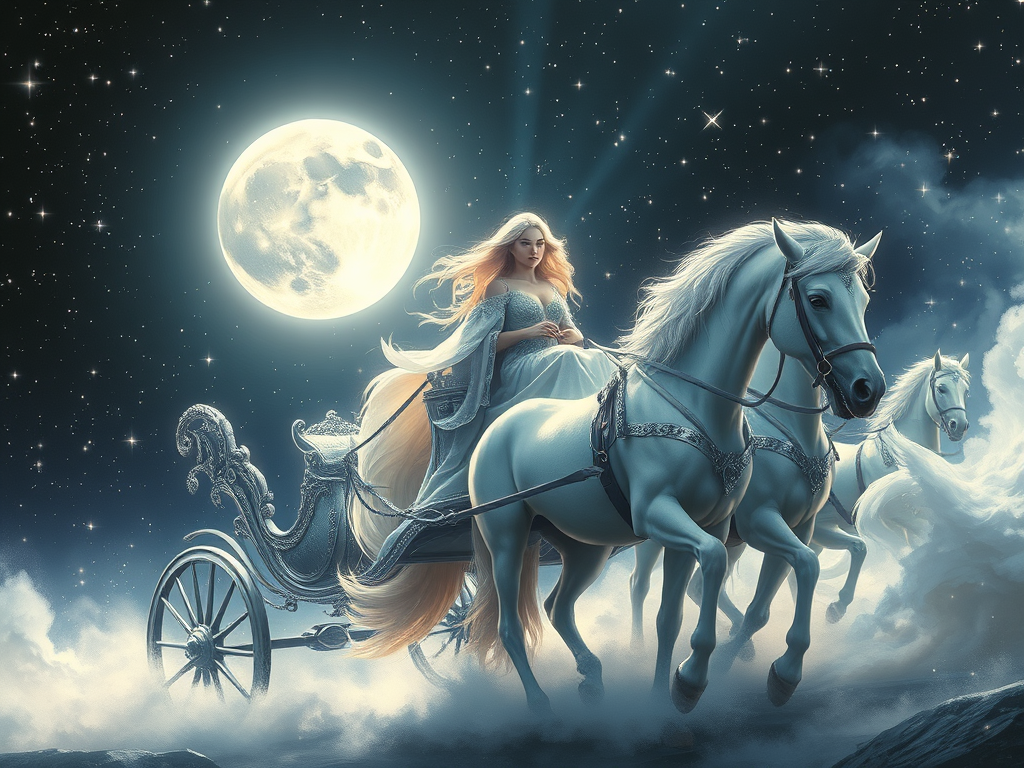
While many today recognize Artemis as the Greek goddess of the Moon, Selene was its original divine personification—before lunar attributes were later absorbed into Artemis and Hecate. A powerful and enigmatic figure, Selene was believed to drive her silver chariot drawn by two white horses across the night sky, illuminating the world with her soft, radiant glow.
Although no ancient Greek festival for Selene has survived in recorded history, February 7 has emerged as a modern day dedicated to her, celebrated by Hellenic pagans, lunar mystics, and moon worshipers. This blog post will explore Selene’s mythology, her worship, her connections to magic and femininity, and how to celebrate her festival today.
The Mythology of Selene: Queen of the Night Sky
Selene’s Divine Family
Selene was born from two powerful primordial deities:
- Hyperion, the Titan of light
- Theia, the Titaness of sight and all things that shine
Her siblings were equally celestial:
- Helios, the personification of the Sun
- Eos, the goddess of the Dawn
Just as Helios rode his golden chariot across the sky each day, Selene took over at night, traversing the heavens in her silver chariot pulled by either two white horses, bulls, or winged steeds.
Selene’s Love for Endymion: A Dreamlike Romance
One of Selene’s most famous myths involves her love affair with Endymion, a mortal shepherd or king known for his extraordinary beauty. In some versions of the myth:
- Selene fell deeply in love with Endymion and could not bear to be apart from him.
- She asked Zeus to grant him eternal youth and sleep, allowing her to visit him night after night.
- Endymion was placed in an eternal slumber in a cave (often said to be on Mount Latmos in modern-day Turkey).
- Selene bore fifty daughters with Endymion, representing the fifty lunar months of an Olympic cycle.
This myth ties Selene to themes of eternity, dreams, love, and the cyclical nature of time, much like the waxing and waning of the Moon.
Selene’s Other Lovers
While Endymion remains her most famous love, some myths suggest that Selene had other lovers, including:
- Zeus, with whom she bore Pandia, a goddess of brightness.
- Pan, who is said to have seduced her by disguising himself in a white fleece, connecting Selene to the wild, primal aspects of the Moon.
These myths highlight Selene’s duality—both a celestial, dreamy figure and a goddess connected to nature’s untamed forces.
Selene in Ancient Worship
Temples and Cults
Unlike other Olympian gods, Selene did not have major temples dedicated solely to her. However, she was worshiped alongside other lunar deities such as:
- Hecate, the goddess of magic and the dark moon.
- Artemis, who later absorbed some of Selene’s lunar attributes.
Selene’s influence can be found in the Orphic Hymns, which describe her as:
“Bull-horned and wandering through the gloom of night,
With stars surrounded, and with circuit wide,
Night’s torch extending, through the heavens you ride.”
Symbols and Sacred Animals
Selene was often depicted with:
- A crescent moon on her forehead
- Flowing white robes
- A torch or a lunar disk
- A team of celestial horses or oxen
Her sacred animals include:
- White horses – Representing her chariot.
- Bulls – Symbolizing the connection between lunar cycles and fertility.
- Owls – Associated with night vision and wisdom.
The Day of Selene: A Modern Festival on February 7
While there is no direct evidence of an ancient Greek festival dedicated solely to Selene, modern practitioners of Hellenic polytheism, Wicca, and lunar spirituality have adopted February 7 as a day to honor her.
Why February 7?
The origins of this date are unclear, but it is believed to have been chosen based on lunar cycles and the midwinter period, when the Moon’s influence is strongest in some traditions.
How to Celebrate the Day of Selene
🌙 1. Moon Gazing and Meditation
Spend time outside at night, connecting with the Moon’s energy. Meditate on Selene’s myths, her role as a guide through darkness, and the cyclical nature of life.
🌙 2. Offerings to Selene
Traditional offerings include:
- White candles (symbolizing her glow)
- Silver objects or coins (representing the Moon)
- Milk and honey (a sacred offering in Greek rituals)
- Jasmine or white roses (flowers associated with lunar energy)
🌙 3. Nighttime Rituals and Prayers
Recite the Orphic Hymn to Selene or write your own prayer to honor her. Example:
“Selene, silver-cloaked queen of the night,
Guide me with your wisdom, bathe me in your light.
Your chariot rides through heavens so wide,
With your radiant glow, forever my guide.”
🌙 4. Divination and Dream Work
As a goddess linked to dreams and prophecy, Selene’s night is perfect for:
- Tarot readings focused on intuition.
- Scrying with a bowl of water or a mirror.
- Keeping a dream journal to track messages from the subconscious.
🌙 5. Lunar Magic and Spellwork
Selene’s night is ideal for spells related to:
- Feminine empowerment
- Emotional healing
- Psychic abilities
- Manifesting dreams and goals
Try a simple moon-charging ritual:
- Place a silver object or crystal (like moonstone or selenite) under the moonlight.
- Hold it and visualize Selene’s light filling you with wisdom and power.
Selene’s Legacy: The Enduring Power of the Moon Goddess
Selene’s myths and imagery have endured for centuries, influencing art, literature, and modern spirituality. Though ancient Greeks may not have widely celebrated her in large temples, her presence remains deeply woven into the fabric of lunar mysticism.
Whether through her love for Endymion, her guidance of the celestial chariot, or her quiet watch over dreamers and night wanderers, Selene continues to inspire those who seek the magic of the Moon.
This February 7, take a moment to step outside, look up at the Moon, and honor the goddess who has watched over humanity since time immemorial. 🌙✨
Conclusion: Will You Honor Selene?
Now that you know more about Selene and her modern festival, will you celebrate her Day of Selene? Let me know in the comments how you plan to honor the Moon Goddess! 🌕🌙✨
Leave a Reply