
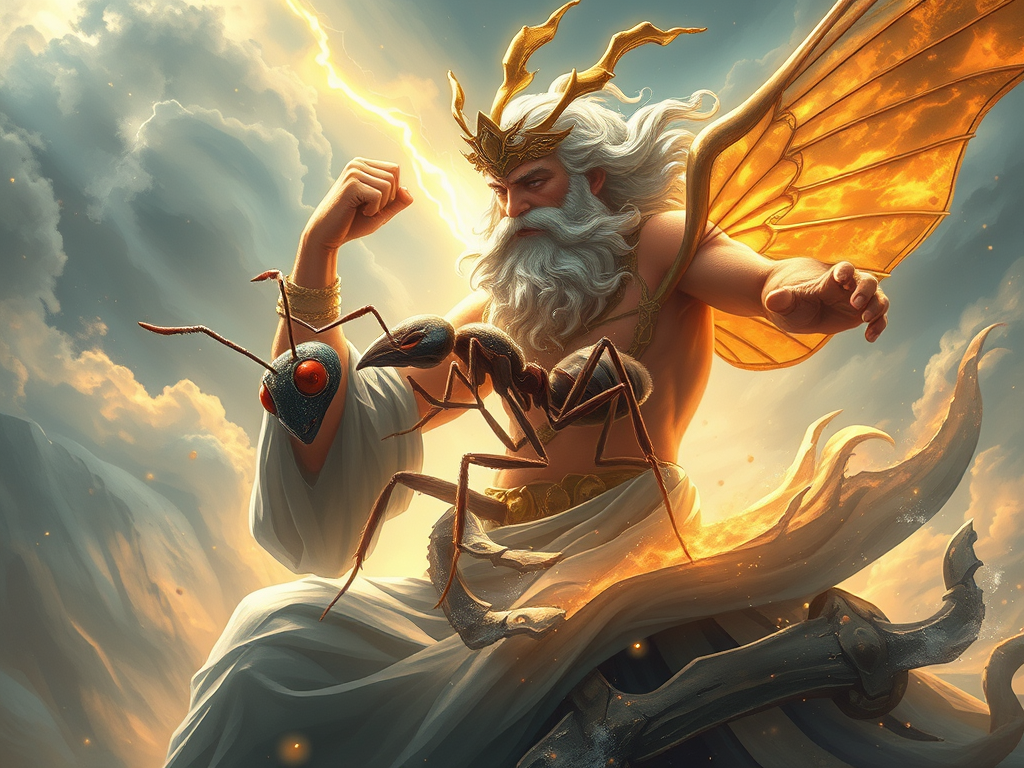
When we think of Zeus, the iconic Greek god of thunder and king of Mount Olympus, most of us picture a wise (and occasionally wayward) old man tossing lightning bolts like frisbees. But the Greek mythology we all learned in school barely scratches the surface. Zeus wasn’t just about thunder, punishment, and being “Dad of the Century” to half the ancient world.
Today, we’re peeling back the layers to reveal some of the quirkiest, most underrated myths about Zeus—the kind of stories that’ll make you go, “Wait, what?” Grab your ambrosia and buckle in; this is about to get legendary.
Zeus: More Than Thunder and Lightning
Sure, Zeus ruled the heavens and dished out justice (with an occasional side of vengeance), but he was also a god of surprises. Beneath that flowing beard was a Greek god full of tricks, transformations, and a lot of “Wait, is he serious right now?” moments.
1. Zeus: The Ant-Man
Before Marvel made shrinking cool, Zeus was out here turning into an ant to seduce a mortal woman. Yes, you read that right—an ant. Eurymedusa, the lucky lady in question, probably didn’t see that one coming. This unusual tactic led to the birth of Myrmidon, the ancestor of the famed Myrmidons, who were Achilles’ loyal warriors.
While we’re unsure how this worked logistically (don’t think too hard about it), it proves Zeus didn’t let size stop him from making his moves.
2. Hospitality Police? That’s Zeus
Ever heard of xenia? That’s the ancient Greek concept of hospitality, and Zeus was its top enforcer. Violating the sacred guest-host relationship was a fast track to Zeus’ bad side.
One infamous offender? King Tantalus, who thought it’d be fun to serve his son as a meal to the gods. Zeus wasn’t impressed and sent Tantalus to eternal torment (yes, that Tantalus, who inspired the word “tantalize”). The moral? Always offer your guests some proper snacks.
3. Nine Nights, Nine Muses
Think your work week is exhausting? Zeus spent nine consecutive nights with Mnemosyne, the goddess of memory, to conceive the nine Muses. These goddesses went on to inspire every art form, from epic poetry to music.
This marathon effort is the Olympian version of “work hard, play harder,” proving Zeus was committed to fostering creativity. (Or maybe he just needed an excuse for some “me” time afterward.)
4. Zeus vs. the Copycats
Zeus didn’t take kindly to people imitating him. Salmoneus, a mortal king, thought it’d be clever to recreate Zeus’ thunder and lightning with a chariot and some noisy contraptions. Spoiler: Zeus wasn’t amused. He struck Salmoneus down with a real lightning bolt, essentially yelling, “Know your place, mortal!”
5. The Foreign Zeus: A God of Many Cultures
While Zeus is the quintessential Greek god, he was no stranger to blending in with other cultures.
- In Egypt, he became Zeus-Ammon, complete with ram’s horns (because why not?).
- In the Roman Empire, Zeus evolved into Zeus Dolichenus, a storm god with a dash of eastern mysticism.
It’s like Zeus was the original world traveler, adapting to local customs wherever he went.
6. Prophecy Problems
For someone so powerful, Zeus was constantly worried about getting dethroned (can you blame him after what he did to his dad?). Prophecies were his kryptonite.
- He swallowed Metis, the goddess of wisdom, because a prophecy warned their child might overthrow him.
- To avoid another disaster, he skipped marrying Thetis, leading to her infamous son Achilles.
Zeus may have been the king of the gods, but even he couldn’t outrun fate (or his trust issues).
7. Zeus, the Mediator
While Zeus loved a good thunderbolt toss, he also had a surprising soft side as a peacemaker.
- He resolved sibling squabbles among the gods, like the time Apollo and Hermes fought over a herd of cattle.
- In the Iliad, he tried to maintain cosmic balance during the Trojan War, even if it meant frustrating both mortals and gods.
Turns out Zeus was basically Olympus’ HR department.
8. The God Who Gave Birth (Kind of)
Here’s a fun fact: Zeus once “gave birth” to Athena. After swallowing her mother, Metis, (classic Zeus), he developed a splitting headache. The solution? Hephaestus cracked open Zeus’ skull, and out sprang Athena, fully grown and armed for battle.
Who needs a delivery room when you’ve got a god-sized cranium?
9. The Gigantomachy: Zeus vs. the Giants
While the Titanomachy (Zeus vs. Titans) gets all the glory, Zeus also fought a war against the Giants in the Gigantomachy. The twist? The gods needed a mortal’s help to win, so Zeus enlisted Heracles.
This was Zeus’ way of saying, “Even the king of the gods knows when to outsource.”
10. Zeus’ Lesser-Known Kids
Britomartis: The Mountain-Loving Huntress
- Her Epithet: Britomartis was sometimes called “Dictynna,” derived from the Greek word diktyon (net), referencing the fishermen’s nets that saved her.
- Her Divine Association: She became closely linked with Artemis, even being considered a Cretan version of the goddess of the hunt. Some myths portray her as a companion of Artemis, emphasizing her role as a protector of nature.
- Her Worship: Britomartis was particularly venerated in Crete and other regions of the Aegean, where she was seen as a goddess of hunting, fishing, and safe harbors for sailors.
Archegetes: Protector of Cities
- Cult Worship: Archegetes was revered in Delphi, the spiritual center of ancient Greece. His connection to city founding made him an essential figure during the establishment of colonies.
- Historical Role: Leaders often invoked Archegetes to legitimize their rule or ask for divine guidance when expanding their cities.
- Symbolism: His association with the founding of cities made him a god of stability, prosperity, and communal identity, reflecting the importance of strong leadership in ancient Greek society.
Myrmidon: The Original Ant-Man
- Cultural Symbol: The Myrmidons, descended from Myrmidon, were known for their unyielding discipline and organization, likened to the industrious nature of ants.
- Name Origin: The name Myrmidon is derived from the Greek word myrmex, meaning ant, tying the myth directly to Zeus’ unusual transformation.
- Legacy: Myrmidon’s descendants became key figures in Greek military lore, immortalized as the elite warriors who served under Achilles during the Trojan War. Their loyalty and unity made them a model for ancient Greek soldiers.
Why Zeus Is Still a Big Deal
Zeus wasn’t just a lightning-wielding ruler; he was a god of contradictions, surprises, and a flair for drama. His uncommon myths show a playful, cunning, and sometimes extra side that makes him one of mythology’s most fascinating figures.
Whether he’s turning into an ant, birthing a goddess, or dishing out divine justice, Zeus proves that being a Greek god is anything but boring.
Ready to Dive Into More Myths?
If you enjoyed uncovering these quirky Zeus myths, why not explore the rest of the Greek pantheon? There’s no shortage of drama, humor, and larger-than-life stories. Leave a comment with your favorite myth or question about Greek mythology, and let’s geek out together!
Leave a Reply