
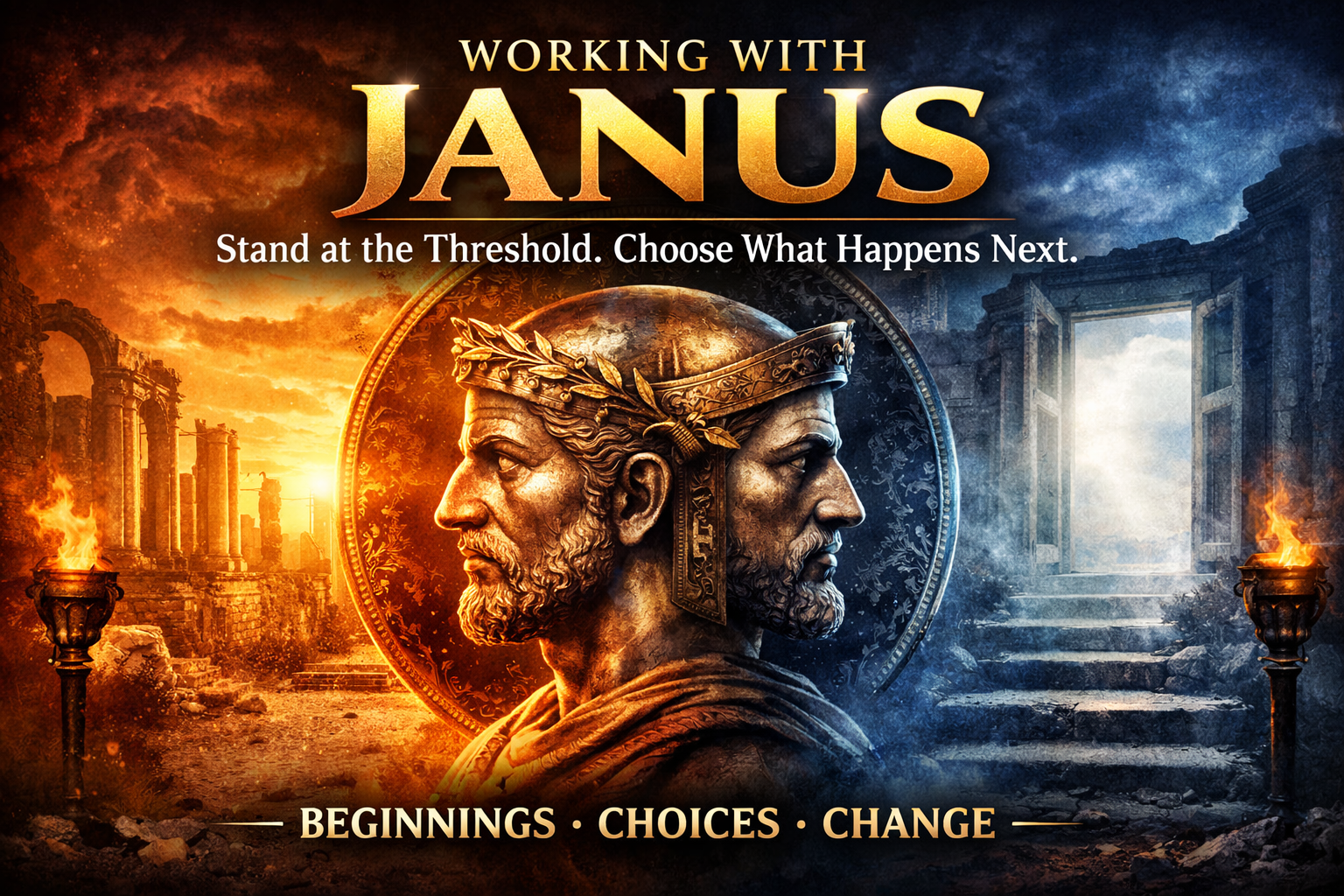
About Course
You are already standing at a doorway.
This course shows you how to recognize it—and decide what to do next.
Working With Janus is a powerful, grounded course on beginnings, endings, and intentional change. It’s not about comfort, signs, or reassurance. It’s about clarity, choice, and moving forward without spiritual confusion or hesitation.
If you’re stuck between what was and what’s next, this course is for you.
What Will You Learn?
- By the end of this course, you will be able to:
- Recognize ethical vs. unhealthy spiritual engagement
- Understand consent and power dynamics in divine relationships
- Act without constant signs or reassurance
- Identify and correct spiritual dependency patterns
- Adapt or end practice without guilt or fear
- Navigate multiple gods with clarity and structure
- Hold responsibility without externalizing authority
Course Content
Welcome Letter
Welcome.
This course focuses on Janus, not as a symbol of vague new beginnings, but as a god who governs thresholds—the moments where one state ends and another begins. Janus does not offer comfort, motivation, or reassurance. He offers clarity.
In Roman practice, Janus was honored at the start of nearly everything that mattered: contracts, journeys, civic acts, and daily transitions. Beginnings were treated as serious moments, because how something begins determines what it can become. Janus stood at those moments to mark them as intentional.
This course is not about asking Janus to change your life. It is about recognizing when you are already standing at a threshold and choosing how you will step forward—or whether you will step at all.
You are not here to be guided. You are here to become responsible
Course Introduction
Working With Janus is part of the Working With Gods course series and follows a grounded, ethical approach to divine relationships. It assumes no automatic calling, no entitlement to contact, and no promise of outcome.
Janus is a god of beginnings, but not in the way that phrase is commonly used. He does not create opportunity. He does not remove obstacles. He does not soften consequences. His role is to mark the point of transition, where intention becomes action and choice becomes commitment.
Throughout this course, you will examine what it means to begin something deliberately. You will explore historical context, ethical boundaries, discernment, and the responsibility that comes with crossing thresholds. Practical engagement is discussed carefully, without encouraging dependency or fantasy.
This course does not require devotion. It requires honesty.
If you are looking for reassurance, this is not the right place.
If you are willing to stand at a doorway and decide whether to walk through it, you are exactly where you need to be.
TABLE OF CONTENTS
Working With Janus
God of Beginnings, Thresholds, and Intentional Change
Student Workbook Introduction
How to Use This Workbook
Topic 1 — What Do We Mean by “Gods”?
Topic 2 — Historical Human–God Relationships
Topic 3 — Calling, Silence, and Discernment
Topic 4 — Boundaries, Power, and Ethics
Topic 5 — Beginning a Relationship
Topic 6 — Maintaining or Ending Relationships
Topic 7 — Working With Multiple Gods (Optional)
Final Integration — Standing at the Threshold
Wrap-Up Lesson — Standing at the Threshold
Thank You Letter
Glossary
Appendix
Student Workbook Download
-
Student Handbook
Topic 1: What Do We Mean by “Gods”?
Before engaging any god, it is necessary to clarify definitions. This topic establishes how the course understands gods, how they differ from spirits, archetypes, or symbols, and why those distinctions matter in practice.
Rather than focusing on belief, this topic focuses on function, responsibility, and context. It provides a foundation for ethical engagement by locating authority correctly and separating meaning from projection.
This topic is not about convincing you what to believe. It is about ensuring you know what assumptions you are working from before you step forward.
-
WWJ Lesson 1.1 — What a God Is (and Is Not)
-
WWJ Lesson 1.2 — Gods vs Spirits vs Archetypes
-
WWJ Lesson 1.3 — Cultural Context and Divine Identity
-
WWJ Lesson 1.4 — Myth as Function, Not Literalism
Topic 2: Historical Human–God Relationships
This topic examines how people historically related to gods, with particular attention to scope, duration, and responsibility. It challenges modern assumptions about intimacy, permanence, and emotional validation.
Understanding historical relationship models helps prevent dependency and misplaced expectation. It also clarifies why silence, distance, and completion were normal aspects of divine engagement rather than signs of failure.
This topic provides context, not instruction, and is meant to recalibrate expectations rather than prescribe behavior.
-
WWJ Lesson 2.1 — Ancient Relationship Models
-
WWJ Lesson 2.2 — Reciprocity and Obligation
-
WWJ Lesson 2.3 — Temples, Shrines, and Practice
-
WWJ Lesson 2.4 — When Gods Were Not Personal
Topic 3: Calling, Silence, and Discernment
This topic addresses how people recognize relevance, interpret signs, and make decisions without outsourcing responsibility. It distinguishes emotional attraction from situational necessity and explores why silence is often part of ethical practice.
Rather than teaching how to seek confirmation, this topic teaches how to decide without it. Discernment is framed as a process, not a feeling.
This topic is especially important for navigating uncertainty without projecting meaning where none is required.
-
WWJ Lesson 3.1 — What “Calling” Looked Like Historically
-
WWJ Lesson 3.2 — Signs vs Projection
-
WWJ Lesson 3.3 — Discernment Tools
-
WWJ Lesson 3.4 — When Silence Is the Answer
Topic 4: Boundaries, Power, and Ethics — Topic Introduction
All divine relationships involve power dynamics. This topic focuses on recognizing those dynamics clearly and maintaining ethical boundaries that protect agency rather than erode it.
Topics include consent, dependency, authority, and knowing when to step back. The emphasis is on responsibility over obedience and clarity over fear.
This topic is central to preventing unhealthy spiritual patterns and ensuring engagement remains grounded.
-
WWJ Lesson 4.1 — Power Dynamics
-
WWJ Lesson 4.2 — Consent and Choice
-
WWJ Lesson 4.3 — Spiritual Dependency
-
WWJ Lesson 4.4 — When to Step Back
Topic 5: Beginning a Relationship
This topic addresses what it actually means to begin working with a god. It emphasizes preparation, restraint, and clarity over impulse or performance.
Rather than offering ritual formulas, this topic focuses on timing, intention, and follow-through. It challenges the idea that beginnings must be dramatic or permanent.
This topic is about starting deliberately—or choosing not to start at all.
-
WWJ Lesson 5.1 — Research Before Reverence
-
WWJ Lesson 5.2 — First Contact and Offerings
-
WWJ Lesson 5.3 — Space and Altars
-
WWJ Lesson 5.4 — Prayer vs Conversation
Topic 6: Maintaining or Ending Relationships
Not all relationships are meant to continue indefinitely. This topic explores sustainability, adaptation, and ethical closure without guilt or dramatization.
Ending is treated as completion, not failure. Change is treated as information, not betrayal.
This topic reinforces that responsibility continues even after divine relevance ends.
-
WWJ Lesson 6.1 — Sustainability
-
WWJ Lesson 6.2 — Evolution Over Time
-
WWJ Lesson 6.3 — When Practice Changes
Topic 7: Working With Multiple Gods
This topic addresses considerations relevant to polytheistic or multi-deity practice.
If you work exclusively with Janus, or if your engagement with Janus is situational rather than ongoing, you may consider the course complete after Topic 6. Topic 7 is optional and intended for those navigating relationships with more than one god or transitioning between divine roles.
Its purpose is to support clarity where multiple engagements already exist, not to encourage accumulation.
-
WWJ Lesson 7.1 — Pantheons vs Personal Practice
-
WWJ Lesson 7.2 — Conflicting Expectations
-
WWJ Lesson 7.3 — Syncretism vs Appropriation
-
WWJ Lesson 7.3 — Syncretism vs Appropriation
-
WWJ Lesson 7.4 — When Gods Do Not Mix
Wrap-Up Lesson — Standing at the Threshold
This course has not been about building devotion, seeking reassurance, or forming permanent spiritual identity. It has been about learning how to recognize thresholds and engage them consciously, ethically, and without dependency.
Throughout these lessons, you have examined what it means to work with gods as functional powers rather than emotional supports. You have explored history, boundaries, discernment, and responsibility. Most importantly, you have been asked—repeatedly—to locate authority where it belongs: with yourself.
Janus governs beginnings, but not outcomes. He marks the moment where one state ends and another begins. Everything that follows belongs to the person who steps forward. This is why clarity matters more than comfort, and responsibility matters more than reassurance.
If there is one idea to carry forward from this course, it is this:
Beginnings do not require certainty. They require consent.
You do not need permission to change. You do not need validation to act. You do not need constant confirmation once a threshold has been crossed. Ethical practice recognizes when divine relevance ends and human responsibility begins.
This course does not ask you to continue working with Janus. It does not ask you to stop. It asks you to decide—deliberately, honestly, and without fear. Some relationships exist only to bring you to a doorway. Once crossed, they do not need to follow you.
Endings are not failures. Silence is not abandonment. Stepping forward alone is not disrespect.
A threshold has been marked.
What you do next is yours.
Workbook Pause — Wrap-Up
Pause here and open your Student Workbook to the Final Integration section.
You will be asked to:
name the threshold you are standing at,
identify what you are leaving behind,
clarify what you are choosing to carry forward,
and acknowledge the responsibility you accept.
Do not rush this final reflection.
Beginnings deserve to be entered with awareness.
Thank You
Thank you for completing Working With Janus.
This course asked you to slow down, think carefully, and take responsibility for your choices. It did not offer certainty, guarantees, or easy answers. If you are leaving this course with more clarity than comfort, then it has done what it was meant to do.
Work with gods—especially gods of thresholds—is not about permanence. It is about timing, relevance, and knowing when responsibility shifts fully into your hands. Whether you continue working with Janus, step back, or move forward in a different direction entirely, what matters is that the choice is conscious.
This course does not require ongoing engagement. It does not assume future devotion. It recognizes that some relationships exist only to bring you to a doorway—and then end.
If you are willing, feedback is welcome. Not to validate the course, but to refine it.
Optional Reflection Questions
(You may answer as much or as little as you wish.)
Which parts of the course were most useful to you?
Which parts felt unclear, unnecessary, or challenging?
Did the pacing support thoughtful engagement?
Did the workbook exercises feel appropriate and grounded?
Is there anything you feel was missing or overemphasized?
Your responses help ensure this material remains ethical, grounded, and useful to others.
Thank you for taking this work seriously.
What you choose next is yours alone.
Glossary
Beginning
The point at which a decision becomes action. A beginning is not a feeling or intention; it is a
moment where responsibility is accepted and something irreversible is set in motion.
Boundary
A limit that defines where responsibility, authority, or relevance begins and ends. Boundaries
protect clarity and prevent dependency.
Calling
In historical context, a situation where a god’s domain becomes relevant due to
circumstance—not emotional attraction, identity, or a sense of being chosen.
Closure
The deliberate acknowledgment that a relationship, practice, or phase has completed its
function. Closure is an act of integrity, not rejection.
Consent
The conscious choice to engage or not engage. Consent applies to spiritual relationships as
much as human ones and includes the right to refuse or step back.
Discernment
The process of evaluating relevance, timing, and consequence before acting. Discernment
involves patience, realism, and responsibility rather than intuition alone.
Domain
The specific area of life, action, or condition over which a god has relevance. Gods are defined
by domain, not personality or preference.
Function
What a god does, not what a god symbolizes. Function refers to the practical role a god plays
within human action and decision-making.
Integrity
Acting in a way that aligns with reality, responsibility, and ethical boundaries. Integrity includes
beginning deliberately and ending respectfully.
Janus
A Roman god associated with thresholds, beginnings, endings, and transitions. Janus governs
the moment where one state ends and another begins, marking change without directing
outcome. Janus
Offering
An act that demonstrates seriousness and follow-through rather than a gift meant to persuade.
An offering represents commitment made visible.
Power
The capacity to influence or define outcomes. In ethical spiritual practice, power is
acknowledged without surrendering personal agency.
Projection
The act of attributing internal desires, fears, or expectations to a god or sign. Projection
obscures discernment and shifts responsibility outward.
Reciprocity
The acknowledgment that engagement carries obligation. Reciprocity emphasizes
follow-through and accountability rather than exchange for reward.
Relevance
The condition under which a god’s domain applies to a real situation. Relevance is situational,
not permanent.
Silence
The absence of response or continued engagement. Historically, silence often indicated
completion of a god’s role rather than rejection.
Syncretism
The blending of practices or beliefs that develops over time through sustained cultural
interaction and understanding. Ethical syncretism requires knowledge, restraint, and respect.
Threshold
A point of transition where one condition ends and another begins. Thresholds may be
physical, social, emotional, or situational, but they always involve choice.
-
Glossary Download
Appendix
Appendix
This appendix provides additional context and reference material that supports the course content. It is not required reading and does not introduce new concepts. Its purpose is to give background for students who want firmer historical footing or clearer orientation without interrupting the flow of the lessons.
Janus in Roman Context
Janus was a uniquely Roman deity. Unlike many Roman gods, he does not have a direct Greek counterpart. His role developed alongside Roman civic life and reflects Roman priorities: order, law, structure, and intentional transition.
Janus presided over:
beginnings and endings
doorways, gates, and entrances
contracts and agreements
journeys and returns
transitions of state (personal and civic)
He was commonly honored at the start of rituals, political acts, and daily activities. His presence did not imply emotional closeness. It implied legitimacy and awareness.
Why Janus Has Few Myths
Janus is not heavily mythologized compared to other gods. This is not an absence; it is a feature of his role. His function was practical rather than narrative. Where other gods taught through story, Janus taught through placement and timing.
His imagery—two faces, keys, doorways—communicated function directly. These symbols oriented behavior rather than conveying moral lessons through myth.
Thresholds in Daily Life
Historically, thresholds were not abstract concepts. They were encountered constantly:
entering or leaving the home
beginning travel
starting contracts or agreements
transitions between life stages
These moments were treated as serious because they shaped outcomes. The course’s emphasis on thresholds reflects this practical understanding rather than symbolic abstraction.
Why This Course Avoids Devotional Instruction
This course deliberately avoids prescribing ritual, prayer formulas, or devotional routines. Historically, working with gods like Janus did not require ongoing devotion. It required recognition of relevance.
Providing rigid practices would risk:
encouraging dependency
replacing discernment with routine
turning situational engagement into identity
Instead, the course focuses on responsibility, clarity, and ethical engagement.
On Modern Adaptation
Modern practice does not need to replicate ancient practice to be respectful. It does need to understand why practices existed.
Adaptation is ethical when:
function is understood
limits are respected
responsibility remains with the practitioner
Adaptation becomes distortion when:
context is ignored
gods are treated as interchangeable
engagement replaces decision-making
Using This Course as a Reference
You may return to this course during future transitions without re-engaging fully. It is designed to support awareness rather than ongoing attachment. Threshold work is episodic by nature.
Once a doorway is crossed, the material does not need to follow you.
Course Product Description
Working With Janus
God of Beginnings, Thresholds, and Intentional Change
A grounded, ethics-focused course on working with Janus as a god of thresholds rather than comfort or reassurance. This course emphasizes historical context, discernment, and personal responsibility over devotional practice or emotional validation.
Is This Course Right for You?
This course is conceptually strong and intentionally demanding. It is best suited for those willing to slow down, reflect deeply, and tolerate silence. It is not designed for beginners seeking devotional warmth, guided experiences, or experiential validation.
-
Appendix Download
Student Ratings & Reviews

No Review Yet