
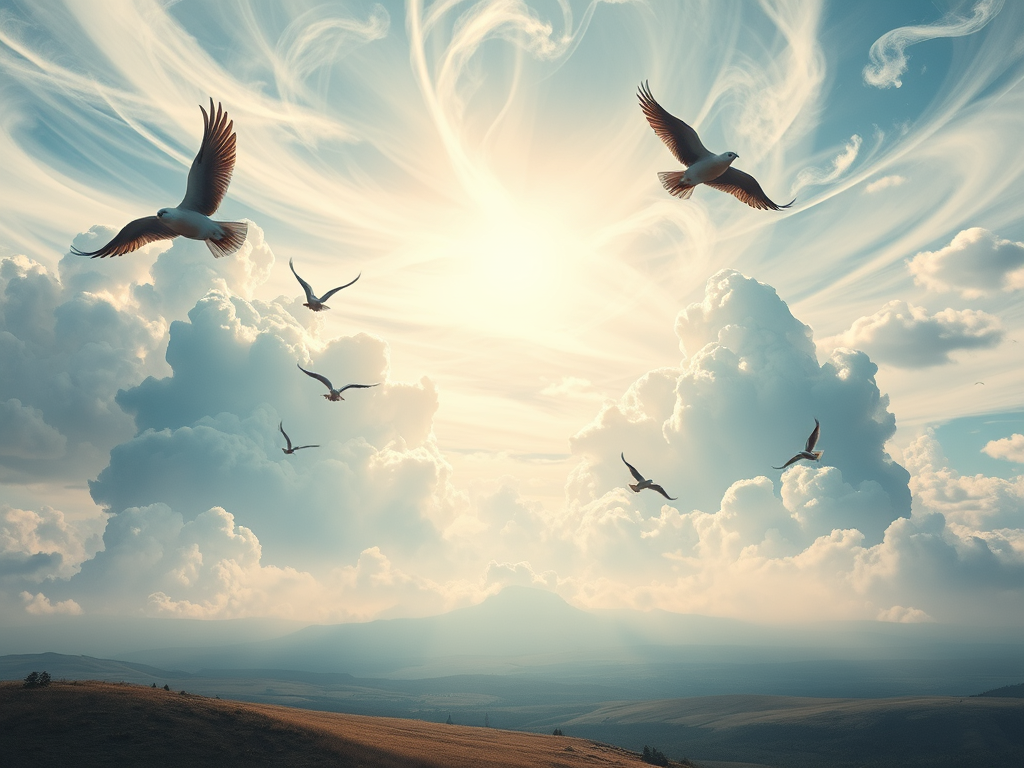
Air surrounds us constantly, invisible yet essential. Throughout human history, this elemental force has inspired rich symbolism across cultures, religions, and artistic traditions. From the breath that sustains us to the winds that shape our landscapes, air embodies some of our most profound concepts: intellect, freedom, spirituality, and the dual forces of creation and destruction.
1. Air as the Element of Thought and Intellect
Of all the classical elements, air most strongly represents the realm of the mind. Its invisible nature mirrors our thoughts—powerful yet intangible, flowing freely between consciousness and subconsciousness.
In the Western esoteric tradition, air governs intellectual pursuits, communication, and abstract thinking. The ancient Greeks associated air with rationality and the higher mind, considering it more refined than the earthly elements.
The tarot reflects this connection through the suit of Swords, which corresponds to the element of air. Sword cards typically deal with mental challenges, decisions, conflict, and clarity of thought. The imagery often shows winds, clouds, or birds in flight, reinforcing the airy qualities these cards represent.
Astrologically, the three air signs—Gemini, Libra, and Aquarius—embody the intellectual and social dimensions of human experience:
- Gemini exemplifies curiosity, communication, and the gathering of information
- Libra represents balance, harmony in relationships, and aesthetic appreciation
- Aquarius channels innovation, progressive thinking, and humanitarian ideals
People with prominent air signs in their birth charts often display quick-wittedness, strong communication skills, and a natural inclination toward analytical thinking—all qualities of the air element.
Contemporary psychologist Mihaly Csikszentmihalyi draws on air symbolism when describing the mental state of “flow”: “Like air moving seamlessly around obstacles, the mind in flow finds its natural path of least resistance, achieving both focus and freedom simultaneously.”
2. Air as a Symbol of Freedom and Change
Perhaps no element better symbolizes freedom than air. The open sky represents limitless possibilities, while birds in flight embody the liberation from earthly constraints.
The wind’s ever-changing nature makes air a perfect metaphor for transformation. Unlike earth’s stability or water’s flowing predictability, air can shift direction in an instant—calm one moment, turbulent the next. This capricious quality has made it a universal symbol for life’s inevitable changes and the importance of adaptability.
In idioms and metaphors across languages, we find this symbolism embedded in everyday speech:
- “The winds of change”
- “Free as the air”
- “Catching a second wind”
- “The air of freedom”
Historical movements toward liberty have often employed air imagery, from kites and balloons to eagles and open skies, creating powerful visual representations of the human desire for independence.
In our digital age, the concept of the “cloud” for data storage metaphorically extends air symbolism into virtual space—our information now exists in an ethereal realm, accessible everywhere yet physically nowhere. Social media platforms like Twitter (now X) with its bird logo and “tweets” deliberately invoke air imagery to suggest freedom of expression and the rapid, widespread dissemination of ideas.
As author Rebecca Solnit observes in her book “Hope in the Dark”: “Ideas are like the wind—they cannot be seen, but their effects can transform everything they touch. The Arab Spring, #MeToo, and climate activism all began as whispers that grew into hurricanes of change.”
3. Air in Spirituality and Religion
Across spiritual traditions, air frequently appears as a life-giving force. The very word “spirit” derives from the Latin “spiritus,” meaning breath—highlighting the ancient connection between air and the divine spark within us.
In Hinduism and Buddhism, the concept of prana (life force) is intimately tied to breath. Pranayama, the practice of breath control, serves as a foundational technique for meditation, connecting practitioners to their life essence through conscious breathing. The Sanskrit term “atman,” referring to the inner self or soul, also carries connotations of breath.
Biblical traditions feature air prominently in creation stories. Genesis describes God’s spirit (or breath) moving over the waters at the beginning of creation. In the New Testament, the Holy Spirit often manifests as wind, most dramatically at Pentecost, where “a sound like the blowing of a violent wind” filled the house as the Spirit descended.
Indigenous spiritual systems worldwide recognize air’s sacred qualities. Many Native American traditions honor the four directions and their associated elements, with air typically connected to the east—the direction of the rising sun, new beginnings, and enlightenment.
The modern mindfulness movement has revitalized ancient breathing practices. Apps like Calm and Headspace, with millions of users worldwide, guide people through breath-centered meditation. Breathwork facilitator Erin Telford notes, “In our hyper-connected yet disconnected world, conscious breathing offers a portal back to our essence. The breath is both our most mundane and most profound connection to life itself.”
Meanwhile, the global popularity of yoga—which literally means “union” of breath, body, and mind—demonstrates how ancient air-centered spiritual practices continue to resonate in contemporary wellness culture.
4. The Dual Nature of Air: Calm vs. Chaos
Air embodies profound dualities that reflect the complexities of human experience. A gentle breeze brings comfort, clarity, and inspiration. We speak of “clearing the air” when seeking resolution, or a “breath of fresh air” when encountering something revitalizing.
Yet air also demonstrates tremendous destructive potential. Hurricanes, tornadoes, and powerful winds can devastate landscapes and communities. This duality has made air a symbol of both divine blessing and divine judgment in many mythological systems.
In Greek mythology, the gentler Zephyrus (west wind) contrasts with the destructive Boreas (north wind). Similar distinctions appear in other cultural traditions, acknowledging air’s capacity for both nurturing and destruction.
The increasing intensity of air-related natural disasters due to climate change has heightened our awareness of this duality. Hurricane Katrina (2005), Typhoon Haiyan (2013), and Hurricane Maria (2017) demonstrated air’s devastating power, while simultaneously inspiring extraordinary human resilience and community response.
Climate activist Greta Thunberg powerfully invokes air symbolism when she speaks of “our house being on fire,” drawing attention to both the literal atmosphere we’re altering and the metaphorical urgency of our situation. “The air we breathe is no longer a given,” she reminds us, “but something we must fight to protect.”
5. Air in Literature and Art
Artists and writers have drawn inspiration from air’s rich symbolism for millennia. In literature, wind often represents fate, transience, or the unseen forces that shape human destiny.
Emily Brontë’s Wuthering Heights uses the wild, tempestuous winds of the Yorkshire moors to mirror the passionate, sometimes destructive emotional forces driving the characters. In contrast, gentle breezes in pastoral poetry often symbolize divine presence or natural harmony.
Shakespeare frequently employed air imagery, from Prospero’s command of the winds in The Tempest to the “ill wind” foreshadowing tragedy in his histories and tragedies.
Contemporary novelist Haruki Murakami continues this tradition, using wind as a recurring motif. In Kafka on the Shore, he writes: “Sometimes fate is like a small sandstorm that keeps changing directions… This storm is you. Something inside of you. So all you can do is give in to it, step right inside the storm, closing your eyes and plugging up your ears so the sand doesn’t get in, and walk through it, step by step.”
Visual artists capture air’s essence through implied movement: billowing fabrics, bending trees, soaring birds, or turbulent skies. Turner’s dramatic atmospheric paintings create emotional resonance through air’s visual effects, while Chinese and Japanese brush paintings often use negative space to evoke air’s presence between mountains or trees.
In contemporary art, Olafur Eliasson’s installations like “The Weather Project” (2003) and “Fog Assembly” (2016) make air visible and tangible, inviting viewers to experience its presence directly. Similarly, architect Neri Oxman’s “Totems” (2019) capture human breath in 3D-printed vessels, transforming this most ethereal element into permanent form.
In music, composers from Debussy (The Wind in the Plain) to Vaughan Williams (Fantasia on a Theme by Thomas Tallis) have created pieces that capture air’s ethereal qualities through sound. More recently, ambient musicians like Brian Eno and Sigur Rós create atmospheric soundscapes that evoke air’s expansive presence.
6. Air in the Age of Climate Change
Our relationship with air has grown increasingly complex in the face of global environmental challenges. The very element we once took for granted now demands our urgent attention as air quality deteriorates in many regions and atmospheric carbon transforms our climate.
Air pollution in cities like Delhi, Beijing, and Los Angeles has transformed the experience of breathing from an unconscious act to a conscious health concern. In many urban areas, air quality index (AQI) readings are now checked as regularly as weather forecasts, creating a new awareness of this invisible element.
Climate scientist Katharine Hayhoe points out the paradox: “Air is what connects us all—we share the same atmosphere across continents and cultures. Yet this shared resource is now revealing the profound inequality of our world systems, as those who contribute least to air pollution and climate change often suffer its worst effects.”
The concept of carbon footprints has introduced a new dimension to air symbolism, linking our daily choices to their atmospheric impact. Meanwhile, technologies like carbon capture attempt to literally make air tangible, extracting and storing the invisible gases that threaten our future.
Environmental philosopher Glenn Albrecht coined the term “solastalgia” to describe the emotional distress caused by environmental change—a feeling particularly connected to air quality and climate shifts. “When the very air we breathe becomes a source of anxiety rather than life,” he writes, “we experience a profound disruption in our sense of home and belonging.”
Conclusion: Breathing Consciously in Modern Life
Air’s symbolism reaches into nearly every aspect of human experience—from our thoughts and speech to our spiritual beliefs and artistic expressions. Its invisible yet palpable nature makes it the perfect carrier for concepts that exist at the boundaries of the tangible and intangible.
As we move through a world of increasing complexity and environmental urgency, perhaps air offers us its most valuable symbolic lesson: the power of presence and conscious awareness. Just as mindfulness practices return us to the breath as an anchor in the present moment, attentiveness to air in all its forms—intellectual, spiritual, physical—can ground us in what matters most.
In the words of poet Mary Oliver: “This is the first, the wildest and the wisest thing I know: that the soul exists and is built entirely out of attentiveness.” The air we breathe, moment by moment, offers a constant invitation to such attentiveness.
Your Turn: Exploring Air Symbolism in Daily Life
How does air symbolism manifest in your own experience? Consider these reflection points:
- Notice your breath throughout the day. When does it quicken, when does it deepen? What might this reveal about your emotional and mental states?
- Observe how wind and weather affect your mood and thoughts. Do you feel differently on windy days versus still ones?
- In your communications with others, where might you “clear the air” or provide “a breath of fresh air”?
- Consider an area of your life that feels stagnant. What “winds of change” might you invite in?
- How might conscious awareness of air—both literally and symbolically—enhance your connection to the world around you?
Share your reflections in the comments, or take these questions into your journal practice. By attending to the symbolism of air in our daily lives, we might discover new dimensions of meaning in this most essential, yet often overlooked, element.
Leave a Reply