
The Hellenic religion, with its rich pantheon of gods, elaborate mythology, and profound influence on Western civilization, emerged through a complex evolutionary process spanning several millennia.
Its origins stretch back to the religious traditions of the Mycenaean civilization (1600–1100 BCE) and even earlier cultures like the Minoans (2000–1450 BCE).
This comprehensive exploration traces the development of Greek religious beliefs and practices from their prehistoric roots through to the sophisticated religious system of Classical Greece.
Map showing major Minoan sites on Crete (Knossos, Phaistos, Malia) and Mycenaean centers on mainland Greece (Mycenae, Pylos, Tiryns, Athens, Thebes)
1. Pre-Greek Influences: The Minoan Foundation
Before the rise of mainland Greek civilizations, the Minoans of Crete (c. 2000–1450 BCE) had developed a sophisticated religious tradition that would later influence Greek beliefs.
Minoan Religious Elements
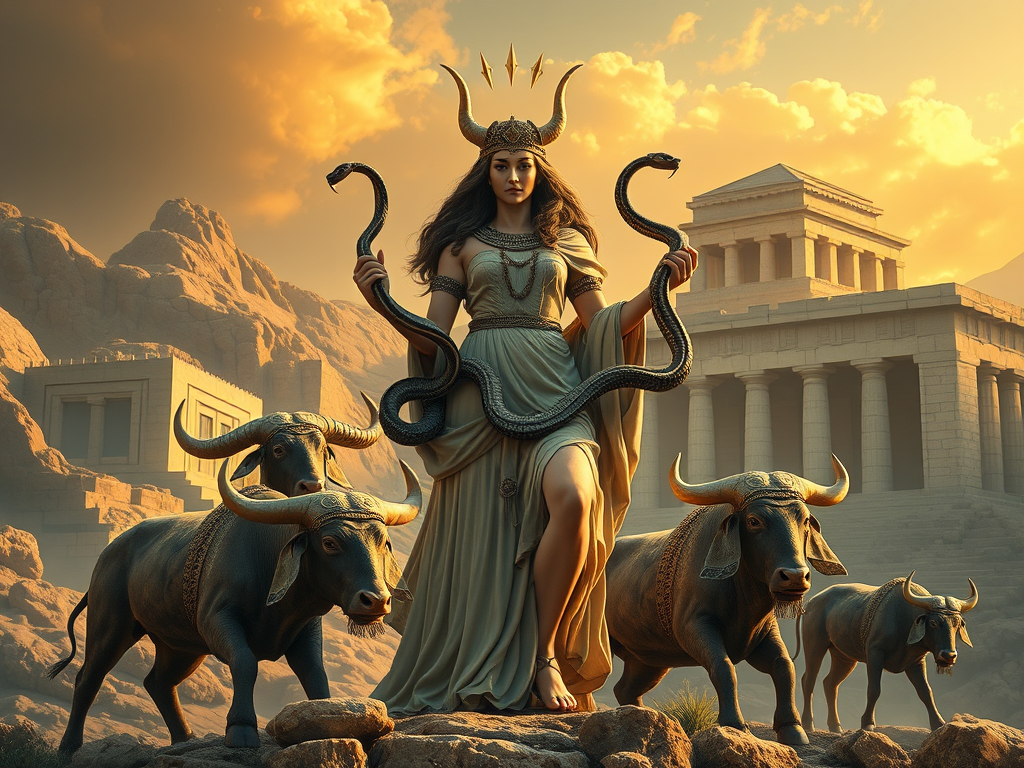
- The Great Goddess: Central to Minoan worship was a female deity often depicted holding snakes or accompanied by animals, suggesting connections to fertility, nature, and rebirth.
- Sacred Bulls: Bull imagery pervaded Minoan religious iconography, reflected in the bull-leaping frescoes at Knossos and later in myths such as the Minotaur and the Labyrinth.
- Nature Worship: Minoans venerated natural features, establishing peak sanctuaries on mountaintops and conducting rituals in sacred caves.
- Religious Architecture: The Minoans built elaborate palace complexes like Knossos with spaces dedicated to religious ceremonies, featuring altars, lustral basins, and sacred repositories.
When Mycenaean Greeks established dominance over the Minoans around 1450 BCE, they absorbed and transformed many of these religious elements, creating a syncretic tradition that formed the bedrock of later Hellenic religion.
“The Minoan influence on later Greek religion cannot be overstated; many elements thought of as typically ‘Greek’ have their roots in Cretan religious practices.” — Martin P. Nilsson, The Minoan-Mycenaean Religion and Its Survival in Greek Religion (1950)
2. Mycenaean Religion: The Proto-Hellenic Foundation
The Mycenaeans (1600–1100 BCE), speaking an early form of Greek and establishing influential centers like Mycenae, Pylos, Tiryns, and Thebes, developed religious practices that directly preceded classical Greek religion.
The Mycenaean Pantheon
The decipherment of Linear B tablets in the mid-20th century revealed the earliest recorded instances of many Greek gods, providing crucial evidence of religious continuity:

Linear B tablet from Pylos showing offerings to various deities, including early forms of Olympian gods
- Zeus (Di-we): Already recognized as a principal deity, associated with the sky and possibly kingship.
- Poseidon (Po-se-da-o-ne): Surprisingly, Linear B tablets suggest he received more offerings than Zeus in some regions. His domain extended beyond the sea to include earthquakes and possibly horses.
- Hera (E-ra): Worship of this powerful female deity was already established.
- Athena (A-ta-na): Early evidence of this goddess exists, possibly as a patron of palaces or crafts.
- Artemis (A-te-mi-to): The hunting goddess appears in early forms.
- Dionysus (Di-wo-nu-so): His presence in Mycenaean tablets challenges the once-common belief that he was a later foreign import.
- Hermes (E-ma-a): Possibly already in his role as messenger.
- Persephone (Pe-re-swa): An early chthonic deity connected to the underworld.
Mycenaean Religious Practices
- Sacrifice and Offerings: Records show detailed accounts of animals and goods offered to specific deities.
- Religious Administration: Priests and priestesses (i-je-re-u and i-je-re-ja) supervised religious activities.
- Sacred Spaces: Religious practice centered around palace complexes with specific rooms for worship, though free-standing temples were rare.
- Ancestor Veneration: Elaborate burial practices, including tholos tombs and shaft graves filled with precious goods, suggest belief in an afterlife and possible ancestor cults.

The Treasury of Atreus at Mycenae, an impressive tholos tomb demonstrating the importance of elite burial practices in Mycenaean religion
The collapse of Mycenaean civilization (c. 1100 BCE) led to the Greek Dark Ages, a period of cultural regression. However, oral traditions preserved many religious elements that would later resurface in more elaborate form.
“The Linear B tablets from Pylos and Knossos reveal that many Olympian deities were already being worshipped in the Bronze Age, indicating remarkable religious continuity despite cultural disruption.” — Thomas G. Palaima, The Triple Invention of Writing in Cyprus and Written Sources for Cypriote History (2005)
3. The Greek Dark Ages: Religion in Transition (1100–800 BCE)
During the Dark Ages, Greece experienced significant depopulation and cultural disruption, yet religious continuity persisted through oral tradition.
Religious Fragmentation and Preservation
- Localization of Cults: With the fall of centralized palace administration, religious practices became more regionalized.
- Heroic Traditions: This period likely saw the development of many heroic legends later incorporated into Greek mythology.
- Burial Practices: Shifting from Mycenaean collective tombs to individual burials suggests changing concepts of the afterlife.
- Preservation Through Storytelling: Bards and oral poets maintained religious narratives and divine genealogies.
“During the Dark Ages, the absence of writing did not mean the absence of religion; rather, it meant the decentralization and localization of religious practice.” — Anthony Snodgrass, The Dark Age of Greece (2000)
4. The Archaic Revival: Emergence of the Olympian Pantheon (800–500 BCE)
The Archaic period witnessed Greece’s cultural and religious renaissance, culminating in the formalized Olympian religion we recognize today.
Literary Codification of Greek Religion
- Homer’s Epics (c. 750 BCE): The Iliad and Odyssey portrayed the Olympian gods with distinct personalities and complex relationships, humanizing them while emphasizing their divine power. These works established a shared religious framework across the Greek world.
- Hesiod’s Works (c. 700 BCE): In the Theogony, Hesiod systematized divine genealogies, describing cosmic origins from Chaos through the Titans to the eventual triumph of the Olympians under Zeus’s leadership. His Works and Days connected religion to everyday agricultural life and moral conduct.
Mythology vs. Religion: An Important Distinction
It’s crucial to understand that Greek mythology and Greek religion, while deeply interconnected, were not identical:
- Mythology consisted of narratives about the gods—their origins, relationships, and adventures. These stories provided cultural context and explanations for natural phenomena but were not necessarily taken literally by all Greeks.
- Religion encompassed the actual practices, rituals, sacrifices, festivals, and devotions through which Greeks interacted with their gods. While informed by mythology, religion was fundamentally about action and experience rather than narrative.
- Relationship Between Myth and Practice: Myths often explained the origins of religious rituals (aetiological myths), but religious practice could vary considerably while referencing the same mythological framework.
- Interpretative Flexibility: Greeks could engage critically with myths while maintaining traditional religious practices. By the Classical period, philosophers and playwrights were reinterpreting myths even as the associated rituals continued.
“The Greeks themselves distinguished between mythos (story) and their actual religious observances. Myths provided the imaginative backdrop against which ritual action took place, but religious life consisted primarily of actions, not beliefs.” — Jean-Pierre Vernant, Myth and Society in Ancient Greece (1988)
Religious Architecture and Sacred Spaces
- Temple Development: The 8th-7th centuries BCE saw the transition from modest wooden structures to monumental stone temples.
- Pan-Hellenic Sanctuaries: Sacred sites like Delphi, Olympia, and Delos became centers of worship transcending city-state boundaries.
- City-State Patronage: Poleis (city-states) adopted patron deities, exemplified by Athens’ special relationship with Athena.

Reconstruction of an early Archaic temple showing the development of Greek religious architecture
Artistic Representations
- Anthropomorphism: Gods increasingly appeared in human form in sculpture and pottery.
- Votive Offerings: Standardized figurines and models were dedicated at sanctuaries.
- Narrative Art: Religious myths became a dominant theme in painted pottery and architectural sculpture.
“The Archaic period represents the crucial moment when Greek religion crystallized into the form we would recognize, with the pan-Hellenic epics providing a common theological language across diverse communities.” — Walter Burkert, Greek Religion (1985)
5. Classical Greek Religion: Maturity and Complexity (500–323 BCE)
By the Classical period, Greek religion had evolved into a sophisticated system with multiple dimensions of religious experience.
The Anatomy of Animal Sacrifice
Animal sacrifice stood at the center of Greek religious practice. Far from a simple offering, it was a complex ritual with specific procedures and social implications:
- Preparation:
- Animals were carefully selected based on species, gender, age, color, and physical perfection
- They were adorned with garlands and ribbons
- Participants purified themselves with water
- Procession:
- The animal was led in procession to the altar
- Music (especially aulos flutes) accompanied the procession
- A basket containing the sacrificial knife (concealed under grain) was carried
- At the Altar:
- Grain was sprinkled on the animal’s head, causing it to nod (interpreted as consent)
- Hair was cut from the animal’s forehead and thrown into the fire
- Prayers were recited specifying the deity and purpose of the sacrifice
- The Killing:
- For Olympian gods: The animal’s throat was cut while its head was pulled back toward the sky
- For chthonic deities: The animal’s head was pushed downward, with blood collected in pits
- Women’s ritual cry (ololuge) marked the moment of death
- Division of the Offering:
- Thigh bones were wrapped in fat and burned completely for the gods
- Internal organs were roasted and eaten immediately by participants
- Remaining meat was distributed according to social status
- Feast:
- The community shared the meat in a communal meal
- This reinforced social bonds and hierarchy
- For some major festivals, hundreds of animals might be sacrificed, feeding entire cities
“Sacrifice was not simply religious ritual but a complex social institution that defined community membership, reinforced political hierarchies, and constituted the primary context for meat consumption in Greek society.” — Marcel Detienne & Jean-Pierre Vernant, The Cuisine of Sacrifice Among the Greeks (1989)
Attic red-figure vase depicting a sacrifice scene, showing the procession, altar, and ritual participants
State Religion and Public Festivals
- Panathenaea: Athens’ great festival honoring Athena featured processions, athletic competitions, and the presentation of a new robe (peplos) for the goddess’s statue.
- Dionysia: This festival celebrating Dionysus gave birth to Greek theater, with tragedies and comedies performed as religious acts.
- Olympic Games: Held every four years at Olympia, these athletic competitions honored Zeus and unified the Hellenic world.
- Thesmophoria: Women’s festival dedicated to Demeter and Persephone, connected to agricultural fertility.
“Greek festivals were not merely religious ceremonies but total social events that integrated worship, entertainment, politics, and commerce.” — Simon Price, Religions of the Ancient Greeks (1999)
The Role of Oracles and Divination
- Delphic Oracle: The Pythia, Apollo’s priestess at Delphi, delivered enigmatic prophecies sought by individuals and states across the Greek world.
- Other Oracular Sites: Sanctuaries at Dodona (Zeus), Claros and Didyma (Apollo) offered alternative prophetic traditions.
- Everyday Divination: Omens, bird flights, animal entrails, and dreams provided divine guidance for common people.

The sanctuary of Apollo at Delphi, showing the temple where the Pythia delivered her prophecies
“The oracle at Delphi served as a form of international arbitration in the Greek world, providing divine sanction for major decisions of state.” — H.W. Parke, A History of the Delphic Oracle (1956)
Mystery Religions: The Eleusinian Mysteries in Detail
The Eleusinian Mysteries were among the most important religious experiences in the ancient Greek world. While their exact content remained secret, we can reconstruct some aspects:
- Preparation and Eligibility:
- Open to all free Greeks (and later Romans) who could speak Greek and had not committed murder
- Participation required purification through bathing in the sea
- Initiates abstained from certain foods and observed periods of fasting
- The Lesser Mysteries:
- Held annually in the spring at Agrae near Athens
- Served as preliminary purification and preparation
- Included ritual washing in the River Ilissos
- The Greater Mysteries (held annually in September-October):
- Day 1: Sacred objects brought from Eleusis to Athens
- Day 2: Proclamation inviting initiates to participate
- Day 3: Sacrifices and purifications
- Day 4: Asclepius honored; a day of rest
- Day 5: Solemn procession from Athens to Eleusis (14 miles)
- Day 6: Day of rest and purification
- Day 7-8: Secret ceremonies in the Telesterion (initiation hall)
- The Central Experience:
- Initiates witnessed “things shown” (deiknymena) and “things said” (legomena)
- May have included dramatic reenactment of Persephone’s abduction and return
- Possibly involved the revelation of sacred objects
- Culminated in an experience of divine light and religious ecstasy
- According to Aristotle, initiates did not learn something but experienced something that changed their emotional state
- Lasting Impact:
- Initiates believed they would enjoy better fate after death
- The experience fostered a sense of community across social boundaries
- The Mysteries continued for almost 2,000 years, ending only with Christianization
“What gave the Eleusinian Mysteries their profound impact was not doctrinal revelation but a carefully orchestrated emotional and psychological experience that transformed participants’ relationship to mortality.” — Kevin Clinton, Myth and Cult: The Iconography of the Eleusinian Mysteries (1992)
Other Mystery Religions
- Dionysian Mysteries: Ecstatic rituals involving wine, music, and dance offered temporary liberation from social constraints.
- Orphic Tradition: This esoteric movement emphasized purification, reincarnation, and salvation through special knowledge.
Hero Cults: Between Human and Divine
- Nature of Heroes: Greek religion recognized an intermediate category between gods and humans—heroes who had once lived but achieved extraordinary status after death.
- Cult Practices: Hero shrines (heroa) received offerings and sacrifices distinct from those given to Olympian deities.
- Famous Cults: Heracles, Theseus, Achilles, and numerous local heroes received worship across the Greek world.
- Political Dimension: City-states often claimed special connections to heroes to enhance their prestige and legitimacy.
“Hero cults bridged the gap between human and divine spheres, providing communities with ancestral figures who could intercede with higher powers.” — Gregory Nagy, The Ancient Greek Hero in 24 Hours (2013)
Household Religion: Everyday Piety
- Domestic Shrines: Greek homes featured altars for family worship and offerings.
- Hestia and Household Gods: The hearth goddess Hestia received daily prayers, while household protectors included Zeus Herkeios and Apollo Agyieus.
- Life Transitions: Birth, coming of age, marriage, and death were marked by religious rituals.
- Daily Practices: Libations, prayers, and small offerings were integrated into routine activities.
Reconstruction of a typical Greek household shrine with offerings and figurines
“The heart of Greek religion was not in temples or festivals but in daily household worship, where religious practice was woven into the fabric of everyday life.” — Christopher A. Faraone, Ancient Greek Love Magic (1999)
6. Women’s Roles in Greek Religion
Women, though restricted in many aspects of Greek public life, held significant and often leading roles in religious practice.
Women as Religious Practitioners
- Priestesses: Women served as priestesses for numerous deities, most notably:
- The priestess of Athena Polias in Athens, who oversaw the Panathenaea
- The Pythia at Delphi, Apollo’s oracle and one of the most influential religious figures in Greece
- The priestesses of Demeter and Persephone at Eleusis
- Festival Participants: Women exclusively celebrated certain festivals:
- Thesmophoria: A fertility festival honoring Demeter, celebrated by married women who lived in ritual purity for three days
- Adonia: Women commemorated Adonis with roof-garden plantings
- Haloa: A winter festival featuring obscene language and sexual imagery
- Ritual Specialists: Women served as:
- Mourners at funerals, leading lamentations
- Birth attendants, invoking protective deities
- Preparers of bodies for religious ceremonies
Religious Authority as Social Compensation
Religious roles provided women with authority, status, and freedoms often unavailable in other domains:
- Priestesses could control significant temple treasuries
- Religious processions allowed women public visibility and prestige
- Religious authority sometimes transcended gender limitations
- Festival participation created female communities with their own traditions
“While Greek women were largely excluded from political power, religious authority offered them alternative avenues for social influence and public recognition.” — Joan Breton Connelly, Portrait of a Priestess: Women and Ritual in Ancient Greece (2007)
Relief depicting a priestess performing a ritual sacrifice, showing women’s central role in certain religious contexts
7. Regional Variations in Greek Religion
While a core pantheon and basic practices were shared across the Greek world, significant regional variations existed, giving Greek religion remarkable diversity.
Local Pantheons and Cult Variations
- Sparta: Emphasized twin gods Castor and Pollux (the Dioscuri) and maintained unique cults like that of Artemis Orthia, with its famous whipping ritual for boys.
- Athens: Developed elaborate cults around Athena Polias and Poseidon, reflecting their mythical contest for the city’s patronage.
- Arcadia: Retained very ancient forms of worship, including a cult of Pan unknown elsewhere until later periods.
- Thessaly: Maintained distinctive worship of Enodia (a goddess of crossroads) and had unique magical traditions.
- Greek Colonies: Often created syncretic cults blending Greek deities with local gods:
- In Sicily, Demeter and Persephone (Kore) received special emphasis
- In Cyrene (North Africa), Apollo was worshipped with distinct local characteristics
- In Ionia (Asia Minor), indigenous goddesses influenced Greek worship
Epichoric Cults
Many localities maintained cults to obscure deities or unique versions of major gods that never gained pan-Hellenic recognition:
- Trophonius: A chthonic oracle deity worshipped at Lebadeia in Boeotia
- Amphiaraus: A hero with oracular powers worshipped near Thebes and Oropus
- Dictynna: A Cretan goddess associated with Mount Dicte and hunting nets
- Britomartis: Another Cretan goddess later partially synchronized with Artemis
“The diversity of local Greek religious practices was so great that it challenges any attempt to speak of a single ‘Greek religion’ rather than multiple ‘Greek religions.’” — François de Polignac, Cults, Territory, and the Origins of the Greek City-State (1995)
8. Colonial Expansion and Religious Syncretism
As Greeks established colonies across the Mediterranean and Black Sea regions (8th-6th centuries BCE), religion served as both a cultural anchor and a bridge to indigenous populations.
Religious Dimensions of Colonization
- Exporting Cults: Colonists brought worship of their home gods, establishing sanctuaries that maintained connections to mother cities.
- Adoption of Foreign Deities: Greeks identified foreign gods with their own (interpretatio graeca), such as Egyptian Amun with Zeus or Isis with Demeter.
- New Cult Foundations: Some colonies established distinctive religious identities through innovative worship.
- Cultural Exchange: Contact with non-Greek civilizations enriched Hellenic religion with new iconography, rituals, and mythological elements.
Temple of Concordia at Agrigento, Sicily, demonstrating how Greek religious architecture spread through colonization
“Greek colonization spread not just people and trade goods but an entire religious worldview that both influenced and was influenced by local traditions.” — Irad Malkin, Religion and Colonization in Ancient Greece (1987)
9. Philosophical Challenges and Transformations
The Classical and early Hellenistic periods saw emerging philosophical traditions that simultaneously critiqued and reinterpreted traditional religion.
Evolving Religious Thought
- Pre-Socratic Natural Philosophy: Thinkers like Xenophanes criticized anthropomorphic depictions of gods, while others sought natural explanations for phenomena traditionally attributed to divine action.
- Socratic and Platonic Thought: Plato’s dialogues reframed religious concepts in philosophical terms, emphasizing divine perfection and the immortality of the soul.
- Stoicism and Epicureanism: These Hellenistic philosophies offered competing visions of gods’ nature and their relationship to humanity.
- Coexistence: Despite philosophical critiques, traditional religious practices continued alongside more abstract theological conceptions.
“Philosophy did not replace religion in ancient Greece but engaged with it critically, creating new ways of understanding divine reality while traditional practices continued.” — Pierre Hadot, What is Ancient Philosophy? (2002)
10. Religion in the Hellenistic Period
After Alexander the Great’s conquests (334-323 BCE), Greek religion entered a new phase characterized by cosmopolitanism and new religious developments.
Transformation of Traditional Religion
- Royal Cults: Divine honors were increasingly paid to Hellenistic kings, beginning with Alexander himself.
- Syncretism Accelerated: Greek gods were increasingly identified with Eastern deities, creating hybrid cults:
- Zeus-Ammon (Greek Zeus + Egyptian Ammon)
- Serapis (a newly created deity combining Osiris, Apis, and Greek elements)
- Isis worship spread throughout the Greek world with Hellenized rituals
- Personal Religion: Greater emphasis on individual religious experience and personal salvation.
- New Religious Movements: Mystery cults gained prominence, offering personal initiation and emotional experience.
Rationalization and Systematization
- Euhemerist Interpretation: The theory (from Euhemerus, c. 300 BCE) that gods were originally great human beings deified after death gained popularity.
- Allegorical Readings: Educated elites increasingly interpreted myths as allegories for natural phenomena or philosophical truths.
- Astrological Religion: The stars and planets were increasingly seen as divine powers affecting human destiny.
“The Hellenistic period saw Greek religion both expand geographically and transform internally, becoming more personal, syncretistic, and cosmopolitan while maintaining traditional forms.” — Angelos Chaniotis, War in the Hellenistic World (2005)
Statue of Isis-Aphrodite demonstrating religious syncretism in the Hellenistic period
11. Key Differences Between Mycenaean and Classical Greek Religion
| Aspect | Mycenaean Religion (1600–1100 BCE) | Classical Hellenic Religion (500–323 BCE) |
|---|---|---|
| Pantheon | Embryonic forms of Olympian gods, more emphasis on nature deities | Fully developed Olympian hierarchy with specialized domains |
| Religious Authority | Palace-centered, connected to kingship | Diverse: city-state officials, priests/priestesses, oracles, mystery cult leaders |
| Architecture | Religious rooms within palaces, limited separate sanctuaries | Monumental temples, extensive sanctuary complexes, theaters, stadia |
| Afterlife Beliefs | Rudimentary underworld concepts, focus on proper burial | Elaborate underworld geography (Elysium, Tartarus), possibility of blessed afterlife through mysteries |
| Artistic Representation | Limited anthropomorphism, symbolic imagery | Highly developed anthropomorphic imagery, narrative religious art |
| Theological Reflection | Little evidence of systematic theology | Rich literary traditions, philosophical interpretations, competing theological frameworks |
| Social Integration | Elite-focused religious expressions | Multiple levels: state festivals, private cults, household worship, personal devotion |
| Women’s Roles | Evidence of female figures in ritual contexts | Formalized roles as priestesses, festival participants, and ritual specialists |
| Regional Variation | Localized worship with limited standardization | Balance of pan-Hellenic traditions and distinctive local cults |
12. Conclusion: The Legacy and Relevance of Hellenic Religion
The Hellenic religion evolved from Mycenaean and Minoan roots into one of history’s most influential religious systems. Its journey from prehistoric nature worship to the sophisticated pantheon of Classical Greece demonstrates remarkable cultural adaptation and continuity despite periods of disruption.
This religious tradition shaped every aspect of Greek civilization—art, literature, politics, philosophy, and social life all existed in constant dialogue with religious beliefs and practices.
Even as rational philosophy emerged, it did not replace religion but engaged with it, creating a dynamic intellectual environment that continues to influence modern thought.
Contemporary Relevance
Today, Greek religious concepts remain deeply embedded in Western culture:
- Our understanding of narrative and myth draws heavily on Greek paradigms
- Modern philosophical discussions about divinity often reference Greek concepts
- Contemporary arts and literature continuously reimagine Greek religious themes
- Modern psychological frameworks (e.g., Jungian archetypes) draw on Greek divine figures
- Environmental and feminist spirituality movements have found inspiration in aspects of Greek nature worship and goddess traditions
Understanding this religious evolution provides not just insight into ancient Greek civilization but also a mirror for examining our own cultural assumptions about divinity, ritual, community, and the relationship between religion and other domains of human experience.
“Greek religion remains vital to understanding not just the ancient world but our own, as its questions about human-divine relationships, fate, morality, and transcendence continue to resonate in contemporary society.” — Robert Parker, On Greek Religion (2011)
Leave a Reply